

¿Alguna vez has intentado convertir una idea para un cuento, un dragón que le teme al fuego o una niña que habla con las estrellas, en un libro ilustrado real? La distancia entre una «gran idea» y un «cuento terminado» antes requería un diseñador, un ilustrador y una editorial. En 2026, un buen creador de cuentos infantiles puede hacer las tres cosas en una sola tarde.
Pero no todas las herramientas para crear cuentos están hechas de la misma manera. Algunas son simples aplicaciones de presentaciones disfrazadas. Otras ofrecen ilustraciones hermosas, pero carecen de una estructura narrativa real. Y unas pocas, las que realmente valen la pena, gestionan todo el proceso creativo, desde la primera frase hasta el libro impreso.
Probamos seis de las herramientas más populares para crear cuentos infantiles disponibles actualmente, comparándolas en los aspectos que realmente importan: facilidad de uso, calidad del arte generado por IA, funciones narrativas, calidad de impresión y precio. Tanto si eres un padre creando un regalo personalizado, un docente elaborando materiales educativos o un autor principiante de libros infantiles, esta guía te ayudará a elegir la herramienta adecuada.
Prueba Story Spark, es la herramienta que más recomendamos y puedes empezar tu primera historia gratis.
Qué Buscar en un Creador de Cuentos Infantiles
Antes de analizar las herramientas, vale la pena entender qué diferencia a un verdadero creador de cuentos infantiles de un simple creador de plantillas.
Soporte narrativo
Un cuento no es un álbum de fotos ni una presentación; tiene un inicio, un desarrollo y un final. Las mejores herramientas te ayudan a construir esa estructura en lugar de dejarte frente a un lienzo en blanco.
Calidad de las ilustraciones con IA
La consistencia es fundamental: si el personaje principal se ve completamente diferente en la página tres y en la siete, la magia desaparece. Busca herramientas que mantengan la apariencia de los personajes durante todo el libro.
Calidad de impresión y producción
Algunas herramientas crean libros hermosos en pantalla, pero generan impresiones borrosas o pixeladas. Si quieres un libro físico, asegúrate de que la plataforma pueda entregarlo con calidad.
Facilidad de uso
Algunas herramientas asumen que ya sabes diseñar; otras te guían paso a paso. La mejor opción depende de tu experiencia y del tiempo que quieras invertir.
Precio y flexibilidad
Las versiones gratuitas son comunes, pero suelen tener muchas limitaciones. Comprueba qué obtienes realmente antes de invertir tiempo en crear algo que no podrás exportar sin pagar.
Los 6 Mejores Creadores de Cuentos Infantiles en 2026
1. Story Spark, el Mejor Creador de Cuentos Infantil en General
Best for: Padres, docentes y autores principiantes que desean una experiencia completa de creación e impresión.
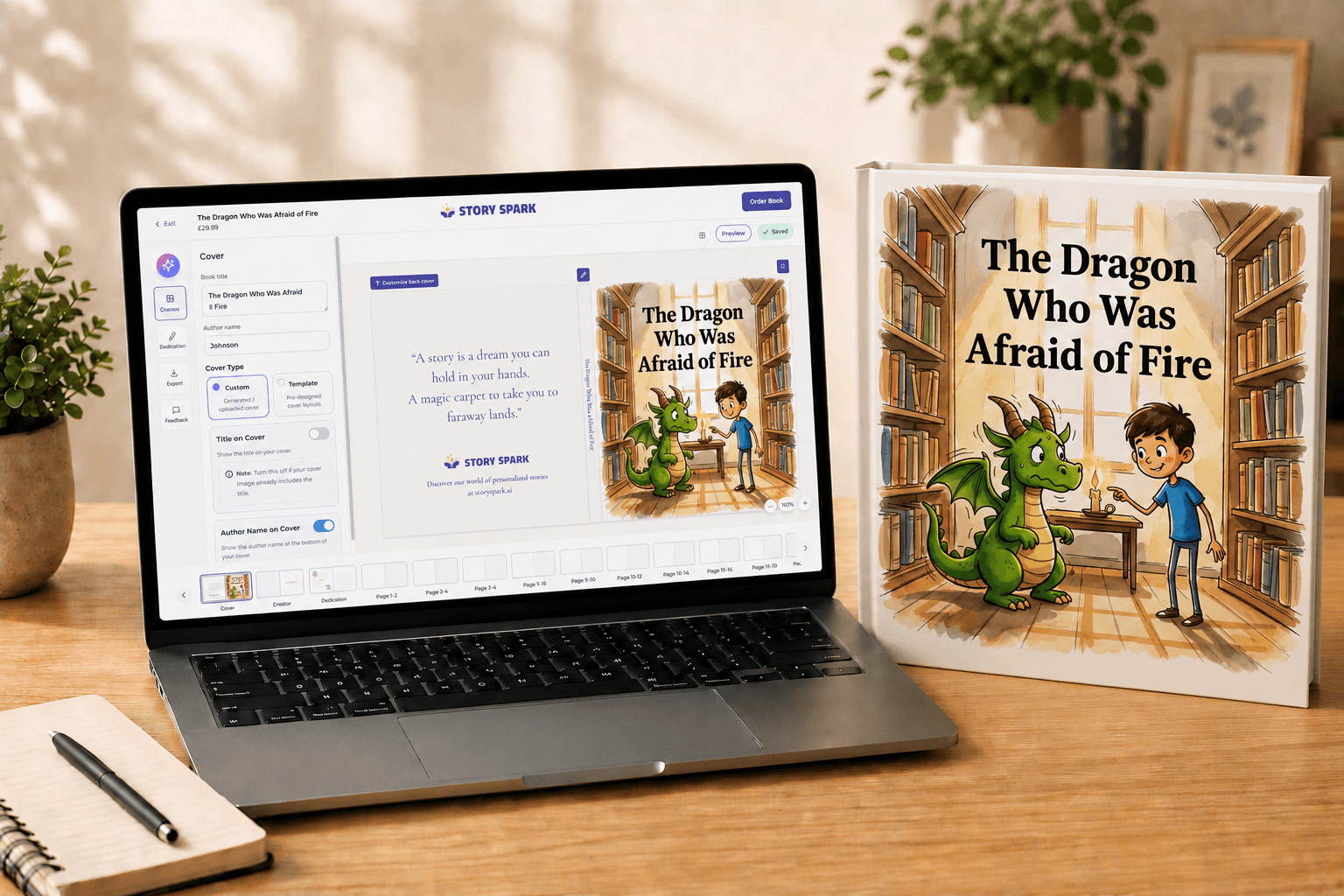
Story Spark fue diseñado desde cero como un creador de cuentos infantiles, no como una adaptación de una aplicación de presentaciones o una herramienta de diseño genérica. Esa filosofía se nota desde el primer momento.
La plataforma te guía a través de una estructura narrativa clara: creación de personajes, arco argumental, ilustración escena por escena y montaje final del libro. No necesitas experiencia en diseño. La IA genera las ilustraciones y, lo más importante, mantiene la consistencia visual de los personajes en todas las páginas.
El motor de ilustración con IA es realmente impresionante. Puedes elegir entre varios estilos artísticos, como acuarela, caricatura o cuento clásico, y la herramienta genera escenas originales en lugar de utilizar imágenes de archivo.
Para los docentes, Story Spark incluye funciones específicas para el aula, como sugerencias de historias alineadas con el currículo y la posibilidad de crear múltiples libros desde una sola cuenta.
La calidad de impresión es uno de sus puntos más fuertes. Los libros se imprimen en papel mate premium con opciones de tapa dura o blanda, y el servicio cubre todo el proceso de producción y entrega.
Price: Gratis para empezar; libros impresos desde 29,99. Suscripciones digitales premium disponibles para docentes y creadores frecuentes.
5
Excellent
2. Book Creator, Best for Educators Building Digital Libraries
Best for: Teachers and schools creating digital first books for classroom use.
Book Creator has been a classroom staple for years, and it earns that reputation in the digital space. It's a well designed tool that lets you build multimedia books combining text, images, audio, and video, and the interface is clean and approachable for older children and teachers alike.
Where Book Creator falls short is in storytelling specific features. It's essentially a flexible page by page builder, which gives you a lot of freedom but very little guidance. There's no narrative structure built in, no AI illustration engine that maintains character consistency, and creating a genuinely illustrated children's story from scratch requires significant manual effort.
The AI features added in recent updates are useful but limited, you can generate individual images, but they don't connect to a broader story context. You're doing the creative heavy lifting yourself.
For schools building digital libraries of non fiction resources, Book Creator is excellent. For parents or authors who want to create narrative picture books, the gap between it and a purpose built storybook creator like Story Spark is significant.
Price: Free tier (limited books); paid plans from £10/month for teachers.
3
Average
3. Canva, Best for Design Confident Users Who Already Know the Platform
Best for: Designers or advanced users who want full creative control.
Canva is a brilliant general purpose design tool that happens to have book and storybook templates. If you're already a confident Canva user, you can create something beautiful, but the experience requires significant design knowledge, and there's nothing specific to the storytelling process.
The AI image generation (via Magic Media) can produce attractive individual illustrations, but consistency across multiple pages is a known issue. Generated characters don't carry over between prompts, meaning your main character is likely to look different on every page unless you're very precise with your prompting.
Canva has no print on demand integration for children's books specifically, you'd need to export your finished pages (at the right resolution) and use a third party printer, which adds cost and complexity.
If you want total control and already live in Canva, it can work. For anyone who doesn't already use it regularly, the learning curve and the limitations in narrative and print workflow make it a poor choice as a primary storybook creator.
Price: Free tier available; Canva Pro from £10.99/month.
2.5
Fair
4. Wonderbly, Best for Highly Personalized Gift Books
Best for: Parents or gift givers who want a polished, professionally illustrated personalized book.
Wonderbly occupies a different part of the market. It doesn't give you a blank canvas creative tool, instead, it offers a curated library of pre written, beautifully illustrated story templates that you personalize with a child's name, appearance, and details.
The illustration quality is exceptional, and the print quality is among the best in this list. The books genuinely look and feel like high quality published children's books. For a birthday or Christmas gift, Wonderbly is hard to beat.
The limitation is creative freedom. You're choosing from existing stories, not creating your own. You can't write your own narrative, change the plot, or create a completely original character. If you want to tell a specific story, about your child's actual life, a family adventure, or a topic you care about, Wonderbly can't do that.
Price: Books from £19.99 each; no subscription model.
3.8
Great
5. Storybird, Best for Encouraging Children's Creative Writing
Best for: Children and teenagers developing creative writing skills.
Storybird takes a different angle: it's designed to inspire children to write their own stories, using a curated library of professional artwork as a starting point. Kids choose the art, then write the story around it, which is a genuinely clever approach to creative writing motivation.
As a tool for adults creating storybooks, it's limited. The artwork library, while lovely, isn't AI generated, you're working with existing pieces, which restricts what stories you can tell. The print options exist but feel secondary to the platform's core educational purpose.
For parents and teachers looking to engage children in storytelling as a literacy activity, it's worth exploring. For anyone trying to create a complete, original illustrated book, there are better options.
Price: Free basic access; premium from $8.99/month (USD).
3.4
Average
6. Adobe Express, Best for Teams with Creative Professionals
Best for: Creative professionals and brand teams who need maximum design control.
Adobe Express (formerly Adobe Spark) is a capable design tool with strong book layout templates. Like Canva, it gives design literate users real creative freedom. The integration with Adobe's Creative Cloud ecosystem is a significant advantage if you're already in that world.
For the average parent or educator, the interface is more complex than necessary, and the AI features, while improving, don't offer the narrative continuity you'd want for children's storybooks. There's no dedicated storybook workflow, no character consistency across pages, and print on demand requires third party integration.
Price: Free tier; Adobe Express Premium from £9.98/month; Creative Cloud plans from £54.98/month.
2.2
Poor
How These Tools Handle the Most Important Features
AI Art Quality and Character Consistency
This is the area where the tools diverge most sharply. Story Spark is the only tool in this comparison that maintains consistent character appearance across multiple pages automatically. Every other AI powered tool (Canva, Adobe Express, Book Creator) generates images in isolation, which means your characters will look different from scene to scene unless you manually engineer consistency through very precise prompting.
For a children's storybook, this matters enormously. Children notice when a character's hair colour changes or their face looks different. The emotional connection to a story depends on visual continuity.
If you're interested in how AI illustration technology actually works behind the scenes, our guide to the best AI story generators of 2026 covers the underlying models in more detail.
Narrative Structure and Story Guidance
Only Story Spark and Storybird have any built in narrative structure. Story Spark's is the more sophisticated of the two, it walks you through character development, conflict, resolution, and scene sequencing, drawing on established children's storytelling frameworks.
The others are blank canvas tools. That's powerful if you know what you're doing, but for most parents and first time authors, starting from a completely blank page is the biggest creative barrier there is.
Print Quality
Print quality splits broadly into three tiers here. Wonderbly and Story Spark produce books that look and feel like professional published children's books, high quality paper stock, accurate colour reproduction, and a finish that holds up to repeated reading by small hands.
Book Creator, Storybird, and Adobe Express either don't offer direct print fulfilment or produce results that fall short of professional quality. Canva's output depends entirely on the third party printer you choose, which introduces significant variability.
Frequently Asked Questions
Last updated: We re-test and re-rank every tool in this list annually. If you're a tool maker and would like us to consider your platform in the next update, get in touch.