



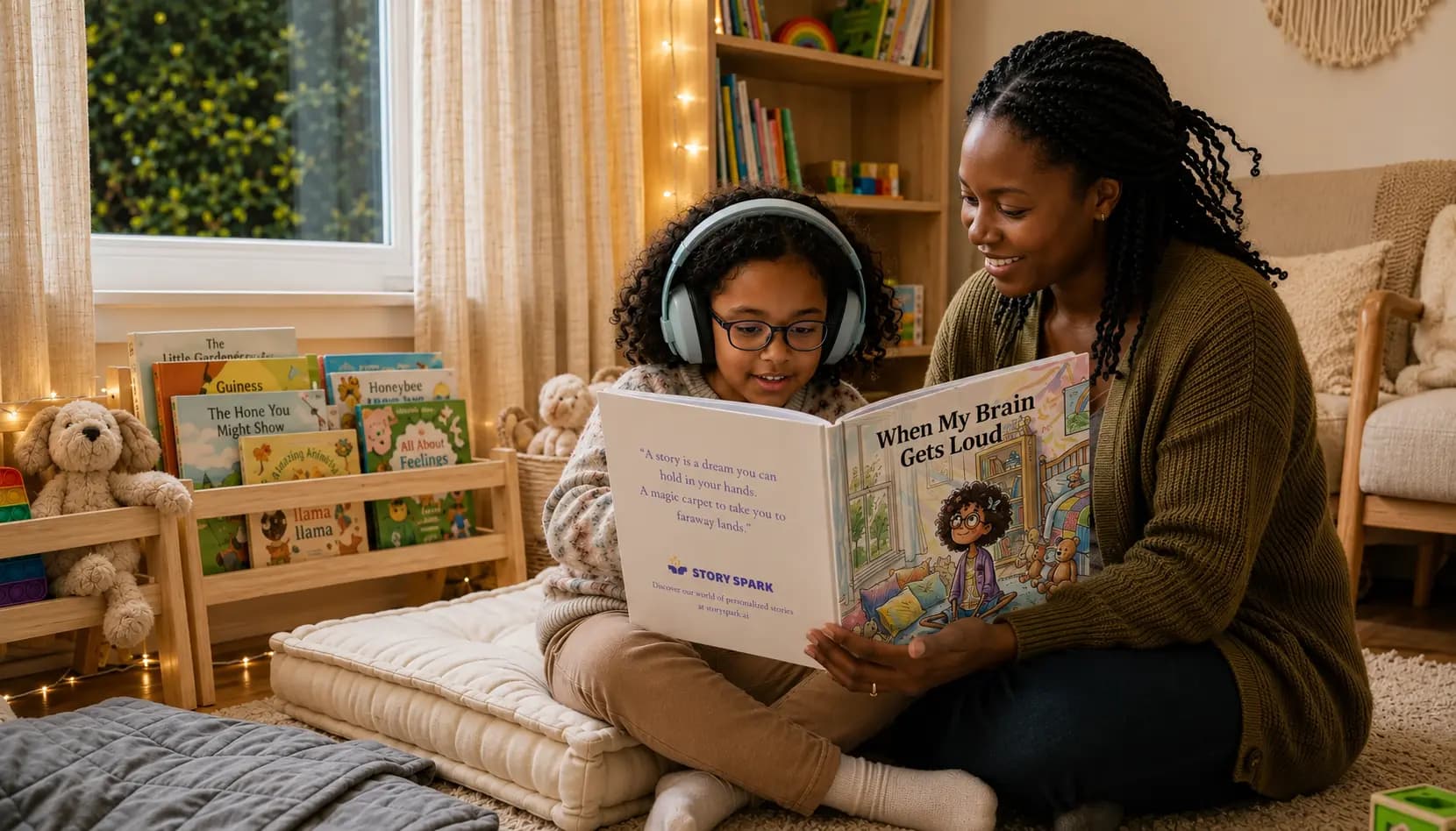
Children with dyslexia can learn to enjoy reading with the right support: read aloud together often, choose books with larger fonts and simpler sentence structure, use audiobooks and text-to-speech tools, and keep reading sessions short, positive, and free of pressure. Personalized, dyslexia-aware storybooks, ones with clean typography, predictable pacing, and a child as the actual main character, tend to work especially well, because they lower the effort of decoding text while raising a child's motivation to keep going. Story Spark builds exactly this kind of story, with dyslexia-aware layout, adjustable text styles, and personalization built in from the start.
Dyslexia is a learning difference that affects how a person processes written language, making reading, spelling, and sometimes writing more effortful than they are for other children the same age. It has nothing to do with intelligence or effort. Children with dyslexia are often just as bright, curious, and imaginative as their peers, but the mechanics of decoding text on a page do not come as easily to them, and that gap can make reading feel like a chore rather than a joy.
Left unaddressed, that mismatch has consequences that reach well beyond the classroom. Reading is one of the most essential skills a child develops, underpinning everything from schoolwork to independent learning to simple everyday tasks like reading a menu or a text message. But just as importantly, a child who associates reading with frustration is a child who avoids it, and avoidance closes the door on all the language, imagination, and confidence-building benefits that reading provides. The goal for parents, teachers, and caregivers is not to force a struggling reader through more of the same. It is to change the experience of reading itself, so a child with dyslexia can rediscover why stories are worth the effort. Here is how.
Understanding Why Reading Feels Different for a Child with Dyslexia
Before getting into practical tips, it helps to understand what is actually happening when a child with dyslexia sits down with a book. Dyslexia affects the brain's ability to quickly and automatically connect written letters to their sounds, a process called decoding. For most readers, decoding eventually becomes automatic, which frees up mental energy for comprehension, the actual meaning of the story. For a child with dyslexia, decoding often never becomes fully automatic, which means a significant amount of mental effort goes into simply sounding out words, leaving less energy for following the plot, understanding characters, or enjoying the story at all.
This is why a child with dyslexia can be a strong, imaginative thinker and still find reading exhausting. It is also why simply assigning more reading practice, without changing the format or the support around it, often backfires. A child who is already working twice as hard as their peers to get through a page does not need more of the same struggle. They need tools that reduce the decoding load so their energy can go toward comprehension and enjoyment instead.
Dyslexia also frequently overlaps with other learning differences, including ADHD and, in some cases, traits associated with autism, which is part of why accessible design for one condition often benefits several at once. Story Spark's guide on how personalized stories support children with autism, dyslexia, and ADHD goes into more detail on this overlap and what it means for choosing the right reading tools.
Read Aloud With Your Child
Reading aloud together remains one of the single most effective things a parent or caregiver can do for a child with dyslexia, at almost any age. When you read aloud, your child can follow along with the text while hearing correct pronunciation and natural sentence rhythm, which helps them start to recognize words and phrases without carrying the full decoding load alone. It also opens up natural opportunities for comprehension support. You can pause to explain a word your child does not know, ask what they think will happen next, or simply talk about the story the way you would with any book, keeping the emotional experience of reading positive even while the mechanics remain difficult.
Paired reading, where you and your child take turns reading a sentence or a page each, is another well-supported technique. It keeps a child actively engaged with the text rather than passively listening, while still sharing the workload so the session does not become exhausting or discouraging.
Choose the Right Books
Not every book is created equal for a child with dyslexia, and choosing carefully makes a real difference to how a reading session feels. Look for books with larger fonts, generous spacing between lines and letters, shorter sentences, and fewer words crowded onto each page. Dense blocks of small text can be genuinely overwhelming for a child who is already working hard to decode each word, while a page with breathing room and a clear typeface removes one layer of difficulty before your child even starts reading.
Illustrations matter here too, and not just as decoration. Pictures give a child visual context for what is happening in the story, which supports comprehension even when a particular word or sentence is difficult to decode. A well-illustrated page lets a child follow the plot through the pictures while they work through the text, rather than losing the thread of the story entirely when they get stuck on a word.
Use Audiobooks and Narrated Stories
Audiobooks are an excellent alternative, and complement, for children with dyslexia who find independent reading tiring or discouraging. Listening to a story read aloud lets a child fully absorb the plot, characters, and vocabulary without the added effort of decoding text, which keeps the story itself, rather than the mechanics of reading, at the center of the experience. Following along with the printed text while listening to a narrated version, sometimes called "read-along," combines the benefits of both approaches, reinforcing word recognition while comprehension stays effortless.
Story Spark's bedtime stories platform includes narrated audiobook options with natural-sounding voices, including the ability to record a parent's own voice once and reuse it to narrate future stories, so a child can hear a familiar, comforting voice even during independent listening time.
Use Technology Built for Accessible Reading
There is now a wide range of apps and tools designed specifically to make reading more accessible for children with dyslexia. Many include text-to-speech functionality, which reads text aloud on demand, highlighting each word or line as it is spoken so a child can follow along visually and audibly at the same time. Others allow adjustments to font, font size, letter spacing, and background color, all of which can reduce the visual crowding and strain that make text harder to process for a dyslexic reader.
These features matter because they let a child control their own reading experience rather than being stuck with a fixed format that does not work for them. A tool that adapts to a child, instead of asking the child to adapt to it, changes reading from something done to them into something they have some ownership over, which has a real effect on motivation over time.
Make Reading Fun and Pressure-Free
Perhaps the most important tip of all is also the simplest to forget under the pressure of school deadlines and reading logs: reading should feel like a genuinely enjoyable activity, not a test. Choose books your child is actually interested in, even if the reading level feels slightly below or above where a school might place them. A dinosaur-obsessed child who is fully engaged with a book about dinosaurs is doing more real reading work, happily, than the same child forcing their way through an assigned book they have no interest in.
Create a comfortable, low-pressure reading environment, a cozy corner, a favorite blanket, no timer running, and build reading into your daily routine so it becomes a predictable, welcome part of the day rather than an occasional source of stress. Letting your child take turns reading aloud, choose the next book, or simply listen while you read gives them a sense of control that matters enormously when so much of a dyslexic child's day can already feel like an uphill effort.
What Makes a Book Genuinely Dyslexia-Friendly
Beyond the general tips above, there are specific design choices that make a real, measurable difference for dyslexic readers, and it is worth knowing what to look for.
Clean, predictable page rhythm. A consistent layout from page to page, rather than text that jumps around in size, position, or density, reduces the cognitive load of simply figuring out where to look next.
Simple, well-structured sentences. Shorter sentences with clear subject-verb-object structure are easier to decode than long, clause-heavy sentences, without needing to feel babyish or oversimplified in tone.
Generous spacing. Extra space between letters, words, and lines reduces the visual crowding that can make individual words harder to distinguish from one another, a common source of frustration for dyslexic readers.
A genuinely readable typeface. Certain fonts are easier for dyslexic readers to process than others, generally ones with clear, distinct letterforms rather than dense or overly stylized text.
Supportive illustrations. Pictures that carry real narrative information, not just decoration, help a child follow the story even through the words that are hardest for them.
Story Spark's learning difficulties friendly story generator builds every one of these principles directly into its dyslexia-aware text style option, using clean page rhythm, simple sentence structure, generous spacing, and a readable typeface specifically to lower the effort of decoding so a child can focus on enjoying the story.
Why Personalization Makes Such a Big Difference for Dyslexic Readers
Here is the piece that traditional reading advice often misses: motivation matters just as much as method. A child with dyslexia is not simply solving a decoding puzzle when they read. They are deciding, often unconsciously, whether the story in front of them is worth the extra effort it demands. A generic book that does not particularly interest them loses that argument quickly. A story where they themselves are the hero, where the character shares their name, their face, their favorite things, rarely does.
This is not just intuition. Children consistently pay closer attention to stories where they recognize themselves, and that heightened attention is precisely what helps a struggling reader push through a difficult page instead of giving up on it. A personalized story does not make the decoding itself easier on its own, but it changes the payoff on the other side of that effort, and for a child who has learned to associate reading with frustration, that shift in motivation can be the difference between avoiding books and asking for one every night.
Story Spark's blog post on the power of storytelling for children with special needs explores this dynamic in more depth, and the platform's guide to supporting children with autism, dyslexia, and ADHD covers how personalized, accessible storytelling works alongside more traditional reading intervention programs rather than replacing them.
How Story Spark Supports Children With Dyslexia
Story Spark is an AI-powered platform for creating personalized, illustrated storybooks, comic books, longer books, and narrated audiobooks, and dyslexia-aware design has been built into the platform from the ground up rather than added on afterward.
On the accessibility side, Story Spark's learning difficulties friendly story generator offers a dedicated dyslexia-aware text style, with clean page rhythm, simple sentence structure, and generous visual spacing designed to reduce the effort of decoding. Illustration styles can also be matched to what works best for a dyslexic reader, with options like the Children's Book and Pixar-inspired styles specifically noted as strong fits. Families can flag sensory preferences or particular themes to avoid, and every story is written in warm, identity-affirming language rather than deficit-focused framing, so a child is never made to feel broken or in need of fixing.
On the personalization side, Story Spark's character creator lets you build a character based on your child's name and personality, or upload a real photo to generate a unique illustrated version of them, which then stays visually consistent across every page. From there, families can choose the format that fits the moment:
- Illustrated storybooks, through the storybook creator, combining dyslexia-aware text with supportive artwork.
- Longer books, through the book creator, for children ready for a richer story with more pages and structure.
- Narrated audiobooks, available through Story Spark's bedtime stories page, including parent voice recording, for a true read-along experience.
Every story can be previewed page by page before anything is finalized, so wording, pacing, and detail can be adjusted until it genuinely fits the child reading it, and every finished story can be ordered as a premium hardcover keepsake, printed and dispatched within five working days.
Building a Reading Routine That Works for a Dyslexic Child
Consistency matters more than intensity when building a reading habit with a child who finds reading effortful. A few practical habits help:
Keep sessions short. Ten to fifteen focused minutes of genuinely enjoyable reading does more good than thirty minutes that ends in frustration for both of you.
Rotate formats. Mix independent reading, read-aloud time, paired reading, and audiobook listening across the week, rather than relying on one format every night.
Celebrate effort, not just accuracy. Praise your child for sticking with a difficult page or trying to sound out a new word, regardless of whether they got it exactly right, to keep motivation intact.
Let your child choose sometimes. Handing over some control, the book, the format, whether tonight is a reading night or a listening night, builds a sense of ownership that matters enormously for a reluctant reader.
Revisit favorites freely. A child who wants the same personalized story again is getting real, valuable repetition, reinforcing vocabulary and word recognition, not avoiding a challenge.
Loop in school support. A personalized, accessible tool like Story Spark works well alongside, not instead of, any structured reading intervention or support your child receives at school, described further in Story Spark's guide on why reading for pleasure matters.
How to Create a Dyslexia-Friendly Story With Story Spark
Getting started takes only a few steps. Begin at Story Spark's create page and choose a format, a storybook, a longer book, or an audiobook. Build your child's character through the character creator, by description or by uploading a real photo, then head to the learning difficulties friendly story generator to select the dyslexia-aware text style and an illustration style that suits your child.
Describe a story idea your child will genuinely want to read, their favorite animal, their current obsession, a situation they are working through, and let the AI story generator write and illustrate it around your chosen settings. Preview every page before deciding whether to keep it as a digital story or order a printed hardcover. Story Spark is free to start, with AI story generation available through the Dreamer subscription from $9.99 per month, and printed hardcover keepsakes from $29.99 for a range of formats. Full details are on the pricing page, and further questions are answered on the FAQ page.
Frequently Asked Questions
What is dyslexia and how does it affect reading?
Dyslexia is a learning difference that affects how the brain processes written language, making it harder to decode letters and words quickly and automatically. It is not related to intelligence, but it does mean reading requires more mental effort, which can make books feel tiring or frustrating without the right support.
What makes a book dyslexia-friendly?
A dyslexia-friendly book uses a clean, predictable page layout, simple sentence structure, generous spacing between letters and lines, a clear and readable typeface, and supportive illustrations that carry real narrative meaning rather than just decoration.
Do audiobooks help children with dyslexia?
Yes. Audiobooks let a child absorb a story's plot, characters, and vocabulary without the added effort of decoding text, and following along with the printed text while listening can reinforce word recognition at the same time.
Can personalized stories really help a child with dyslexia enjoy reading more?
Yes. Children pay closer attention to stories where they recognize themselves, and that increased motivation can help a struggling reader push through a difficult page instead of giving up, even though the underlying decoding challenge remains the same.
Does Story Spark offer dyslexia-friendly stories?
Yes. Story Spark's learning difficulties friendly story generator includes a dedicated dyslexia-aware text style with clean page rhythm, simple sentence structure, and generous spacing, alongside personalization based on your child's name, appearance, and interests.
What age should a child be to start using dyslexia-friendly reading tools?
There is no fixed age. Dyslexia-friendly supports, larger fonts, audiobooks, read-aloud sessions, and personalized stories, can help children from early readers through upper primary school, adapting in complexity as a child's reading skills develop.
Should a personalized story replace school reading intervention?
No. Personalized, dyslexia-aware storytelling works best alongside structured school support and any formal reading intervention a child receives, offering an engaging, low-pressure way to build confidence and a love of reading rather than replacing targeted instruction.
How much does it cost to create a dyslexia-friendly story with Story Spark?
Story Spark is free to start and preview a story. AI-generated stories are unlocked through the Dreamer subscription from $9.99 per month, and printed hardcover keepsakes are available from $29.99, with full details on the pricing page.
Related Reading
Personalized Storybooks for Children with Autism
How Story Spark Supports Children with Autism, Dyslexia, and ADHD
The Power of Storytelling for Children with Special Needs
Top Tips to Develop Your Child's Reading Fluency
The Bottom Line
A child with dyslexia can absolutely learn to love reading, but it usually takes a different approach than simply pushing through more of the same material. Reading aloud together, choosing books built for easier decoding, using audiobooks and accessible technology, and above all keeping the experience positive and pressure-free, all make a genuine difference. Personalization adds one more powerful lever: a story where a struggling reader is the hero gives them a reason to keep going that a generic book rarely can.
With Story Spark, dyslexia-aware design and personalization work together in the same story, so children with dyslexia can develop their literacy skills and rediscover the simple joy of a story built just for them.
Written by the Story Spark Team. Story Spark is an AI-powered platform for creating, illustrating, and printing personalized storybooks, comic books, books, and audiobooks.