


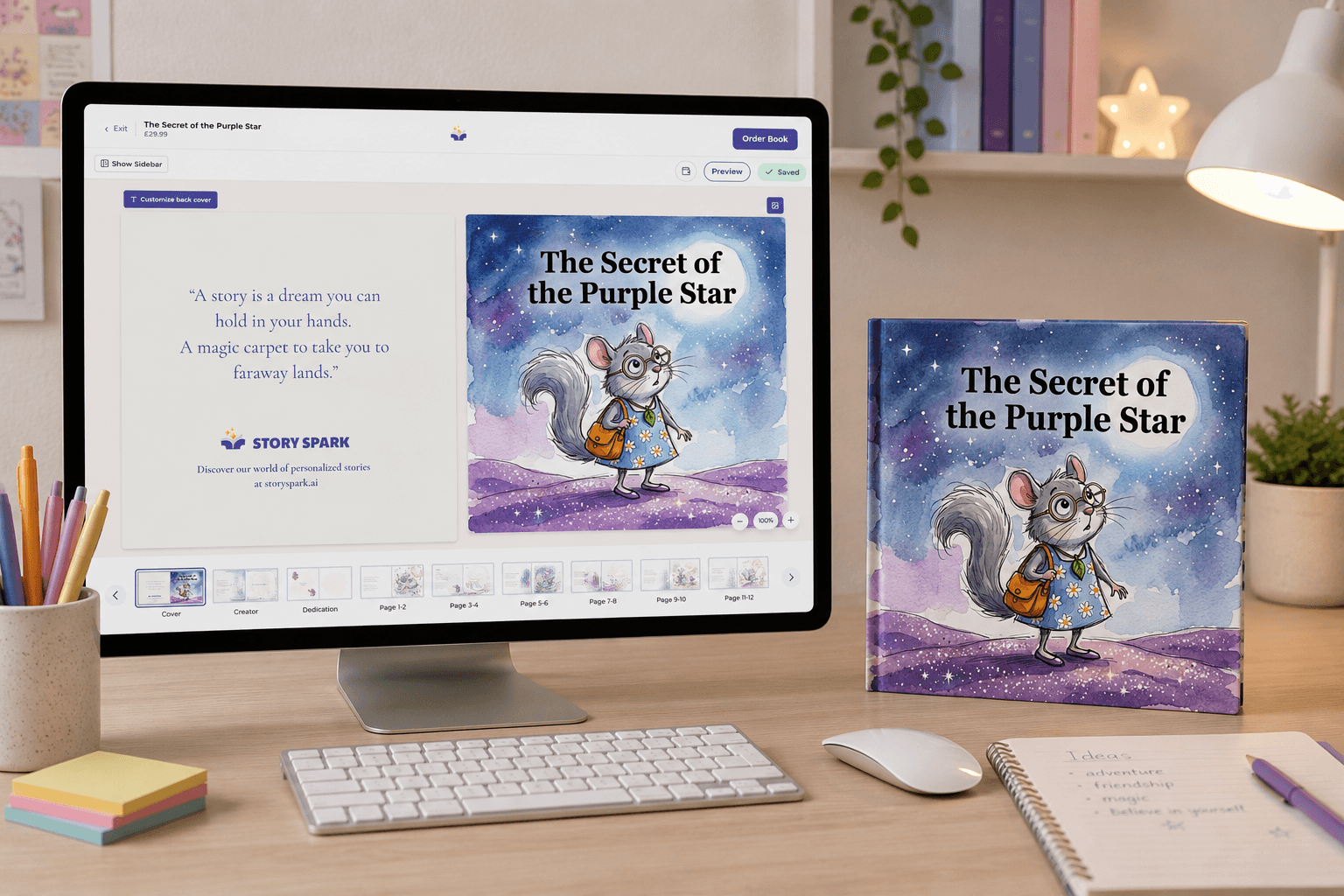
Anyone can publish a book and become an author today. Write your story, illustrate it if needed, choose a book format that fits your idea, edit it until it reads the way you imagined, and print it as a real hardcover you can keep, gift, or sell. Story Spark supports this entire journey in one place, from a blank page to a printed storybook, novel, or comic book delivered to your door.
For most of history, becoming an author meant querying agents, waiting months for replies, and hoping a publishing house would take a chance on your manuscript. That world still exists, and it still works for some writers. But it is no longer the only path, and for most people, it is no longer the fastest or most rewarding one.
Today, publishing a book is something you can start this afternoon. You do not need an agent, a publishing deal, or years of experience. You need an idea, a bit of guidance, and a tool that can carry you from that idea to a finished, printed book. This guide walks through exactly how to do that, whether you are writing a picture book for your child, a novel you have been outlining for years, a memoir for your family, or a comic book starring yourself as the hero.
What Does It Actually Mean to "Become an Author"?
There is a quiet myth that authorship only counts if a publishing house stamps its logo on the spine. In practice, an author is simply someone who writes a book and shares it with readers, whether that is one reader (a child at bedtime) or thousands (a self-published bestseller list).
Self-publishing has made this definition real for millions of people. Independent authors now write across every genre, from children's picture books to full-length fiction, and many earn a living doing it without ever submitting a manuscript to a traditional publisher. What changed is not the definition of an author. What changed is the number of tools available to help someone finish the book, illustrate it properly, and get it into print without a six-figure production budget.
Story Spark was built around that shift. It is a book creator that combines an AI story generator, a book illustrator, a full editing suite, and print-on-demand hardcover production, so the distance between "I have an idea for a book" and "I am holding my printed book" is as short as possible.
Traditional Publishing vs Self-Publishing: What Actually Differs
Before diving into the how, it helps to understand the two broad paths, because they lead to very different timelines and levels of control.
Traditional publishing involves writing a full manuscript, querying literary agents, securing representation, and then having your agent pitch the book to publishing houses. If a house accepts it, they handle editing, illustration, printing, distribution, and marketing, but the process from query to bookshelf commonly takes one to three years, and acceptance rates are extremely low. The author also gives up a large share of creative control and royalties in exchange for the publisher's reach.
Self-publishing puts the author in charge of every decision: the story, the art style, the trim size, the cover, the pricing, and the distribution. It also removes the multi-year waiting game. With a platform like Story Spark, a complete illustrated storybook can go from idea to printed hardcover in a single sitting, and a longer novel or memoir can be finished over days or weeks rather than years.
Neither path is objectively better. Traditional publishing still carries prestige and wide retail distribution that self-publishing cannot fully replicate. But for authors who want speed, ownership, and creative control, especially for personalized, illustrated, or niche projects, self-publishing through a dedicated book creator is now the more practical route for most first-time authors.
Step 1: Decide What Kind of Book You Are Writing
The single biggest decision an aspiring author makes is choosing the right format for the story. Trying to force a memoir into a 24-page picture book, or a picture book idea into a 200-page novel, is one of the most common reasons manuscripts stall. Story Spark builds around three core formats, plus a fourth interactive one, so you can match the format to the story rather than the other way around.
Illustrated Storybooks
If your idea is a bedtime story, a picture-book adventure, a rhyming tale, or an illustrated gift for a child (or the child in anyone), the storybook creator is the right starting point.
Storybooks print as a 21cm x 21cm hardcover with up to 60 pages, and can be generated entirely from a short description using the AI story generator, illustrated from a story you have already written, or built page by page from a blank canvas. This is also the format most personalized gift books and children's series use, since it supports custom characters created from real photos.
Full-Length Books
If you are writing a novel, a memoir, a family history, an educational resource, or a non-fiction project, the book creator is designed for longer-form writing. These print as a 16.5cm x 24cm hardcover with up to 200 pages, giving serious authors the space a full manuscript needs, alongside a proper book editor and the Spark writing assistant for support at any stage of the draft.
Comic Books
For readers and gift-givers who want something more visual and playful, the comic book creator turns a real photo into a fully illustrated superhero, explorer, or fantasy character, then builds a 24-page hardcover comic around them. It is a favorite for personalized gifts, but it works just as well as a creative outlet for anyone who wants to publish something visually distinct from a standard novel.
Search-and-Find Books
Story Spark also offers a personalized search-and-find book, a 24-page hardcover where the reader (or someone they upload a photo of) becomes the hidden character across richly illustrated scenes. It is a smaller niche than the three core formats, but it is worth knowing about if your idea leans more interactive than narrative.
Choosing the right format early saves enormous time later, because it determines the length you should be writing toward, the illustration style that will suit the page, and the trim size your final printed book will take.
Step 2: Write the Story
Once you know the format, it is time to write. There are three practical ways to approach this inside Story Spark, and none of them require prior writing experience.
Generate it from an idea. Describe your concept, even in a sentence or two, such as "a shy dragon who is scared of fire" or "a memoir about my grandmother's journey from Lisbon to London." The AI story generator will draft a complete story structured for your chosen format.
Illustrate a story you already wrote. If you have a manuscript sitting in a notebook or a document, upload it and let Story Spark's illustrator bring it to life visually, page by page, in a style you choose.
Start from a blank canvas. If you want full authorial control from the first word, write it yourself inside the editor. The Spark Writing Assistant is available throughout to help with pacing, dialogue, description, or simply beating writer's block, and Creator plan subscribers also get access to a dedicated proofreading tool.
Whichever route you take, this is the stage where "having an idea" becomes "having a manuscript," and it is usually the fastest part of the whole process. Many storybook authors finish a full first draft, including illustrations, in under an hour.
Step 3: Illustrate and Design the Book
Illustration is where most aspiring authors get stuck when working alone, since hiring a freelance illustrator for a full picture book or comic can cost thousands of dollars and take months. Story Spark's built-in illustrator removes that bottleneck entirely.
If your story involves real people, whether that is a child, a parent, a grandparent, a pet, or even a beloved toy, you can upload a photo and Story Spark will turn it into a consistent illustrated character that appears throughout the book. This is especially powerful for personalized storybooks and comic books, where seeing a recognizable version of yourself or a loved one on the page is often the entire point of the gift.
For longer books, illustration matters less on every page, but a strong cover design and, where relevant, chapter art still shape how a book is perceived by readers. The same tools apply, whether you are illustrating a 60-page storybook or designing the cover of a 200-page novel.
Step 4: Edit Until It Is Ready
No first draft is a final draft, and this step is where many independent authors either skip ahead too fast or stall out entirely. Story Spark's editor lets you refine every part of the book before committing to print, including text, layout, page order, and imagery, with the Spark writing assistant on hand throughout.
A few things worth checking before you consider a manuscript finished:
- Does the pacing suit the format? A 24-page comic book needs tighter, punchier scenes than a 200-page novel.
- Is the reading level consistent, particularly important for children's storybooks?
- Do the illustrations match the tone of the text on each page?
- Have you previewed the complete book, page by page, exactly as it will print?
That last point matters more than it sounds. Story Spark lets you preview your entire book before ordering a physical copy, so there are no surprises when it arrives.
Step 5: Decide on Ownership, Copyright, and Selling Rights
This is the step many new authors skip, and it is the one that determines whether "publishing a book" also means "owning a book you can sell."
On Story Spark, content created under the Creator plan comes with full ownership of the AI-generated content and watermark-free downloads, including EPUB files and individual high-resolution assets. That matters if your goal is to distribute your book on other platforms, sell physical or digital copies independently, or build a series over time. The Dreamer plan, by comparison, is built for personal creations and branded downloads rather than commercial resale.
If self-publishing and selling is the goal, particularly for a children's book series, it is worth reading Story Spark's dedicated guide, How to Be a Children's Author on Story Spark, which walks through illustration rights, copyright basics, and printing in more depth. The full self-publishing page also covers watermark-free exports and commercial ownership for authors who want to sell beyond Story Spark itself.
Step 6: Print Your Book as a Real, Physical Copy
There is a particular kind of validation that comes from holding a printed copy of something you wrote, and it is one of the clearest differences between "I wrote something" and "I published a book." Every Story Spark book, whether a storybook, a full-length book, or a comic book, is produced as a premium hardcover and dispatched within five business days, with delivery to the USA, UK, UAE, Australia, Canada, Saudi Arabia, Spain, the Netherlands, Qatar, and Portugal, with bespoke delivery available on request for other countries.
Pricing depends on format. Storybooks start from $29.99, full-length books start from $39.99, and comic books are $29.99, with volume discounts available for print runs of five copies or more, which matters if you are printing a series, a classroom set, or copies to sell. Subscribers on the Dreamer or Creator plans also receive free standard shipping on every book order. Full details are on the pricing page.
Step 7: Share Your Book and Build Your Author Platform
Publishing does not end at the print button. Part of becoming an author, in any era, is finding readers.
Story Spark includes a built-in Community library where you can create a Storyteller profile, write an introduction about yourself, and publish your stories for other creators to read. Authors earn a royalty on any book sold through the community, which makes it a genuinely useful first audience for a new author testing whether a story resonates before investing in a larger print run.
Beyond the Story Spark community, authors with watermark-free, commercially owned content can distribute their books through other retailers and platforms entirely, since nothing about the export locks you into Story Spark alone.
Choosing the Right Format for Your Story: A Practical Comparison
If you are still deciding between formats, this breakdown should help.
Choose a storybook if: your idea is under roughly 60 pages, involves illustration on most or every page, and is aimed at children, gift recipients, or readers who want a picture-driven story. Storybooks are the format most personalized bedtime stories, birthday gifts, and children's series use. Explore the storybook creator.
Choose a book if: your idea is longer-form, whether that is a novel, a memoir, a family history, or an educational resource, and needs up to 200 pages of space to breathe. This is the format for serious, sustained writing projects. Explore the book creator.
Choose a comic book if: your idea centers on a single strong visual concept, such as turning yourself or someone you love into a superhero or fantasy character, and works best as a punchy 24-page illustrated arc. Explore the comic book creator.
Choose a search-and-find book if: you want something interactive rather than narrative, where the reader becomes a hidden character to spot across illustrated scenes. Explore the search-and-find book.
Who Is Publishing a Book With Story Spark
The idea of "becoming an author" often conjures a narrow image, a novelist alone at a desk for years. In practice, the people publishing books on Story Spark come from a much wider range of motivations, and it helps to see where your own goal fits.
Gifting. Many first-time authors are not chasing a writing career at all. They are creating a one-of-a-kind gift, whether that is a personalized storybook starring a child for a birthday, a comic book that turns a partner into a superhero, or a memoir capturing a parent's life story to hand over at a milestone birthday. For this audience, publishing a book means producing a single, deeply personal hardcover rather than a print run. The personalized gifts collection is built around exactly this use case.
Self-publishing. Others are building something closer to a traditional author career, whether that is a children's book series, a novel they intend to sell widely, or a growing catalog of titles. For this audience, the priorities shift toward commercial ownership, watermark-free exports, and consistent character tools so a series can maintain visual continuity across multiple books. The self-publishing guide is written specifically for this path.
Education. Teachers and parents also use Story Spark to build books around a specific curriculum, from history and science topics to language learning resources, turning classroom material into an illustrated book that students actually want to read. More on this use case is covered on the education page.
Family memory-keeping. The final group are authors preserving something that would otherwise only live in memory: a grandparent's immigration story, a family history spanning generations, a record of a child's early years. These books are rarely written to sell. They are written to last, printed as a hardcover precisely because a shared document or a phone photo album is too easy to lose.
None of these paths require different tools inside Story Spark. They mostly differ in which format you choose and whether you prioritize a single beautiful copy or a commercially ready, sellable edition.
Writing for the Format: A Closer Look at Genre and Audience
Once you know your format and your reason for publishing, a little more thought about genre and reading level pays off later in the editing stage.
Children's storybooks benefit from short, rhythmic sentences, a clear emotional arc (a fear overcome, a lesson learned, an adventure completed), and illustrations that carry as much of the story as the text itself. If children's publishing is the long-term goal rather than a single gift book, it is worth reading Story Spark's dedicated guide on how to be a children's author, which goes deeper into illustration consistency, copyright, and building a series.
Novels and memoirs need the opposite discipline: pacing across chapters rather than pages, a consistent narrative voice, and enough structural planning (even a loose outline) to prevent the middle of the manuscript from sagging. The 200-page ceiling on Story Spark's book format is generous enough for most debut novels and full memoirs, and the Spark writing assistant is particularly useful here for maintaining continuity across a longer draft.
Comic books live or die on a strong hook in the first few pages, since the format is short. The most successful personalized comics tend to center on one clear transformation: an ordinary person becoming a hero, an explorer, or a legendary character, told in a tight 24-page arc rather than an attempt to cram a sprawling plot into a small page count.
Common Reasons Authors Never Finish
It is worth naming the obstacles honestly, since most people who never publish a book do not fail because the idea was bad. They stall for a handful of very common reasons.
Perfectionism on the first draft. Waiting for a perfect first attempt before writing a single word is the most common form of procrastination among first-time authors. Draft first, refine after.
Illustration bottlenecks. Many strong stories die because the author cannot draw and cannot afford a freelance illustrator. This is precisely the gap an AI-powered book illustrator is built to close.
No clear finish line. Traditional publishing has no obvious finish line for a first-time author; querying can continue indefinitely with no guaranteed outcome. Self-publishing with a print-on-demand hardcover gives you a concrete, achievable finish line: a physical book in your hands.
Underestimating format. Trying to cram a 200-page memoir into a 24-page comic, or stretching a simple bedtime idea across 200 pages, both stall projects. Match the format to the story early, as covered in Step 1.
Frequently Asked Questions
Do I need to be a professional writer to publish a book? No. Story Spark's AI story generator can write and illustrate a complete book from a short description, so you only need the idea. If you prefer to write it yourself, the platform gives you the tools and editing support to do that too, at any experience level.
How long does it take to publish a book with Story Spark? A short illustrated storybook can be generated, edited, and ordered in a single sitting. Longer books, such as a full novel or memoir, take as long as the writing itself requires, but the editing, illustration, and printing steps add days rather than months once the manuscript is ready.
Do I own the book I publish? Yes. On the Creator plan, you receive full ownership of your AI-generated content along with watermark-free downloads, so you can sell or distribute your book beyond Story Spark. Learn more on the pricing page.
Can I turn a real person into a character in my book? Yes. You can upload a photo of a child, parent, grandparent, pet, or even a toy, and Story Spark will turn it into a consistent illustrated character that appears throughout your storybook or comic book.
What is the difference between a storybook and a book on Story Spark? Storybooks are illustrated, up to 60 pages, and printed at 21cm x 21cm, designed for picture-driven stories. Books are longer-form, up to 200 pages, and printed at 16.5cm x 24cm, designed for novels, memoirs, and educational writing.
Can I sell the books I publish? Yes. Authors can sell through their own Storyteller profile in the Story Spark Community and earn a royalty, or distribute independently using watermark-free exports if they are on the Creator plan.
Where does Story Spark print and ship books? Books are printed as premium hardcovers and dispatched within five business days, shipping to the USA, UK, UAE, Australia, Canada, Saudi Arabia, Spain, the Netherlands, Qatar, and Portugal, with bespoke delivery available on request.
Can I create more than one book, such as a series? Yes. Story Spark supports saved, reusable characters, which is particularly useful for authors building a children's book series or a recurring comic book hero, since the same illustrated character can appear consistently across multiple titles.
What if I want to write the story myself instead of using AI? That is fully supported. You can start from a blank canvas and write every word yourself, then use Story Spark purely for illustration, layout, editing, and printing. The AI story generator is an option, not a requirement.
Start Publishing Today
Becoming an author has never required a publishing deal. It requires a story, a decision on format, and a way to get from idea to printed page without the process eating years of your life. Story Spark was built to close that gap, combining an AI story generator, a book illustrator, a full editing suite, and print-on-demand hardcover production, whether you are writing a storybook, a novel, a memoir, or a comic book.
Explore plans to see which one fits your project.
Explore more on self publishing with AI on the Story Spark self-publishing page, read more creator guides on the Story Spark blog, or check common questions on the FAQ page.
Written by the Story Spark Team. Story Spark is an AI-powered platform for creating, illustrating, and printing your own books.