


Storytelling is one of the oldest tools we have for helping children make sense of the world, and for children with special needs it can be one of the most powerful. Whether a child is autistic, has ADHD, dyslexia, sensory processing differences, or another learning difference, the right book at the right moment can build confidence, teach emotional language, and make reading feel like something to look forward to rather than something to get through.
This guide looks at why storybooks matter so much for children with special needs, what the research says about the benefits, what actually makes a book "accessible," and how Story Spark's personalized, accessible storybooks are built specifically to meet neurodivergent children where they are.
Quick Answers
- Do storybooks help children with special needs? Yes. Storybooks support communication, emotional regulation, social understanding, and reading confidence in children with autism, ADHD, dyslexia, and other learning differences, particularly when the pacing, layout, and content are adapted to the child.
- What makes a book "special needs friendly"? Predictable structure, clear and dyslexia-aware typography, shorter scenes for attention differences, sensory-conscious content, identity-affirming language, and color choices that do not rely on color alone to convey meaning.
- Can a book be personalized to a specific child's needs? Yes. Platforms like Story Spark let parents build a story around a child's own routines, interests, communication style, and sensory preferences, then print it as a hardcover keepsake.
- Where can I create one? Story Spark's accessible storybook platform lets you build a personalized book for a neurodivergent child in minutes, with ADHD-friendly pacing, dyslexia-aware layout, and autism-conscious storytelling built in.
Why Storybooks Matter So Much for Children with Special Needs
Every child benefits from stories, but for children with special needs, the right book can do work that few other tools can. Special needs is a broad term that covers autism, ADHD, dyslexia and other learning differences, sensory processing differences, speech and communication differences, and physical or developmental disabilities. What connects almost all of these experiences is that mainstream books were not built with them in mind. Standard picture books assume a level of pacing, visual processing, and narrative structure that works well for many children but leaves others feeling frustrated, overstimulated, or simply left out of the story.
The scale of this gap is significant. The CDC's most recent Autism and Developmental Disabilities Monitoring Network data puts autism prevalence at roughly 1 in 31 eight year old children in the United States, up from 1 in 36 just two years earlier. Estimates for ADHD among children aged 3 to 17 sit at close to 1 in 9, according to CDC survey data, and researchers estimate that dyslexia affects somewhere between 7 and 20 percent of school aged children, making it the most common learning difference by a wide margin. Put simply, in almost any classroom, playgroup, or family gathering, there is a strong chance that at least one child is neurodivergent in some way. Yet the overwhelming majority of children's publishing is still designed around a single, narrow idea of how a child reads, feels, and processes a story.
That gap matters because reading is not just a literacy skill. It is one of the main ways young children build vocabulary, emotional understanding, empathy, and a sense of identity. When a child cannot access that experience in a way that works for their brain, they do not just miss out on a story. They miss out on a tool that their peers are using every day to build language, confidence, and connection.
There is also a compounding effect worth naming. Learning differences rarely occur in isolation. Research on co-occurring conditions suggests that roughly a third of children with dyslexia also have ADHD, and a large share of children with ADHD have at least one other co-occurring condition, whether that is anxiety, a learning disability, or a difference in social communication. In practice, this means many families are not managing a single, neatly defined need. They are managing an overlapping set of differences in attention, language processing, sensory regulation, and emotional expression, and a single, rigid book format is unlikely to work well across all of them. A book that can flex, in pacing, in sensory content, in the way emotions are labeled, is far more useful to real families than a book built around one diagnosis in isolation.
The Developmental Benefits of Storybooks for Special Needs Children
A Safe Way to Build Communication and Self-Expression
Many children with special needs, particularly autistic children and those with speech or language differences, find traditional conversation harder than most adults realize. A well-designed story sidesteps that difficulty. It gives a child a shared reference point, a set of characters and events they can point to, react to, and eventually retell in their own words.
This matters even for children who use augmentative and alternative communication (AAC), sign, gesture, or no spoken language at all. A story does not require a child to generate language from nothing. It gives them a scaffold: a beginning, a character, a feeling, a resolution. Over time, many parents and therapists find that children start to borrow phrases and structures from their favorite stories to describe their own day, which is a meaningful step in developing self-expression.
Building Social and Emotional Skills
Stories are, at their core, rehearsal spaces for real life. A child who reads about a character feeling nervous before a birthday party, or overwhelmed in a loud room, gets to experience that emotion at a safe distance, with a name attached to it and an outcome attached to it too. This is especially valuable for autistic children, who research consistently shows can find it harder to intuit emotional and social cues in the moment but who can build genuine, lasting understanding through repeated, structured exposure to those same cues in story form.
Over time, this kind of exposure builds empathy in both directions. Neurodivergent children see themselves reflected and understood. Their siblings, classmates, and friends who read about characters with different needs build empathy for the neurodivergent children in their own lives.
Supporting Executive Function and Emotional Regulation
Children with ADHD often experience the world as a stream of competing demands on their attention. A story with clear structure, short scenes, and a strong sense of momentum gives that attention something worth holding onto. Rather than fighting a child's attention span, a well-paced book works with it, building small wins into the reading experience so a child finishes a scene, feels a sense of completion, and is drawn into the next one.
Books can also become genuine regulation tools. A familiar, predictable story, read at bedtime or during a transition, can lower a child's stress level simply because they know what is coming next. For children who rely on routine to feel safe, particularly autistic children, that predictability is not a small thing. It is often the difference between a book that gets requested every night and one that gets abandoned after a single read.
An Escape That Is Also a Rehearsal
Childhood, and especially childhood with a disability or learning difference, can be genuinely overwhelming. Appointments, therapies, sensory overload, and the daily experience of navigating a world not built for you all add up. Stories offer something rare: a world a child can fully control and fully understand, where they get to be the hero rather than the person being managed or accommodated.
This escapism is not just comforting. It is quietly building the child's sense of agency, competence, and identity, three things that are frequently in short supply for children who spend much of their day being assessed, corrected, or supported by well-meaning adults.
Strengthening the Parent-Child Bond
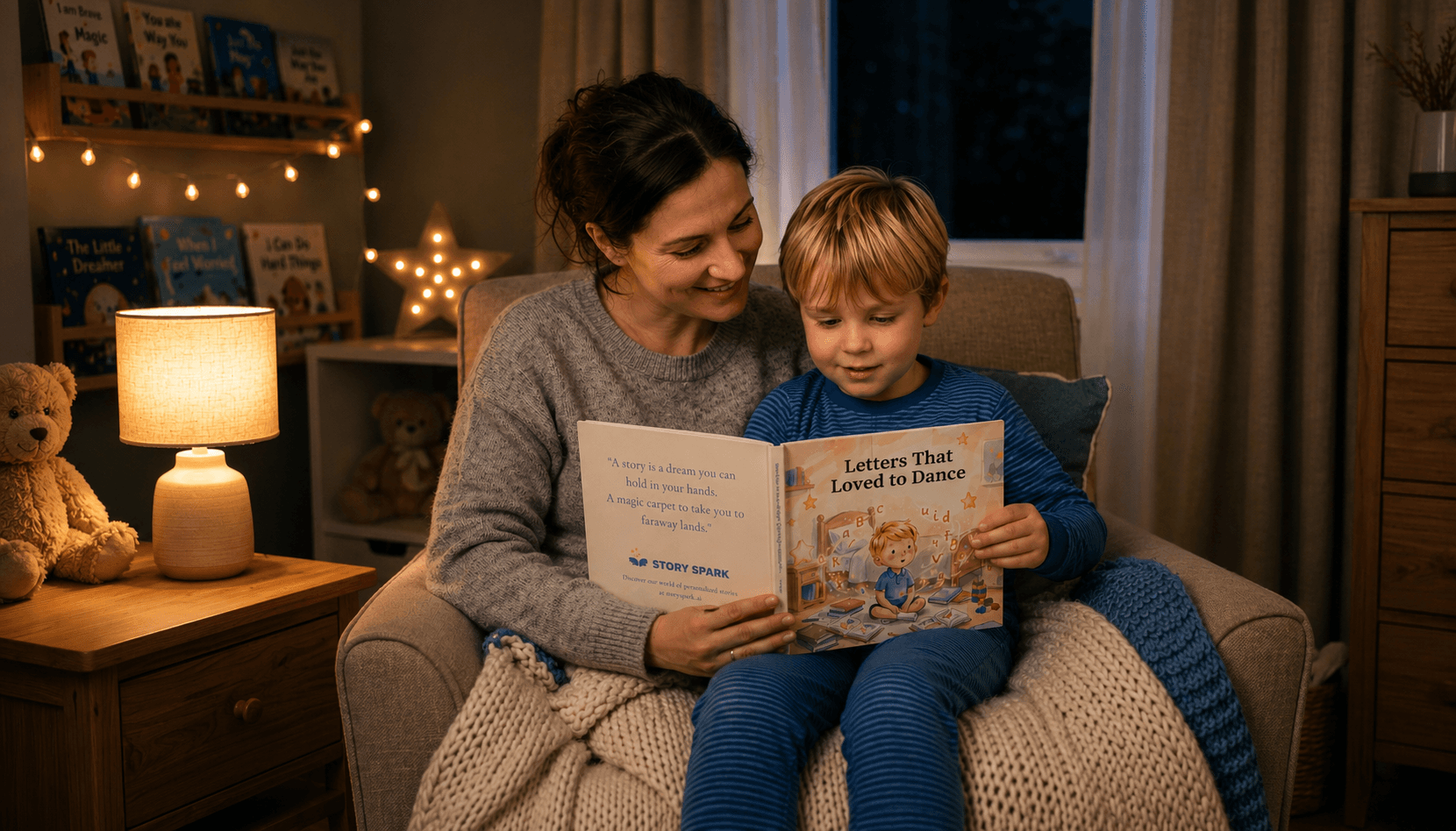
For families raising a child with special needs, reading together can become one of the few unhurried, low-pressure moments in a day that otherwise revolves around therapy schedules, school meetings, and sensory management. A story your child actually wants to read, again and again, creates a shared ritual and a shared language, inside jokes, comforting phrases, and characters that become part of family life.
There is a quieter benefit here too. Siblings, grandparents, and caregivers who read a personalized story alongside a neurodivergent child often come away with a clearer, warmer understanding of that child's inner world. A story that explains, in a gentle and age-appropriate way, why a sibling wears headphones in a loud room, or why a particular routine matters at bedtime, can do more to build family-wide empathy than a direct conversation ever could, simply because it is being absorbed as a story rather than delivered as an instruction.
Building Long-Term Reading Confidence
There is also a longer arc worth considering. A child's early experiences with books shape whether they grow up thinking of themselves as "a reader" at all. For a child who has repeatedly struggled through books that were not built for how they process language or attention, reading can quietly become associated with frustration well before they are old enough to articulate why. Reversing that association matters. A handful of genuinely accessible, genuinely enjoyable books early on can be the difference between a child who avoids reading and a child who grows up seeking it out, which has knock-on effects for vocabulary, academic confidence, and even how a child talks about their own learning differences later in life.
What Actually Makes a Storybook "Special Needs Friendly"?
Not every book marketed as inclusive is genuinely built for accessibility. Here is what tends to make the real difference.
ADHD-Friendly Pacing
Books that work well for children with ADHD tend to favor shorter scenes, clear goals on each page, and momentum over long descriptive passages. Anchoring the story in a child's own interests, whether that is dinosaurs, football, or a favorite pet, also helps keep attention from drifting, because the content itself is doing some of the work that willpower alone cannot.
Dyslexia-Aware Layout and Language
For children with dyslexia, the barrier is often less about the story and more about the mechanics of decoding text on a page. Clear, readable typefaces, generous line spacing, simple and predictable sentence structure, and a steady page rhythm all reduce the visual and cognitive load of reading, which frees up more of a child's attention for actually enjoying the story rather than fighting through it.
Autism-Conscious Storytelling
Autistic children often respond well to predictable structure, clear cause and effect, and stories that avoid heavy reliance on idiom or figurative language that can be hard to interpret literally. Gentle, explicit emotional labeling inside a story, rather than expecting a child to infer how a character feels, tends to make the emotional content of a book far more accessible.
Color Blind and Sensory-Conscious Design
Good accessible design also considers color and sensory content. That means not relying on color alone to convey meaning, using contrast and pattern as backup cues, and giving families the option to flag sounds, textures, or scenarios a child finds distressing, or to specifically request calming environments and gentle, predictable endings.
Identity-Affirming Language
Perhaps the most important and most overlooked element is tone. Genuinely accessible children's books avoid deficit framing and "fix-it" language. A neurodivergent character should not be written as a problem to be solved. They should be written the way every protagonist deserves to be written: as the hero of their own story, exactly as they are.
This reflects a broader shift in how special needs are understood. The neurodiversity movement frames differences like autism, ADHD, and dyslexia as natural variation in how human brains process the world, rather than as deficits to be corrected. That shift matters for storytelling specifically, because the language a book uses shapes how a child understands themselves. A story that treats a child's routines, sensory preferences, and communication style as simply part of who they are, rather than as obstacles to a "normal" childhood, tends to land very differently than one that frames the same traits as problems the character has to overcome by the final page.
How Story Spark Supports Children with Special Needs
Story Spark was built on the idea that every child deserves a book that reflects how they actually experience the world, not a generic story they have to adapt themselves. Our accessible storybook platform lets parents build a personalized, printed storybook around a child's interests, routines, sensory needs, and communication style, then have it delivered as a premium hardcover.
In practice, that means:
- ADHD-friendly pacing. Shorter scenes, clearer goals on each page, and stories built around your child's actual interests to keep their attention anchored rather than fighting against it.
- Dyslexia-aware reading. A clean, predictable page rhythm, simple sentence structure, and a readable typeface designed to lower the effort of decoding so your child can focus on the story itself.
- Autism and access-need conscious writing. Stories that respect routines, communication style, sensory preferences, and familiar patterns, without ever framing your child's way of experiencing the world as something to fix.
- Color blind friendly illustration. Adjusted color palettes, contrast, and patterns so meaning never depends on color alone.
- AAC and non-speaking representation. Stories can reflect AAC use, signed communication, gestural communication, or no spoken language at all, written without treating any of it as a deficit.
- Full parental control. You can flag sounds, textures, or themes to avoid, request calming environments and gentle transitions, and preview the entire book before it goes to print.
Every book starts with the storybook creator, where you can generate a complete story from a short description of your child, hand over a story you have already written, or start from a blank page. You can also turn a photo of your child, a sibling, a parent, or even a beloved toy into a consistent illustrated character who appears throughout the book, so your child gets to see themselves as the hero from the very first page.
For families who want to go further, our learning difficulties friendly story generator and our free library of neurodivergent-friendly stories are good places to start exploring what a personalized, accessible story actually looks like before you create your own.
Choosing or Creating a Storybook for a Child with Special Needs: A Practical Checklist
If you are choosing a book, or building one, here is what is worth thinking through:
- Does the pacing match your child? Look for shorter scenes and clear momentum if your child has ADHD or a shorter attention span, and predictable, unhurried pacing if your child is autistic and relies on routine.
- Is the text itself accessible? Clear fonts, generous spacing, and simple sentence structure matter more for reading confidence than most parents expect, particularly for children with dyslexia.
- Is your child represented, not just included? A book that reflects your child's actual interests, routines, and communication style will get read far more often than a generic "inclusive" title.
- Is the emotional content explicit rather than implied? Stories that name feelings directly, rather than expecting a child to infer them, are usually easier for autistic children to follow and learn from.
- Can you remove things that overwhelm your child? The ability to avoid specific sounds, scenarios, or sensory triggers, and to request a calm, predictable ending, makes a real difference for many families.
- Is the language identity-affirming? Avoid books that frame a child's neurodivergence as something to overcome. Look for stories where the character simply is who they are.
- Can you preview before you commit? Especially for printed books, being able to review the full story before it is finalized means you can catch anything that will not work for your specific child.
Storybooks for Every Family Moment
Personalized, accessible storybooks are not limited to one use case. Families use them in several different ways:
- Gifting. A personalized book that reflects a child's own world makes a genuinely memorable gift for birthdays, holidays, or milestones. Explore more personalized gift ideas.
- Self-publishing. Some parents and therapists go further and self-publish a short series built around a specific need, whether that is a social story for a transition like starting school, or a recurring character a child can return to again and again. Learn more about self-publishing children's books.
- Education. Teachers, tutors, and specialists use personalized and educational stories to reinforce curriculum content or specific learning goals in a format that feels far less clinical than a worksheet. See how Story Spark supports stories for education.
- Family memory-keeping. For families navigating diagnoses, therapies, and milestones, a printed story can also become a way of documenting a child's own journey in language that belongs to them.
Frequently Asked Questions
Do storybooks really help children with special needs, or is this just a nice idea? There is a genuine developmental basis for it. Stories support language development, emotional regulation, and social understanding in all children, and for children with special needs, a story adapted to their pacing, sensory needs, and communication style removes many of the barriers that make traditional books hard to access.
What is the best type of book for a child with autism? Generally, books with predictable structure, explicit emotional labeling, and content built around a child's specific interests and routines tend to work best. Predictability reduces anxiety, and familiar interests keep a child engaged long enough to build a genuine connection to the story.
What is the best type of book for a child with ADHD? Look for shorter scenes, a clear sense of momentum, and content tied to something your child already cares about. Books that reward attention quickly, rather than asking a child to sit through long stretches of description, tend to hold focus far better.
How do you help a child with dyslexia enjoy reading rather than dread it? Start with material that removes as much decoding friction as possible: clear typefaces, short predictable sentences, and generous spacing. Pairing that with a story genuinely tailored to the child's interests helps reframe reading as something enjoyable rather than something difficult, which matters enormously for long-term reading confidence.
Can a storybook be personalized to my specific child's needs rather than a general diagnosis? Yes. Personalization is what separates a genuinely useful accessible book from a generic one. Story Spark's accessible storybook platform lets you build a story around your child's specific routines, sensory preferences, interests, and communication style, not just their diagnosis.
Is it possible to create a book for a non-speaking child or a child who uses AAC? Yes. A story can reflect AAC use, signed communication, gestural communication, or no spoken language at all, written in a way that presents this as simply how the character communicates, not as something missing.
How long does it take to create and receive a personalized storybook? With Story Spark, you can generate a complete personalized story in minutes using the storybook creator, preview it in full before committing, and receive it as a printed hardcover within about 5 working days of ordering.
Where can I learn more about supporting a child's reading development alongside personalized books? Our Learning Centre includes practical guides such as Reading and ADHD: A Guide for Parents, alongside further reading on the blog about how Story Spark supports children with autism, dyslexia, and reading challenges.
Do I need to know exactly what my child needs before I start, or can I figure it out as I go? You do not need a precise clinical picture to get started. Most parents begin with what they already know, a child's favorite interests, the routines that matter most, and the things that tend to overwhelm them, and refine the story from there. Because you can preview the full book before it prints, there is room to adjust pacing, wording, or content until it genuinely fits your child.
Are personalized special needs storybooks only for young children? Not necessarily. While most families create books for children roughly two to ten years old, the underlying approach, predictable structure, explicit emotional language, and content built around a person's actual interests, works for older children and pre-teens too, particularly for topics like a new school, a house move, or a new diagnosis.
In Summary
Stories are essential to how children grow, and that is especially true for children with special needs. A well-built storybook can give a child a safe way to communicate, a rehearsal space for social and emotional skills, a tool for regulation, and simply an escape into a world where they are the hero. The difference between a book that gets ignored and one that gets requested every single night usually comes down to whether it was actually built with that specific child in mind.
That is the gap Story Spark set out to close. Our platform lets you build a personalized, accessible storybook around your child's own interests, routines, sensory needs, and communication style, with ADHD-friendly pacing, dyslexia-aware layout, and autism-conscious storytelling built in from the start, then have it printed as a hardcover book they can hold, keep, and return to for years.
Ready to Create Your Own Book?
Create Your Book or explore Story Spark's accessible storybook platform to see how a personalized story can be built around your child, exactly as they are.
Written by the Story Spark Team. Story Spark is an AI-powered platform for creating, illustrating, and printing your own books.