



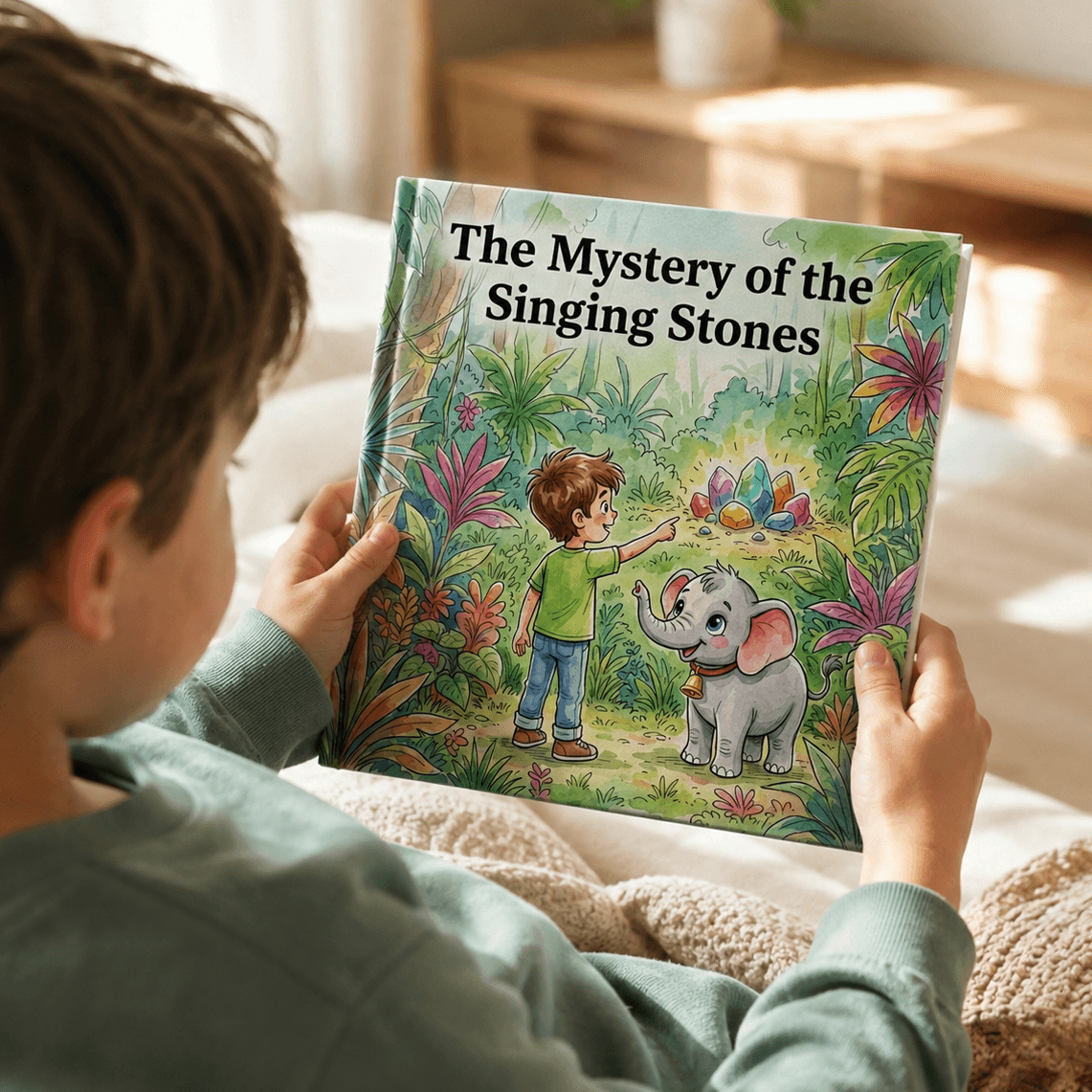
Stories help children learn by building vocabulary and language skills, strengthening memory and attention, developing empathy and emotional regulation, teaching cause-and-effect reasoning, and making abstract ideas concrete through character and narrative. Reading aloud for as little as 10 to 15 minutes a day, choosing stories a child can relate to, asking open-ended questions, and letting children retell or co-create stories are among the most effective ways parents and educators can use storytelling to support learning. Personalized storybooks, where a child becomes the main character, can deepen engagement even further because children pay closer attention to stories about themselves.
Long before classrooms, textbooks, or apps, humans were already teaching their children through story. Around firelight and at bedsides, elders passed down survival skills, moral lessons, and a sense of identity through narrative. That instinct has not gone anywhere. Today, developmental psychologists, educators, and speech-language pathologists all point to the same conclusion: story is one of the most powerful learning tools available to a child's developing brain, and it works because it mirrors how the brain is wired to make sense of the world.
This guide breaks down exactly how stories support learning at every stage of childhood, what the research says about why it works, and how parents, grandparents, and educators can use storytelling more intentionally at home and in the classroom. Along the way, we will also look at how personalized storytelling tools, like the ones available through Story Spark, can amplify these benefits by putting a child directly inside the narrative.
Why Stories Matter for a Child's Developing Brain
A story is never just a sequence of events. It is a structure: a beginning that sets up a world, a middle that introduces a problem, and an end that resolves it. Cognitive scientists sometimes call this "narrative structure," and it turns out that the human brain is remarkably good at absorbing and remembering information when it is delivered this way, far better than when the same information is presented as a list of disconnected facts.
For children, whose brains are undergoing extraordinary growth in the first eight years of life, this matters enormously. Every story a child hears is doing several jobs at once: introducing new vocabulary, modeling sentence structure, demonstrating cause and effect, and asking the listener to hold characters, settings, and plot points in working memory. None of this feels like "work" to a child, because it is wrapped inside something that feels like play or connection. That is precisely why storytelling is such an efficient teacher. It teaches without announcing that it is teaching.
Language Development
Every story is a vocabulary lesson in disguise. Children who are regularly read to or told stories are exposed to words, phrases, and sentence patterns they are unlikely to encounter in everyday conversation. Picture books and storybooks often use richer, more varied vocabulary than typical spoken speech between adults and children, which is why researchers consistently link frequent reading with stronger vocabulary and earlier literacy skills. For more on the research behind this, Story Spark's guide on when parents should start reading to their children walks through the evidence in detail, including why some experts recommend starting as early as infancy.
Beyond individual words, stories teach children how language works: how to build a sentence, how dialogue functions, how tone changes meaning. Children absorb grammar patterns simply by hearing them modeled again and again inside an engaging narrative.
Memory and Cognitive Skills
Following a story requires real cognitive effort, even though it rarely feels that way to a child. A listener has to track who the characters are, remember what has already happened, anticipate what might happen next, and understand how the setting shapes the plot. This is a genuine mental workout for memory, sequencing, and attention, three skills that transfer directly into classroom learning, from following multi-step instructions to solving math word problems.
Stories with repeating structures, such as those with a refrain or a predictable pattern, are especially useful for young children because they build confidence: a child who can predict what happens next is practicing the same anticipatory thinking that supports reading comprehension later on.
Emotional Development and Empathy
Stories are one of the few tools that let a child safely experience emotions and situations they have not lived through yet. When a character in a story feels scared, embarrassed, excited, or left out, the child listening has a chance to recognize and name that feeling, often for the first time. This is the foundation of emotional literacy: before a child can regulate an emotion, they need the vocabulary and awareness to identify it.
Stories also builds empathy by putting children inside someone else's perspective. Research on social-emotional learning consistently shows that narrative exposure helps children better recognize emotions in others, practice perspective-taking, and develop stronger relationship skills. Story Spark has written more extensively about this connection in Social Emotional Learning Through Stories, which outlines six specific ways storytelling builds empathy, problem-solving, and self-reflection in children.
Resilience and Problem-Solving
Nearly every story worth telling involves a character facing a challenge. Whether it is a fairy tale hero overcoming an obstacle or a picture-book character solving an everyday problem, children absorb a quiet but powerful lesson every time: difficulties can be faced, and they can be overcome. Psychologists refer to this as "narrative modeling," where children internalize coping strategies and persistence by watching (or hearing about) a character work through adversity.
This is part of why bedtime stories in particular are so valuable. A calm, low-stakes story at the end of the day gives children repeated, gentle exposure to the idea that problems have solutions. Story Spark's Definitive Parent's Handbook for Bedtime Stories goes deeper into why this nightly ritual supports both emotional security and cognitive development, and how long a bedtime story should ideally last depending on a child's age.
Curiosity and a Love of Learning
Stories are often a child's first window into worlds beyond their own home, whether that is a different culture, a historical period, outer space, or the inner workings of the human body. A well-told story about a topic can generate more genuine curiosity in a child than a textbook chapter on the same subject, because narrative gives facts an emotional anchor. Children remember what happened to the character, and the surrounding facts come along for the ride.
This is also why storytelling is increasingly used as a deliberate teaching method inside classrooms, not just at home. Story Spark's article on Storytelling in Education explores techniques teachers use, from opening lessons with a narrative hook to using the "Hero's Journey" framework to structure a unit, and explains why narrative reduces cognitive load and improves retention compared to fact-based instruction alone.
What the Research Says
The connection between storytelling and learning is not just intuitive, it is well documented. A few key findings worth knowing:
Children who are read to daily hear millions more words by kindergarten than children who are rarely read to, a gap that has measurable effects on vocabulary size and school readiness. Early and consistent reading exposure is one of the strongest predictors of later academic performance, not just in reading and language arts but across subjects, because literacy underpins almost every other area of the curriculum.
Neuroimaging studies have found that children who are read to frequently show greater activation in brain regions associated with mental imagery and narrative comprehension, suggesting that storytelling actively shapes how the brain processes language, even before a child can read independently.
Studies on social-emotional learning show that narrative-based interventions, including simple read-aloud programs, can improve children's ability to identify emotions, resolve conflicts, and demonstrate empathy toward peers. This lines up with what many parents and teachers observe anecdotally: children who are read a wide range of stories tend to have a broader emotional vocabulary and more developed perspective-taking skills.
None of this requires expensive programs or special training. It requires consistent access to stories and a bit of intentionality about how they are shared.
How to Use Stories for Learning: Practical Strategies
Knowing that stories help children learn is only useful if it translates into daily habits. Here is how parents, caregivers, and educators can make the most of storytelling as a learning tool.
1 Build a Regular Story Routine
Consistency matters more than length. A short story read at the same time every day, whether that is after breakfast, in the car, or at bedtime, builds an association between stories and comfort, which in turn makes children more receptive learners. Experts often point to somewhere between 10 and 20 minutes a day as a reasonable target, depending on a child's age and attention span, but the real goal is simply making it a predictable part of the routine rather than an occasional treat.
Bedtime is one of the most natural windows for this, since it is quiet, low-distraction, and already part of most families' daily rhythm. If you are looking to build or refine that routine, Story Spark's collection of bedtime stories is designed specifically for this moment: gentle, imaginative stories that can include a child's own name and likeness as the main character, which tends to hold attention far better than a generic tale.
2 Ask Open-Ended Questions While Reading
Reading a story straight through without pausing is fine, but reading interactively, stopping occasionally to ask "What do you think will happen next?" or "How do you think that character feels right now?", turns a passive activity into an active one. This kind of dialogic reading has been shown to improve comprehension, vocabulary retention, and critical thinking far more than silent, uninterrupted reading.
Good questions to weave in include: What would you do in that situation? Why do you think the character made that choice? What do you think the character learned by the end?
3 Choose Stories That Reflect a Child's Interests and Identity
Children pay closer attention, and retain more, when a story connects to something they already care about. A child fascinated by dinosaurs will absorb far more from a dinosaur-themed adventure than from a generic story with no personal hook. This is also why representation matters: children who see characters who look like them, share their family structure, or reflect their own experiences tend to engage more deeply and build stronger self-identity through the stories they consume.
This is one of the areas where personalization can make a measurable difference. Rather than hoping a generic storybook happens to reflect a child's interests, tools like Story Spark's Storybook Creator let a parent build a story around exactly what a child loves, whether that is dinosaurs, space, animals, or a favorite hobby, with the child's own name, likeness, and even family members woven directly into the plot and illustrations.
4 Explore a Wide Range of Characters and Worlds
Variety exposes children to different problem-solving styles, personalities, and settings, which builds cognitive flexibility. Rotating between adventure stories, quiet emotional stories, funny stories, and stories set in unfamiliar places keeps engagement high and broadens the range of situations a child has "practiced" through narrative.
Story Spark's Character World is a useful resource here: a growing library of pre-made characters spanning different genres and themes that children can explore and drop directly into their own personalized stories, giving them a low-effort way to sample new kinds of narratives before committing to a full story.
5 Encourage Retelling and Co-Creation
Asking a child to retell a story in their own words is one of the most effective (and most overlooked) comprehension exercises available. Retelling requires a child to reconstruct the sequence of events, recall key details, and organize their thoughts verbally, all skills that map directly onto both reading comprehension and written composition later in school.
Taking this a step further, inviting a child to help create a story from scratch, deciding what the character wants, what problem they face, and how it gets solved, builds narrative reasoning and creative confidence simultaneously. This is the exact idea behind Story Spark's Create a Book tool, which lets a child (with a parent's help) shape their own storybook or longer illustrated book from an idea into a finished, printed keepsake.
6 Connect Stories to Real Life
After finishing a story, briefly connecting it to something in a child's own life reinforces the lesson and helps it stick. If a character in a story felt nervous about trying something new, a parent might gently ask whether the child has ever felt that way. This kind of bridge-building turns a one-time story into a lasting reference point a child can return to.
7 Use Storytelling to Support Different Learning Needs
Not every child processes stories the same way, and that is worth planning for rather than treating as an obstacle. For children with ADHD, for example, shorter story sessions, more interactive questioning, and multi-sensory elements like illustrations or audio narration can make a significant difference in engagement and comprehension. Story Spark's guide to Reading & ADHD offers specific, practical strategies for parents navigating this, including the "5 C's" framework for supporting reading development.
Stories Across Childhood: What Changes With Age
The way stories support learning shifts as children grow, and adjusting expectations accordingly helps parents and educators get the most out of story time at every stage.
In infancy and the toddler years, roughly birth through age two, stories are primarily about bonding, rhythm, and exposure to language sounds. Board books with simple, repetitive text and bright illustrations help babies and toddlers build early listening skills long before they understand plot.
Between ages three and five, children begin to grasp basic story structure: they understand that stories have a beginning, middle, and end, and they start predicting what happens next. This is the age where interactive questions during reading become especially valuable, and where a storybook, one with a full illustrated narrative rather than simple board-book text, becomes a genuinely powerful learning tool.
From roughly ages six through nine, children can follow more complex plots, hold multiple characters in mind, and start to draw their own inferences and morals from a story without being told explicitly what to think. This is the sweet spot for introducing chapter books and longer illustrated narratives, and for encouraging children to start retelling and eventually writing their own stories.
By the pre-teen years, stories increasingly become a tool for identity exploration and moral reasoning, helping children work through bigger questions about fairness, friendship, and their place in the world. Longer personalized books, including illustrated biographies or adventure novels featuring the child themselves, tend to resonate strongly here, which is part of why Story Spark also offers longer-format book creation tools alongside its shorter illustrated storybooks.
Why Personalized Stories Take This Even Further
Every benefit described above, vocabulary growth, empathy, memory, resilience, curiosity, gets a meaningful boost when a child is not just hearing a story, but living inside one. This is the core idea behind personalized storytelling: when a child sees their own name, their own face, and details from their own life reflected in a narrative, their attention and emotional investment increase substantially compared to a generic, mass-produced book.
There is a simple psychological reason for this. Children, like adults, pay closer attention to information that feels personally relevant. A story about "a brave explorer" is engaging. A story about a child by name, illustrated to look like them, going on that same brave adventure, is memorable. That heightened engagement translates directly into better retention of the vocabulary, lessons, and emotional content embedded in the story.
Story Spark was built around exactly this idea. Using its AI-powered storybook creator, a parent, grandparent, or educator can describe an idea (or start from a photo), and the platform will help write and illustrate a fully personalized storybook, complete with custom characters pulled from real photos, in a matter of minutes. From there, families can choose to keep the story digital or have it printed as a premium hardcover book and delivered to their door, turning a simple bedtime story into a lasting keepsake a child can return to for years. Details on formats, page counts, and pricing are available on Story Spark's pricing page.
Beyond individual storybooks, Story Spark also supports personalized comic books for children who love a faster-paced, visual format, as well as interactive search-and-find books that combine storytelling with visual attention and observation skills, another way narrative can be adapted to different learning styles and interests.
Storytelling in the Classroom: A Note for Educators
While this guide focuses primarily on parents and caregivers, the same principles apply directly to classroom settings. Teachers who open lessons with a short narrative, rather than a list of objectives, tend to see higher engagement and better recall of the material that follows. Story-based frameworks, such as structuring a science unit around a character's "journey" through a topic, give students an emotional and sequential anchor for information that might otherwise feel abstract or disconnected.
Educators looking to build this into their teaching practice in a more structured way can find a deeper breakdown of specific classroom techniques, including TPRS (Teaching Proficiency through Reading and Storytelling) and story-based lesson openers, in Story Spark's article on Storytelling in Education. Personalized books can also play a role here: teachers have used custom storybooks featuring class pets, classroom scenarios, or student-authored characters as a way to make curriculum content feel more immediate and relevant to young learners.
Common Questions Parents Ask About Stories and Learning
How young is too young to start reading stories to a child?
It is never too early. Many experts recommend reading aloud from infancy, since even before a baby understands words, they are absorbing rhythm, tone, and the comforting association between a caregiver's voice and story time. Story Spark's guide on when parents should start reading to their children covers age-by-age recommendations in more depth.
How long should a story session be?
There is no single right answer, but many experts suggest aiming for somewhere between 10 and 20 minutes a day, adjusted for a child's age and attention span. Shorter, more frequent sessions are often more effective than occasional long ones, particularly for younger children or children who find it harder to sit still.
Does it matter if the same story is read over and over?
Not at all, and in fact, repetition is valuable. Children often ask for the same story repeatedly because predictability is comforting and because each re-read allows them to notice new details, practice recall, and build a stronger sense of mastery over the material.
Can stories really help with subjects like math or science, not just reading?
Yes. Narrative structure helps children retain almost any kind of information more effectively than facts presented in isolation, which is why storytelling techniques are increasingly used across subjects, not just in language arts. A story about a character solving a problem using basic math, for example, can make an abstract concept feel concrete and memorable.
What makes a personalized storybook different from a regular one?
A personalized storybook places the child directly into the narrative, using their name, likeness, and sometimes real people or pets from their life. This tends to increase engagement and attention because children naturally pay closer attention to content that feels relevant to them, which in turn can strengthen the learning benefits already associated with story time.
Bringing It All Together
Stories are not a supplement to a child's education, they are one of its foundations. Every time a child hears or reads a story, they are quietly practicing vocabulary, memory, empathy, reasoning, and resilience, all wrapped inside something that feels like connection rather than instruction. The research is consistent, and so is the experience of generations of parents, caregivers, and educators: a well-chosen story, told with care and a bit of interaction, is one of the most reliable tools available for helping a child grow.
The good news is that building this habit does not require a curriculum or a budget. It requires time, attention, and a willingness to ask a child what they think happens next. For families who want to take that a step further, tools like Story Spark make it possible to put a child directly at the center of their own story, turning an already powerful learning tool into something even more personal, memorable, and worth returning to again and again.
Ready to create a story of your own? Explore Story Spark's Storybook Creator to turn your child's imagination into a keepsake they will want to read on repeat, or browse the full Learning Centre for more research-backed guides on reading, storytelling, and child development.
Written by the Story Spark Team. Story Spark is an AI-powered platform for creating, illustrating, and printing your own books.