


Page one shows a curly-haired girl in a yellow raincoat, jumping into a puddle. Turn to page two, and the same girl now has straight hair, a blue coat, and a face that looks nothing like the child the book was supposedly made for. The story might still make sense. The rhymes might still land. But something has already broken, quietly, in the reader's mind: this is not actually a book about my child. It is a book about several different children who happen to share a name.
That break is what character consistency exists to prevent. It is one of the least glamorous parts of AI-assisted book creation and one of the most important, because it is the difference between a personalized book that feels genuinely personal and one that only pretends to be. Most people never think about it until it goes wrong, and by the time it goes wrong, the book is usually already printed.
This post explains what character consistency actually means, why it matters more than most people realize across storybooks, comics, memoirs, and search-and-find books, and how Story Spark is built around keeping a character looking like themselves from the first page to the last. It also covers a few practical habits that make a noticeable difference in how consistent your own finished book turns out.
Quick Answers
- What is character consistency? It is the ability to keep a character, whether a real child, a pet, or an invented hero, looking the same (same face, hair, clothing, and defining features) across every illustration in a book, rather than subtly changing from page to page.
- Why does it matter? Inconsistent characters break immersion, undermine trust in a personalized gift, and make certain formats, like search-and-find books and comics, unusable, since both depend entirely on the reader recognizing one character on sight.
- How does Story Spark keep characters consistent? Through its character creator, which builds a saved character profile from a photo or description that gets reused across every page and every future book, rather than regenerating the character from scratch each time.
- Can I reuse the same character in more than one book? Yes. Characters are saved to your profile, so the same version of your child, pet, or original character can appear in a birthday storybook, a holiday comic, and a search-and-find adventure without being rebuilt.
- Does character consistency cost extra? No. It is a core part of how storybooks, books, comic books, and search-and-find books are built on Story Spark, not an add-on feature.
What Character Consistency Actually Means
Character consistency is the ability of an illustration system to generate one character, with the same face, body, hairstyle, clothing, and defining details, across many separate images, rather than producing a slightly different-looking person every time a new picture is generated. It sounds like a small technical detail. In practice, it is the single feature that separates a real book creation tool from a novelty image generator that happens to produce pretty pictures.
Most general-purpose AI image tools were built to generate one striking image at a time, not a coherent set of twenty or thirty images that all need to agree with each other. Ask one of those tools for "a boy with brown curly hair in a red jacket" five times, and you will likely get five different boys. Every image might be beautiful on its own. None of them will convince a child that it is actually them on the page. Our companion guide, the best AI for character consistency in 2026, goes deeper into the technical approaches different tools use to solve this and how they compare. This post focuses on a simpler question: why does any of this actually matter to the person holding the finished book?
Why Consistency Is Technically Hard to Get Right
It helps to understand why this problem exists at all, because it is not a small bug that most AI tools have simply forgotten to fix. Many AI image generators work by turning a written prompt into a brand new image every time, with no memory of what was generated a moment earlier. Type the same description twice, and the model treats it as two independent requests, not two pages of the same story. Small differences in wording, or even pure randomness in the model itself, are usually enough to produce two visibly different characters, even when the prompt looks identical on the page.
There are a few ways developers try to solve this. The simplest is prompt repetition, describing the character in as much identical detail as possible on every page, which helps a little but rarely holds up across more than a handful of images. A stronger approach is reference image conditioning, where earlier images of the character are fed back into the system as a visual anchor for new ones. The most reliable approach, and the one that matters most for a multi-page book, is a trained or stored character profile: a persistent representation of one specific character that every new illustration is generated from, rather than a prompt typed fresh each time. This is the approach Story Spark's character creator is built around, which is why a character created on page one is drawn from the same underlying profile on page thirty.
Why Character Consistency Matters
It Is What Makes a Story Feel Real to a Child
Children are remarkably good at noticing when something is off, even if they cannot always explain what. A storybook that is supposed to star them works because of a simple, almost magical substitution: the child on the page becomes a stand-in for the child holding the book. The moment that stand-in changes appearance mid-story, the spell breaks. The book stops being "a story about me" and becomes "a story about a cartoon kid who sort of looks like me, some of the time."
This matters most in exactly the moments a personalized storybook is meant to deliver: the page where the character does something brave, funny, or kind, and a child gets to see themselves as the one doing it. A storybook built on a consistent character protects that moment on every single page, not just the cover. Parents reading the story aloud tend to notice this too, since a wobbly, ever-changing character makes the read-aloud experience feel less like a bedtime story and more like flipping through unrelated stock illustrations.
It Is the Entire Point of a Search-and-Find Book
Nowhere does character consistency matter more directly than in a search-and-find book. The entire format depends on a reader being able to spot one specific, recognizable character hidden inside a busy, detailed scene, page after page. If that character's face or clothing shifts even slightly between pages, the game stops being challenging and starts being impossible, because the reader no longer knows exactly what they are looking for.
This is why Story Spark builds search-and-find books around a single saved character profile created from a real photo, used consistently across every scene in both the Classic and Around the World editions. Without strict character consistency, this entire product category simply would not work, since younger children in particular rely on very literal visual cues, a specific hair color, a specific outfit, and cannot compensate for a character that keeps subtly shifting the way an adult reader might.
It Keeps a Comic Book's Hero Recognizable Panel to Panel
Comic books ask even more of consistency than picture books do, because a comic tells its story primarily through sequential images rather than text. A personalized comic book that stars a real person as the hero needs that hero to look like the same person across every panel, in every illustration style, whether it is the clean lines of European Clear Line, the shadows of Noir, or the energy of Modern Comics.
If the hero's face drifts from panel to panel, readers lose the thread of who is who, especially in action sequences with multiple characters on the page at once. Consistency is not a nice-to-have here. It is the mechanism that lets a comic actually read as a comic, rather than a loose sequence of unrelated illustrations. This is especially true for gift-giving occasions like birthdays and Father's Day, where the whole appeal of a comic book gift is seeing a specific, recognizable person cast as the hero of their own story from cover to cover.
It Turns One Character Into a Series, Not Just a Single Book
One of the more overlooked benefits of consistent characters is what it makes possible after the first book is finished. Because Story Spark saves each character to a creator's profile, the same illustrated version of a child, a pet, or an original invented hero can headline a birthday storybook in the spring, a Halloween comic in the autumn, and a Christmas search-and-find book in December, all without rebuilding the character from scratch each time.
Our guide on how to create your own characters touches on exactly this idea: the same character can star in a funny story one day, a magical adventure the next, and a cozy bedtime book after that. That only works, and only feels like a growing personal universe rather than a coincidence, if the character actually looks the same every time. Consistency is what turns a single purchase into a running family tradition, and it is also what makes a saved character genuinely reusable rather than something you have to painstakingly rebuild and hope matches closely enough for a second or third book.
It Matters Even More in Longer Books and Memoirs
Picture books ask a character to stay consistent across twenty or thirty pages. A longer novel, memoir, or family history can ask far more of it, sometimes covering dozens of illustrated scenes across an entire life story, with multiple family members who all need to remain individually recognizable throughout. A memoir where a grandmother looks like three different women depending on the chapter undermines the very thing the book is trying to preserve: an accurate, lasting record of a real person.
Because Story Spark's character profiles persist across a project regardless of length, a face established in chapter one is the same face that appears in chapter twenty, which matters enormously for a book meant to be kept for decades rather than read once and set aside. Family history projects often illustrate several relatives across several decades of a life story, and consistency is what lets a reader tell at a glance which illustrated figure is the grandmother as a young woman and which is her sister, rather than guessing from context alone.
It Is a Trust Signal for Self-Publishers and Professional Use
For anyone using Story Spark to self-publish a children's book for a wider audience rather than a single family, character consistency is also a quality signal that readers judge, whether they realize it or not. Professionally illustrated children's books, the kind found in bookstores, never let their protagonist's appearance drift between spreads, because publishers know that inconsistency reads as amateur, even to very young readers who cannot articulate why a book feels slightly wrong.
A self-published author who gets this right is competing on a level footing with traditionally illustrated books. One who does not risks readers, or reviewers, noticing that something is subtly off, even if they cannot name the problem as "character consistency" specifically. Over a full print run or a growing catalog of titles, that difference compounds, since consistent illustration quality is one of the signals readers use, often unconsciously, to decide whether to trust an independent author with their next purchase.
Warning Signs of Weak Character Consistency
Before committing to any personalized book tool, it is worth knowing what weak character consistency actually looks like in practice, since it is usually easier to spot in someone else's sample pages than to predict from marketing copy alone.
The clearest warning sign is a tool that regenerates a character from a fresh text prompt on every page rather than working from a single saved profile. If a platform asks you to re-describe your character's appearance for each new scene, small wording differences will almost always produce visible drift over the course of a book. A second sign is a preview step that only shows one or two sample pages rather than the full book before printing, which makes it impossible to check consistency across the whole project until it is too late to change anything. A third sign is a tool built primarily as a general image generator with book creation added on afterward, since these platforms are usually optimized for one striking image at a time rather than a coherent set of illustrations that all need to agree with each other.
By contrast, a tool built specifically for multi-page book creation, like Story Spark's character creator, treats a saved character profile and a full page-by-page preview as core parts of the process rather than optional extras. If you want a closer look at how several popular AI tools handle this specific problem, our comparison of the best AI for character consistency in 2026 rates them side by side.
How Story Spark Keeps Characters Consistent
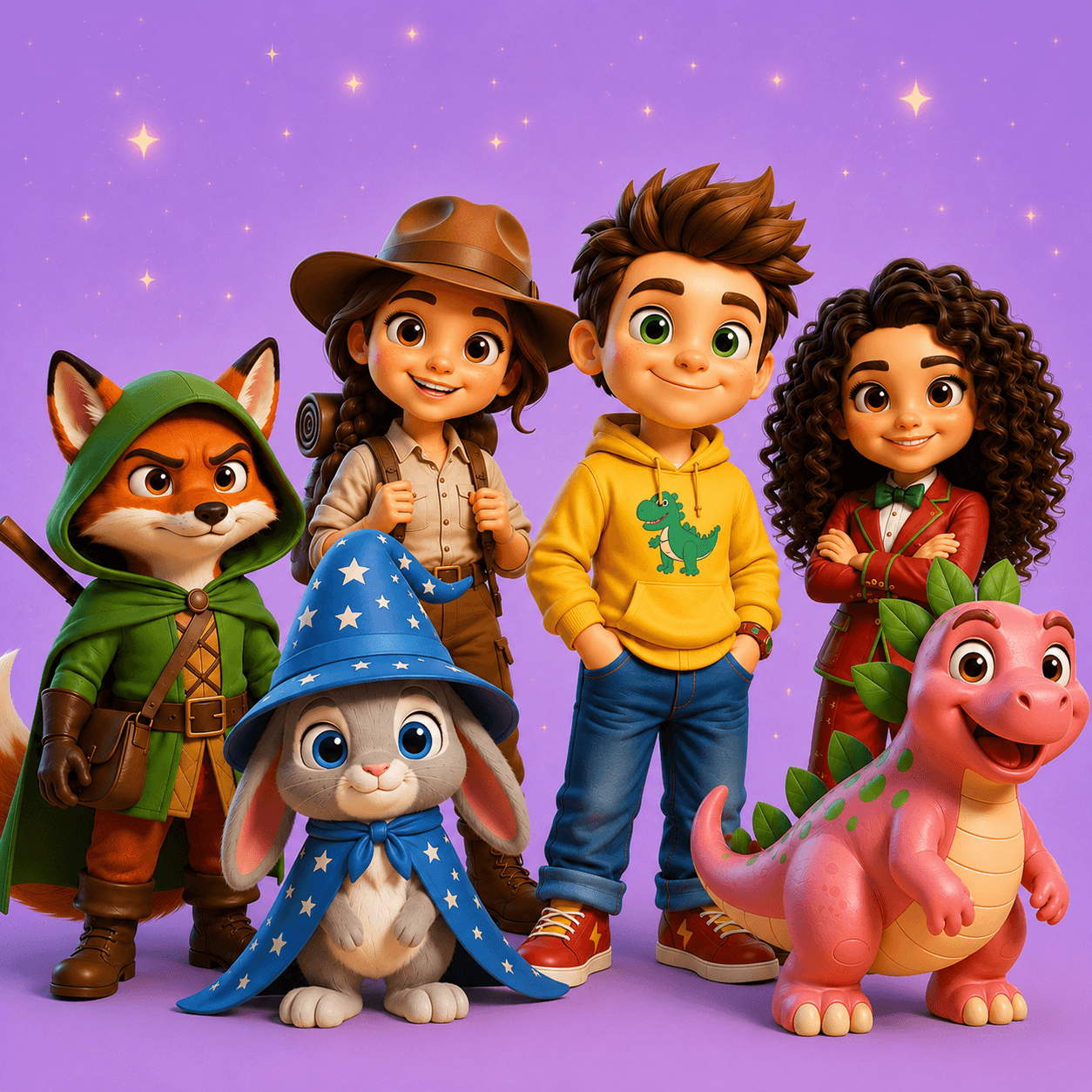
Story Spark's approach starts with the character creator, where a character is built once and then reused, rather than regenerated from a text prompt on every new page. There are three ways to build one: upload a photo of a person, pet, or toy and let the platform convert it into a unique illustrated character, describe a character from scratch and choose its name, type, and appearance through a guided builder, or select an existing character from Story Spark's growing library. Whichever path you choose, the result is a defined character profile rather than a one-off image.
That profile is what makes consistency possible. Because a character is saved to your account, the same version of them can be dropped into a new storybook, book, comic book, or search-and-find book without rebuilding it, and the illustrations generated for that character draw from the same underlying appearance every time, whether it is page three or page thirty. You can also apply any of Story Spark's illustration styles, from watercolor to bold flat cartoon looks, and the character keeps their defining features even as the artistic style around them changes.
Every project also includes a free, page-by-page preview before anything goes to print, specifically so you can check that a character looks like themselves throughout the whole book before committing to a printed hardcover. Since orders cannot be changed once placed, according to Story Spark's FAQ, that preview step is your last chance to catch any inconsistency before it becomes permanent on paper.
This same underlying character profile also travels across formats, not just across pages within one book. A character built once through the character creator can headline a picture-style storybook this month and a comic book or search-and-find adventure later in the year, with the same face and details carried through automatically, rather than needing to be re-described or re-uploaded for every new project.
Tips for Getting the Most Consistent Character Results
A few habits make a noticeable difference in how consistent your finished book looks, regardless of which format you choose.
Start with a clear, well-lit photo if you are using the photo-to-character option. A clean, front-facing image with good lighting gives the character creator more accurate detail to work from than a blurry or heavily shadowed photo, which tends to produce a more reliably recognizable result across many illustrations.
Keep defining features simple and specific. A character description built around two or three clear, memorable details, curly red hair, round glasses, a favorite striped jumper, tends to stay recognizable more reliably than a description trying to capture ten different details at once. This is the same principle our guide on creating your own characters recommends: build from a defining trait rather than an elaborate, overloaded description.
Reuse saved characters instead of recreating them. Once a character exists in your profile, use that same saved version across every new project featuring them, rather than describing or uploading them again from scratch, which introduces unnecessary variation between books that should otherwise match.
Always use the free preview before ordering. Flip through every page before printing, specifically checking faces, hair, and clothing from the first page to the last. This is the single most reliable way to catch a rare inconsistency before it becomes part of a printed hardcover you cannot change.
Frequently Asked Questions
What does character consistency mean in a personalized storybook? It means the same character, with the same face, hairstyle, clothing, and defining features, appears identically across every illustration in the book, rather than looking like a slightly different person from page to page.
Why does character consistency matter more for some book formats than others? Formats like search-and-find books and comic books depend entirely on a reader instantly recognizing one character across many illustrations, so any inconsistency makes those formats far harder to enjoy or, in the case of search-and-find books, impossible to play properly.
How does Story Spark keep a character consistent across an entire book? Story Spark builds a saved character profile through the character creator, from a photo or a description, and reuses that same profile for every illustration in a project, rather than regenerating the character's appearance from a new prompt on each page.
Can I use the same character in more than one book? Yes. Characters are saved to your profile, so a character built for one project can be reused in future storybooks, comics, or search-and-find books without being recreated, which also keeps their appearance consistent across an entire family of books over time.
Does uploading a photo produce a more consistent character than a text description? Both methods produce a saved, reusable character profile, but a clear photo generally gives the character creator more specific visual detail to work from, which can make the resulting illustrated character easier to keep recognizable across many pages.
Can I check for consistency before my book is printed? Yes. Every Story Spark project includes a free, page-by-page preview before printing, which is the best opportunity to review a character's appearance across the whole book, since orders cannot be changed or canceled once placed.
Does character consistency affect the price of a book? No. It is built into how every format works on Story Spark rather than sold as a separate feature. Pricing depends on the book format and page count, not on whether characters remain consistent; full details are on the pricing page.
Can I create more than one character and combine them in the same book? Yes. Any single illustration can include up to four characters at once, including ones you have created yourself, so a book can feature a child alongside siblings, parents, or a pet, with each one drawing from its own consistent saved profile.
What should I do if a character looks slightly different on one page? Use the free page-by-page preview to catch it before printing, since this is the point in the process built specifically for reviewing consistency. If something looks off, adjusting the character's description or trying a clearer reference photo through the character creator before regenerating that page usually resolves it.
How is Story Spark's approach to character consistency different from general AI image generators? General-purpose AI image tools are typically built to generate one strong image per prompt, not a coherent set of images that all need to match. Story Spark is built specifically for multi-page book creation, so character profiles persist across an entire project by design. Our comparison of the best AI tools for character consistency breaks down how several popular tools handle this differently.
The Bottom Line
Character consistency is easy to overlook until it goes wrong, and impossible to ignore once it does. A single inconsistent face on one page can undo the effect of twenty pages that got everything else right, because it quietly tells the reader that the book was not actually built around them after all. That is true whether the reader is a five-year-old flipping through a birthday storybook, a couple giving each other a personalized love story, or a self-published author hoping readers take their book seriously.
Story Spark treats character consistency as a foundation rather than an afterthought, built into the character creator and carried through every format, from storybooks and books to comic books and search-and-find adventures. It is also, quietly, one of the reasons a Story Spark book tends to hold up on a re-read months or years later, since nothing about a familiar character's appearance ever needs re-explaining to a child who has grown attached to them.
If you want to see it in action, start with the create a book page and build a character once. You will notice it is the same character on the last page as it was on the first, and the same character again the next time you bring them back for a new story.
Written by the Story Spark Team. Story Spark is an AI-powered platform for creating, illustrating, and printing your own books.