


Finding the right book for an autistic child is rarely as simple as walking into a bookshop and picking something off the shelf. Many mainstream children's books rely on unpredictable plots, busy illustrations, idiomatic language, and social situations that can be genuinely confusing, or even overwhelming, for a child who processes the world differently. Parents, caregivers, and educators often end up patching together a reading experience from several imperfect sources: a workbook here, a social story printed from a therapist's website there, a picture book that almost fits but not quite.
Autism story books solve a different problem than ordinary children's books. They are not just stories that happen to feature an autistic character. At their best, they are built from the ground up around how an autistic child actually reads, processes language, and experiences the world: predictable structure, literal and clear language, sensory-considerate illustrations, and characters who are never framed as broken or in need of fixing. That is a meaningfully different design brief, and it is exactly what Story Spark was built to deliver.
In this guide, we will look at why autism story books matter, what the research and lived experience of the autism community tell us about what actually works, where generic storybooks fall short, and how Story Spark's personalized storybook creator lets any parent, teacher, or caregiver build a book shaped around one specific child rather than a generic "autism-friendly" template.
Why Representation and Predictability Matter in Children's Books
Reading is one of the earliest and most powerful ways children make sense of themselves and the world around them. A child who never sees a character who thinks, communicates, or experiences sensory input the way they do can come away with a quiet but persistent message: stories are for other kinds of children, not for me.
Autism is far more common than many parents realize. According to the most recent surveillance data released by the CDC's Autism and Developmental Disabilities Monitoring Network, roughly one in 31 eight-year-old children in the United States has been identified with autism spectrum disorder, a figure that has risen steadily as awareness and screening have improved. Put simply, most classrooms, playgroups, and extended families now include at least one autistic child. Yet the vast majority of children's publishing still defaults to neurotypical narrative conventions: rapid scene changes, sarcasm and idiom, ambiguous emotional cues, and endings that rely on inference rather than being stated outright.
For an autistic reader, those conventions are not neutral stylistic choices. They can be the difference between a book that is enjoyable and a book that is exhausting. Predictability, clarity, and a story that reflects a child's own routines and interests are not "extra" features bolted onto a book for accessibility's sake. For many autistic children, they are the difference between a story that lands and one that does not.
Understanding Autism and the Reading Experience
Every autistic child is different, and it is worth saying clearly: there is no single "autism reading profile." Some autistic children read fluently well ahead of their age and gravitate toward detailed non-fiction. Others find decoding text straightforward but struggle to infer a character's feelings from context. Some are still building spoken or written language and communicate through AAC (augmentative and alternative communication), signing, or gesture. A genuinely useful autism story book has to be flexible enough to meet a wide range of these profiles, rather than assuming one type of autistic reader speaks for all.
That said, a few patterns come up again and again in guidance from autism organizations, speech and language therapists, and autistic self-advocates:
Sensory processing differences. Many autistic children experience sound, light, texture, and visual clutter more intensely than their neurotypical peers. A page dense with background detail, clashing colors, or busy patterns can be genuinely difficult to look at, let alone read alongside.
A preference for predictability. Sudden shifts in scene, tone, or plot direction can be disorienting. Stories with a clear, repeated structure, where a child can anticipate roughly what happens next, tend to feel calmer and more accessible.
Literal language processing. Idioms, sarcasm, and figures of speech ("it's raining cats and dogs," "she was over the moon") are frequently taken literally and can create genuine confusion rather than charm.
Special interests as a gateway to engagement. When a story incorporates a child's specific, deeply held interest, whether that is trains, dinosaurs, a particular video game, or a favorite animal, engagement and comprehension often increase significantly. This is one of the best-documented levers for building motivation to read.
A need for routines and transitions to be shown clearly. Stories that walk through a transition (a new sibling, a first day at a new school, a change in routine) step by step, rather than skipping ahead, tend to be far more useful and far less anxiety-inducing.
Identity-affirming, non-deficit language. How a story talks about a character matters. Books that frame autistic traits as something to be corrected or apologized for send a very different message than books that simply present a character's way of being in the world without judgment.
These patterns are echoed in one of the most widely used tools in autism education: Social Stories, a technique developed by educator Carol Gray in the early 1990s. Social Stories describe a situation, skill, or concept in specific, literal, and reassuring language, and they remain a go-to approach used by therapists, teachers, and parents to help autistic children understand and prepare for social situations. The underlying principle, that stories work best for autistic readers when they are concrete, predictable, and free of unnecessary ambiguity, is the same principle that should guide any well-designed autism story book, not just a formal social story.
It is also worth noting that autistic children are not a uniform audience for the purposes of illustration and pacing either. A child who loves fast-moving, high-energy narratives about their special interest may find a slow, muted book just as disengaging as a neurotypical child would. The goal of a genuinely well-designed autism story book is not to make every story slow and quiet by default, but to make the pacing, structure, and visual language deliberately chosen rather than accidental, and to give parents and caregivers control over those choices for their specific child.
What to Look for When Choosing an Autism Story Book
If you are comparing options, whether that is a specialist publisher, a printable PDF, or a personalized platform, it helps to have a short checklist in mind:
- Predictable structure. Does the story move through events in a clear, logical order without sudden jumps in time, tone, or setting?
- Literal, clear language. Are idioms, sarcasm, and figurative language kept to a minimum, or at least clearly explained where they appear?
- Considered illustration style. Are the visuals calm and uncluttered, or does every page compete for attention with background detail and high contrast?
- Room for the individual child. Can the story reflect a specific comfort object, routine, pet, or special interest, rather than only a generic idea of "an autistic character"?
- Identity-affirming language. Does the story treat the character's autism as simply part of who they are, rather than as a problem needing to be solved?
- Sensory flexibility. Can you flag specific sounds, textures, or themes to avoid, and request a calm, predictable ending?
- A format built to last. Is the finished book something sturdy enough to be read again and again, rather than a single-use printout or a low-resolution PDF?
A platform that can check every one of these boxes for one specific child, rather than an average or imagined child, is doing something genuinely different from a standard picture book.
Where Generic Storybooks Fall Short
It is worth being specific about why a shelf full of ordinary picture books often does not do the job, even when the intentions behind them are good.
One-size-fits-all characters. A generic storybook about "a boy who has autism" is written for an imagined average child, not the actual child in front of you. It cannot reflect a specific sensory sensitivity, a specific special interest, a specific family routine, or a specific communication style.
Deficit-framed language. Many older or lower-quality books about autism still lean on language like "overcoming" autism, or frame meltdowns and stimming as problems to be solved rather than as valid ways of self-regulating. This can be genuinely harmful to a child's sense of self.
Visual overload. Illustration styles designed to be eye-catching for a broad audience often use busy backgrounds, high contrast, and lots of simultaneous action, exactly the kind of visual environment that can be difficult for a sensory-sensitive reader to settle into.
No room for a child's own reality. A generic book cannot include a child's actual pet, actual bedroom, actual comfort object, or actual way of communicating. It can only ever gesture at autism in the abstract.
Limited print runs and formats. Specialist autism story books are often self-published, out of print, or available only as low-quality PDFs, making it hard to build a proper home library of books a child will want to return to again and again.
None of this means existing autism-focused children's books lack value. Many are written with real care and expertise. But they solve a general problem, "what might help an autistic child," rather than the specific problem in front of a specific parent: "what will help my child."
How Story Spark Builds Autism Story Books That Actually Fit
Story Spark takes a different starting point. Instead of writing one story and hoping it resonates with autistic readers in general, Story Spark's platform for neurodivergent readers lets you build a story around one particular child: their routines, their special interests, their sensory preferences, and their communication style.
Autism-Aware Text Settings
When you create a story with Story Spark's AI story generator, you can select text and pacing settings designed specifically with autism, alongside dedicated options for ADHD and dyslexia, in mind. Rather than assuming every neurodivergent reader needs the same adjustments, the generator tailors sentence structure, pacing, and clarity to the setting you choose, so the story reads the way that particular child needs it to read.
In practice, that means:
- Clear, literal language with idioms and ambiguous phrasing minimized
- A steady, predictable page rhythm rather than abrupt tonal or scene shifts
- Story structures that walk through transitions, routines, and new situations step by step
- Gentle, non-judgmental narration that never frames a character's autism as something to fix
Sensory-Considerate Illustration Styles
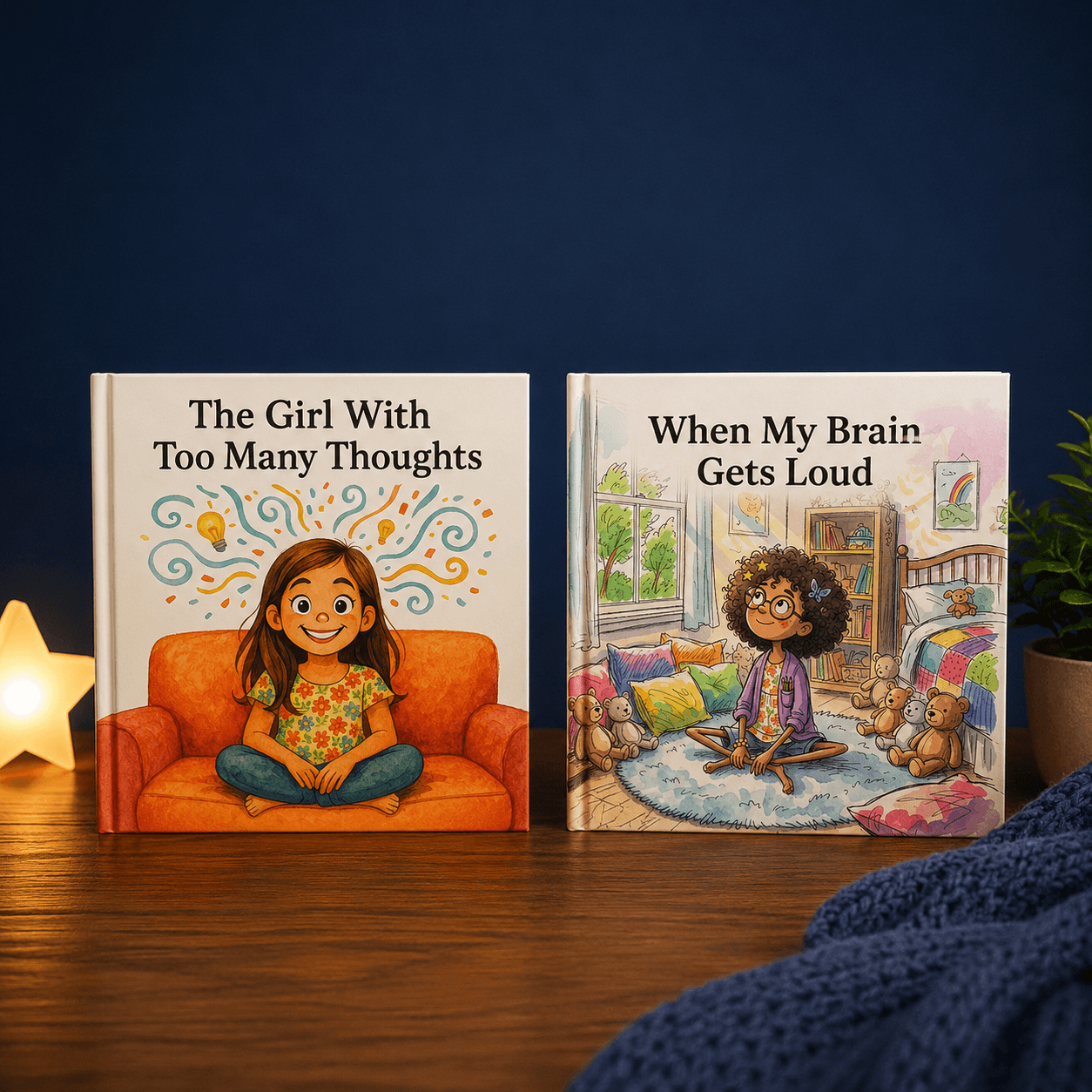
Visual design is just as important as text. Story Spark's neurodivergent-focused illustration options include styles like a soft Children's Book look and a calmer Pencil Sketch style, both selected because they tend to work well for autistic readers who find heavily saturated, high-contrast, or visually busy illustrations overstimulating. You choose the style that suits your child, whether that is a gentle, muted palette or a bolder, high-energy look for a child who responds better to vivid visuals.
Color choices matter too. Story Spark also builds in color-blind-friendly design, using contrast, labeling, and pattern rather than color alone to carry meaning, so a story never becomes harder to follow because of how a particular child perceives color.
Built Around a Real Child's Routines and Interests
This is where a personalized platform pulls ahead of any pre-written book. When you build a storybook with the Character Creator, you can bring your child's actual world into the story: a comfort object, a beloved pet, a daily routine, a favorite food, family language you actually use at home, or a specific special interest that reliably captures their attention. You can also flag sounds, textures, or scenarios you would rather the story avoided, and ask for calming environments, predictable transitions, and gentle endings.
The result is not a generic story that happens to be autism-friendly. It is a story that is specifically about your child's world, illustrated in a style that suits their sensory preferences, and paced to match how they actually read.
Identity-Affirming, Never Deficit-Framed
Language matters enormously here. Story Spark's approach to writing for neurodivergent readers deliberately avoids deficit framing and "fix-it" language. Characters are not written as broken, difficult, or in need of correction. They are the heroes of their own story, exactly as they are. For a child who may already encounter subtle or not-so-subtle messages elsewhere that they need to be different, a story that simply accepts and celebrates who they are can carry real weight.
Support for Non-Speaking and AAC-Using Children
Not every child communicates through spoken words, and a genuinely inclusive storybook platform needs to reflect that. Stories built on Story Spark can represent AAC use, signed communication, gestural communication, or a character who does not use spoken language at all, without ever framing that as a problem the story needs to solve. That is a level of specificity that a mass-market picture book simply cannot offer.
A Real, Printed Keepsake
Once a story is finished, it does not stay trapped on a screen. Story Spark prints every storybook as a genuine hardcover, sized at 21cm by 21cm, full colour, dispatched within five working days. For a child who benefits from repetition and routine, a robust, well-made physical book that can be read at bedtime, taken to school, or brought along to a new or unfamiliar situation, becomes a tool as much as a treasure. You can preview every page before it goes to print, so nothing is locked in until you are happy with the wording, the images, and every small detail.
Storybooks or Longer Books: Choosing the Right Format
Story Spark actually offers two different physical formats, and it is worth knowing which one fits your child. Storybooks are illustrated hardcovers sized at 21cm by 21cm, with up to 60 pages, and they tend to be the natural choice for younger autistic readers or for stories built primarily around illustration and shorter text. For older children, or for a family who wants to build a longer narrative, perhaps a chapter-style story that follows a character across an extended routine or a school year, the Book Creator supports longer-form projects up to 200 pages at 16.5cm by 24cm. Both formats use the same accessibility settings, so the choice comes down to length and reading level rather than which one supports neurodivergent readers better.
How to Create an Autism Story Book on Story Spark
Getting started takes only a few steps.
- Start a new storybook. Head to Create Your Book and choose whether you want Story Spark's AI to write and illustrate the story from your description, whether you want to bring your own written story and have it illustrated, or whether you want a blank canvas with full creative control.
- Build your character. Describe your child, or upload a photo, to create a consistent illustrated character who can appear across multiple books over time.
- Choose your accessibility settings. Select the autism-aware text option (or the dyslexia or ADHD settings, if those fit better) so the story's pacing and language are tailored appropriately.
- Pick an illustration style. Choose a sensory-considerate style like Children's Book or Pencil Sketch, or another style entirely if that suits your child better.
- Add the details that make it personal. Include routines, special interests, comfort objects, family language, and anything you would like the story to avoid.
- Preview, refine, and print. Review every page before ordering, make any changes you want, and then have a premium hardcover shipped to your door.
You can start for free, with no subscription required to write or upload your own content and use the editor. A paid plan on the pricing page unlocks the AI story generator, illustration tools, character creation, and audio narration if you want extra support bringing the story to life.
Beyond Autism: Dyslexia, ADHD, and Every Kind of Reader
Autism rarely exists in isolation from other learning differences, and many families are navigating more than one diagnosis at once. Story Spark's accessibility settings were built with that overlap in mind. Alongside autism-aware pacing, the platform offers dyslexia-aware text, using clean page rhythm, simple sentence structure, and generous spacing to lower the effort of decoding, and ADHD-friendly pacing, which uses shorter scenes and clearer page-by-page goals to help keep attention anchored. If you would like a deeper look at supporting a child with ADHD specifically, Story Spark's guide to reading and ADHD covers strategies, common misconceptions, and practical tips for parents.
Because these settings sit on the same platform, a family with more than one neurodivergent child, or a single child with overlapping needs, does not have to piece together tools from several different places. Everything from story generation to illustration to printing happens in one connected workflow.
Real-World Uses for Personalized Autism Story Books
At home, for everyday reading and bedtime. A calm, predictable storybook built around a child's own interests and routines makes an excellent addition to a nightly reading ritual, especially when the story reflects the exact routine a family already follows.
Preparing for change. New siblings, a house move, starting school, a hospital visit, or any other significant transition can be introduced gently through a story that walks through what to expect, step by step, well before the event itself happens.
In the classroom. Teachers building individualized supports for autistic students can use Story Spark's education tools to create custom classroom readers or curriculum-based stories, with subscription options available for schools and institutions.
As a thoughtful gift. Grandparents, therapists, and family friends can order a personalized storybook as a gift, complete with a gift message, for birthdays or any other occasion worth marking.
Supporting therapy and skill-building. Speech and language therapists and occupational therapists often use social-story-style narratives as part of their practice. A personalized, professionally illustrated, printed version of that same approach can extend the work being done in sessions into everyday home reading.
Building a growing library around one character. Because characters created on Story Spark are saved to your profile, you can reuse the same illustrated version of your child across multiple books. Many families build an ongoing series: one book about starting school, another about a new sibling, another about a family holiday, all featuring the same familiar, consistent character. That consistency can be reassuring in its own right, since the child is not just seeing themselves once, but returning to a version of themselves they already recognize.
Frequently Asked Questions About Autism Story Books
What makes a storybook "autism-friendly"? An autism-friendly storybook typically uses clear, literal language, a predictable and repeated structure, calm and uncluttered illustrations, and identity-affirming rather than deficit-based framing of its characters. The best examples also reflect a specific child's real interests, routines, and communication style rather than a generic idea of "an autistic character."
Can I create a storybook for a child who is non-speaking or uses AAC?
Yes. Story Spark's storybooks can represent AAC use, signed communication, gestural communication, or no spoken language at all, without treating any of it as a problem the story needs to resolve.
What illustration styles work best for sensory-sensitive readers?
Softer, less visually busy styles such as Children's Book and Pencil Sketch tend to work well for children who find high-contrast or highly detailed illustrations overstimulating, though every child is different and Story Spark offers a range of styles so you can choose what suits your reader.
Is Story Spark suitable for children with more than one learning difference?
Yes. Because autism, dyslexia, and ADHD text settings all live on the same platform, families supporting a child with overlapping needs, or more than one neurodivergent child, can adjust settings for each individual book rather than switching between different tools.
Do I need a subscription to try Story Spark?
No. You can write or upload your own content and use the storybook editor for free. A subscription unlocks the AI story generator, illustration tools, character creation, and audio narration. Full details are available on the pricing page.
How long does it take to receive a printed storybook?
Once an order is placed, books are printed and dispatched within five working days, with delivery times varying by destination country.
Can the story avoid specific sounds, textures, or topics that overwhelm my child?
Yes. When building a story, you can flag particular sounds, textures, scenarios, or themes you would like the story to avoid, and request calming environments, predictable transitions, and gentle endings instead.
Will the language in the story avoid "fixing" or "overcoming" framing?
Yes. Story Spark's approach deliberately avoids deficit language. Characters are written as the heroes of their own stories exactly as they are, rather than as children who need to be corrected or changed.
Give Your Child a Story That Actually Fits
A child does not need a story about autism in general. They need a story that reflects their own routines, their own comfort objects, their own pace of reading, and their own way of experiencing the world, illustrated in a style that feels calm rather than overwhelming, and printed as a book sturdy enough to be read again and again.
That is the gap Story Spark was built to close. Whether you are a parent building a bedtime favorite, a teacher preparing a student for a classroom transition, or a grandparent looking for a genuinely thoughtful gift, you can start building a personalized autism story book today.
Create Your Book or explore Stories for Every Child to see the full range of accessibility options available.
Written by the Story Spark Team. Story Spark is an AI-powered platform for creating, illustrating, and printing your own books.