



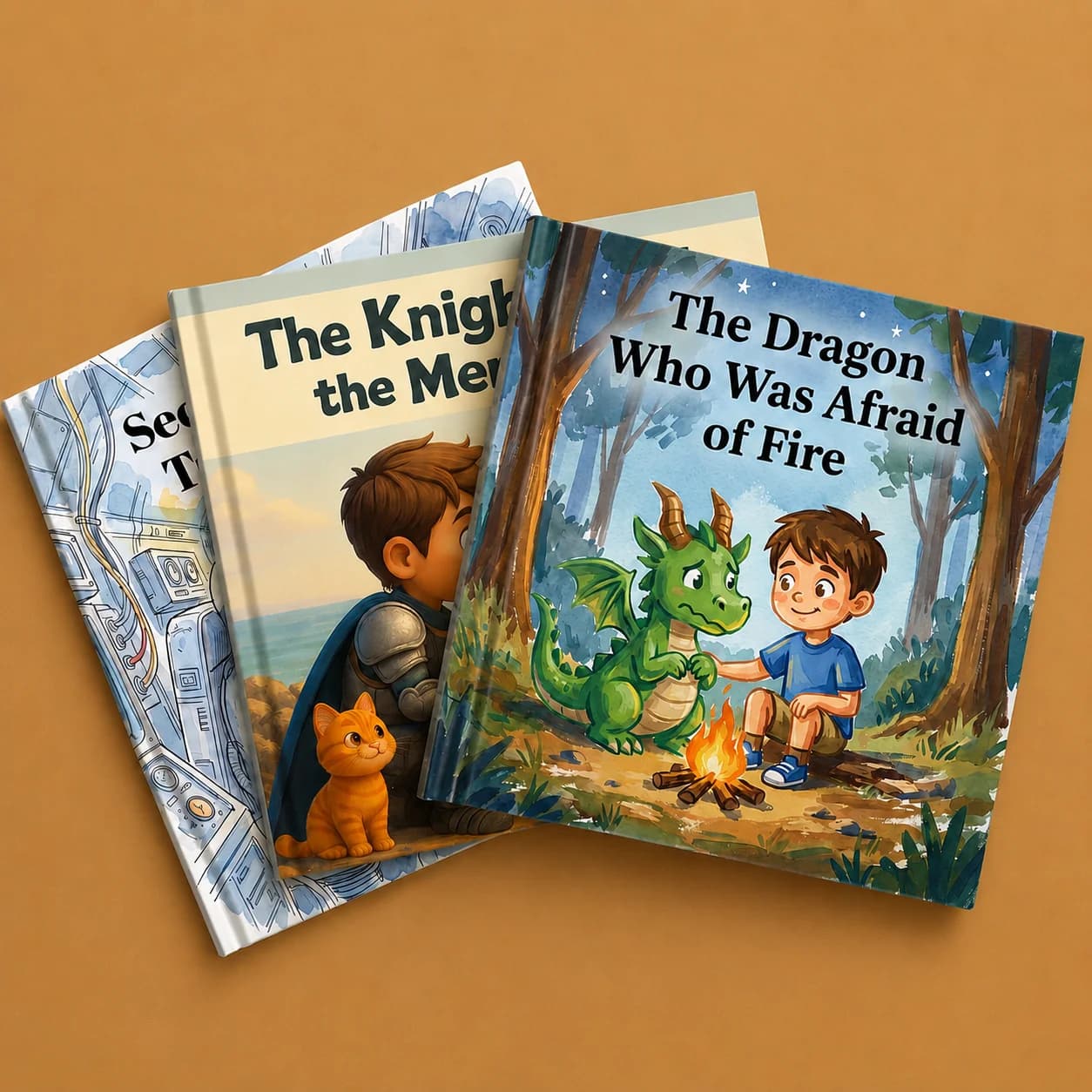
Bedtime stories support children's development in four measurable ways: they build vocabulary and language skills, strengthen early cognitive reasoning, help children understand and regulate emotions, and create a nightly bonding ritual between parent and child. Personalized bedtime stories, where a child sees their own name, face, or family in the story, deepen every one of these benefits by holding a child's attention more effectively than generic picture books. Story Spark lets parents build these personalized stories in minutes, as illustrated storybooks, comic books, longer books, or narrated audiobooks.
Bedtime stories have been a tradition in families for generations, and the tradition has survived for a good reason. Long before screens, apps, and streaming, a parent sitting on the edge of a bed with a book was one of the most reliable tools available for calming a child, teaching them language, and closing out the day on a note of connection rather than chaos. That has not changed. What has changed is how much we now understand about why it works, and how much further a bedtime story can go when it is built around the specific child listening to it.
As parents, we want to give our children the best possible foundation for their future, and bedtime stories play a genuinely outsized role in that foundation. This guide walks through the developmental research behind bedtime stories, the specific cognitive and emotional benefits they offer, and how a personalized story, one that stars your own child, their toy, their pet, or their family, can multiply those benefits well beyond what a generic storybook from the shelf can offer.
The Power of Bedtime Stories for Language Development
Reading aloud is one of the most consistently recommended activities for early language development, and bedtime is one of the most natural windows for it. As children listen to stories, they absorb new words, phrases, and sentence structures in a low-pressure, unhurried setting, which helps expand both vocabulary and comprehension over time. Story time exposes children to language patterns and sentence structures that differ from everyday conversation, including the kind of descriptive, varied vocabulary that does not always come up naturally when a family is discussing dinner or homework.
As children hear the rhythms and patterns of language repeated night after night, they also develop an ear for storytelling itself. They start to recognize how a story opens, how tension builds, and how a resolution feels satisfying, well before they can read or write a story of their own. This early sense of narrative structure becomes a foundation for reading comprehension once formal schooling begins, because a child who already understands how stories work has an easier time following written text independently.
Repetition matters here too. Children often ask to hear the same story multiple times, and rather than being a sign of a limited attention span, this repetition is doing real developmental work. Each re-reading reinforces vocabulary, cements sentence patterns, and lets a child notice new details they missed the first time. A personalized story that a child genuinely wants to revisit, because it features them, gets more of this valuable repetition than a book they have grown bored of.
Cognitive and Emotional Development Through Storytelling
Beyond language, bedtime stories also shape how children think and how they process emotion. Through hearing stories, children learn to think logically and make connections between events, characters, and consequences. A story where a character makes a choice and faces a result teaches cause and effect in a way that is far more memorable than an abstract explanation. Over time, this builds the sequencing and reasoning skills that support everything from following instructions to solving problems independently.
Stories are also one of the most effective tools available for helping children understand emotions they cannot yet name on their own. Watching a character feel frustrated, scared, excited, or disappointed, and seeing how that character works through the feeling, gives children a vocabulary and a framework for their own emotional experiences. This is part of why stories are used deliberately in therapeutic and educational settings to help children process difficult transitions, from a new sibling arriving to starting at a new school. A story that is personalized to reflect a child's actual situation, rather than a generic version of it, tends to land with far more relevance and impact.
Empathy develops in much the same way. As children follow a character through a difficult moment, they practice imagining how someone else feels, which is one of the core building blocks of empathy. This effect strengthens further when the character in the story looks and sounds like the child listening, because it becomes easier to relate a story's emotional lessons back to real life.
Bedtime Stories as a Bonding Ritual
Bedtime stories also offer a unique opportunity for parents to bond with their children, in a way that is easy to overlook amid the practical benefits of language and cognition. As parents and children share a story together, close together, voices low, full attention on one another, they create a moment of connection that is genuinely rare in a busy day. In a world where time with a child is often fragmented across school, activities, screens, and chores, a nightly story provides a small, protected window that belongs entirely to the two of you.
This bonding effect is amplified further when the story itself involves the family. A story where a parent, sibling, or grandparent appears as a character, or where a real family memory becomes the plot, turns story time into something closer to a shared family artifact than a piece of entertainment borrowed from a shelf. Families who build a recurring bedtime story ritual around personalized stories often find that the ritual itself, not just any individual story, becomes something a child looks forward to and remembers well beyond the toddler years.
The Power of Imagination in Early Development
In addition to the benefits of language and cognitive development, bedtime stories play a crucial role in fostering a child's imagination. As children listen to a story, they are transported to new and exciting worlds where almost anything is possible. They can picture themselves as the hero of the adventure, or imagine a world where animals can talk and magic is real, all from the safety and familiarity of their own bed.
Imagination is not simply a pleasant byproduct of storytelling. It is essential to how children develop the ability to think creatively, generate their own ideas, and solve problems that do not have an obvious answer. A child who regularly practices imagining new worlds and new possibilities through story is building a mental habit that carries directly into creative play, classroom problem solving, and eventually into adult skills like innovation and flexible thinking.
Personalized stories give this kind of imaginative development an extra push, because a child does not just imagine a hero somewhere out there. They imagine themselves, specifically, doing something extraordinary. A child who has been the hero of a story where they discover a hidden door in their bedroom, or become a secret superhero once the lights go out, carries a small piece of that imaginative confidence with them the next day, whether they are building a blanket fort or trying something new at school.
Bedtime Stories Versus Screen Time
Many parents wrestle with the same question in the final stretch of the evening: a story, a show, or a game on a tablet. The two are not equivalent, and understanding why matters when deciding how to spend those last twenty minutes before lights out.
A screen is largely a one-directional experience. A child watches or taps, and the device does the rest of the work, generating the images, setting the pace, and supplying the sound. A bedtime story, by contrast, asks a child to do active mental work. They have to picture the setting, imagine what a character looks like, and follow a plot using only words and a parent's voice as raw material. That active construction is exactly what builds imagination, language processing, and attention span over time, and it is largely absent from passive screen viewing.
There is also a physiological difference worth noting. Bright screens close to bedtime are widely associated with delayed sleep onset, because blue light exposure can interfere with the body's natural wind-down process. A story, read aloud in a dim room, does the opposite. It signals calm, reduces stimulation, and pairs naturally with the physical closeness of a parent nearby, all of which support an easier transition into sleep.
None of this means screens have no place in a family's routine. It simply means that in the specific window right before bed, a read-aloud story, especially one personalized enough to hold a child's full attention without the help of moving images, tends to do more of the developmental and settling work parents are hoping for.
Why Generic Bedtime Books Only Go So Far
A shelf of mass-market picture books offers real value, and there is nothing wrong with the family favorites that get read again and again. But a generic story, however well written, was never built with your specific child in mind. It cannot reference your child's actual fear of the dark, the new baby arriving next month, the family trip you took last summer, or the exact toy that goes everywhere with them.
Developmental research on attention and engagement consistently points to the same pattern: children pay closer attention to stories where they recognize themselves. A character who shares a child's name, age, appearance, or real-life situation holds focus in a way a generic character rarely does, and that focus is precisely what unlocks the language, cognitive, and emotional benefits described above. A story a child is only half listening to cannot teach vocabulary, model empathy, or build a bond nearly as effectively as one they are fully absorbed in.
This is the gap that personalized storytelling exists to close, and it is the reason Story Spark was built.
Customizable Bedtime Stories With Story Spark
With Story Spark, parents can take bedtime stories to the next level. The platform allows parents to create unlimited personalized bedtime stories based on their child's own interests, name, appearance, and family, creating a genuinely unique and engaging experience every night rather than a repeat of last week's book. Parents can choose from a wide range of settings, characters, and themes, giving their child a personalized story experience built to capture their imagination and inspire their creativity, and can even make their own child the main character of the adventure.
Story Spark offers several formats, so the story can match the mood, the age of the child, and the occasion:
- Illustrated storybooks, built through the storybook creator, for the classic read-aloud bedtime experience with beautiful full-page illustrations.
- Personalized comic books, built through the personalized comic book tool, for children who love action, adventure, and vibrant comic-style artwork.
- Longer books, built through the book creator, for richer worlds, extended chapters, and family keepsake stories worth revisiting again and again.
- Narrated audiobooks, available directly through Story Spark's bedtime stories page, including the option to record a parent's own voice once and use it to narrate stories going forward, ideal for nights when a parent cannot be there in person.
Every character in a Story Spark story starts with the character creator, where a child, sibling, parent, pet, or even a favorite stuffed animal can be turned into a consistent illustrated character, either by description or by uploading a real photo. Once created, that character stays visually consistent from the first page to the last, exactly the way a real storybook hero should, and can be reused across future stories to build an ongoing series your child returns to for months or years.
Bedtime Stories for Every Kind of Family and Child
Not every child processes a story the same way, and Story Spark's approach to personalization is built with that in mind. For children who are neurodivergent or who take longer to settle at night, Story Spark's accessibility-minded story generator offers pacing, structure, and text styles designed to reduce visual stress and support comprehension, alongside predictable story structure that can be especially reassuring for autistic children. Story Spark has written in more depth about how personalized storytelling can support children with additional needs in The Power of Storytelling for Children with Special Needs and Personalized Storybooks for Children with Autism.
Families building a story around a specific milestone, a new baby, a first day at school, a birthday, will find the same personalization tools work just as well for those occasions as they do for a purely imaginative adventure. And for classrooms or homeschool settings, Story Spark's educational storybook tools allow a story to be built around a lesson or subject, turning story time into a small learning moment as well as a bedtime ritual.
Building a Bedtime Story Routine That Actually Sticks
Getting the developmental benefits of bedtime stories is less about any single night and more about consistency. A few practical habits make a real difference:
Keep the same time and place each night. Predictability helps children settle faster and signals that story time means winding down, not winding up.
Let your child make choices. Asking whether tonight's story should be an adventure, a comic book, or a quiet wind-down tale gives a child a small sense of control at the end of a day where most decisions were made for them.
Read slowly and use your voice. Pausing for a page turn, changing your tone for different characters, and asking a simple question along the way, such as how a character might be feeling, all deepen comprehension and connection.
Revisit favorites, but keep adding new stories. Repetition builds language skills, but a completely stagnant rotation eventually loses a child's attention. A steady mix of familiar favorites and freshly generated stories keeps both benefits active.
Match the story to the moment. A high-energy comic book adventure works well earlier in the evening, while a slower, gentler story is often a better choice in the final ten minutes before lights out.
Keep screens out of the last stretch. Save any tablet time for earlier in the evening, and let the final story of the night be read aloud rather than watched, so the room stays dim and calm right up to lights out.
Let the story grow with your child. As children age out of simple picture books, longer formats, chapter-length books, or comic book adventures, can keep the ritual alive instead of letting it fade once picture books start to feel too young. A recurring character built once and reused across many stories can carry a family's bedtime tradition from toddlerhood well into the early school years.
How to Create Your Own Bedtime Story With Story Spark
Getting started takes only a few steps. Begin at Story Spark's create page and choose a format, an illustrated storybook, a personalized comic book, a longer book, or an audiobook. Build or upload your child's character through the character creator, either by description or by photo, and add any additional characters, siblings, pets, or parents, you want included. Describe the story idea in your own words and let the AI story generator write and illustrate it, choosing an age range, language, and illustration style to match your child.
Every story can be previewed page by page before you commit to anything, so you can make adjustments before deciding whether to keep it as a digital story for tonight's reading or order a printed hardcover keepsake. Story Spark is free to start, with AI story generation available through the Dreamer subscription from $9.99 per month, and printed hardcover books available from $29.99 for different formats. Full details are available on the pricing page, and answers to common questions can be found on the FAQ page.
Frequently Asked Questions
Why are bedtime stories important for child development?
Bedtime stories build vocabulary and language comprehension, strengthen early cognitive reasoning and cause-and-effect thinking, help children understand and regulate emotions, and create a consistent bonding ritual between parent and child at the end of the day.
Do personalized bedtime stories work better than generic storybooks?
Personalized stories tend to hold a child's attention more effectively because children naturally focus more closely on characters and situations they recognize as their own, which strengthens every developmental benefit a story offers, from vocabulary building to emotional understanding.
What age is right to start reading bedtime stories?
Bedtime stories benefit children of nearly every age, from infants who respond to the rhythm and tone of a parent's voice, through toddlers and early readers building vocabulary, to older children who enjoy longer, more complex narratives. Story Spark offers stories designed across this full age range.
Can I make my child the main character of their own bedtime story?
Yes. Story Spark's character creator lets you build a character based on your child's name and personality, or upload a real photo to generate a unique illustrated version of them, which then stays consistent across every page of their story.
Are personalized bedtime stories helpful for children with additional needs?
Yes, when built with that in mind. Story Spark supports neurodivergent readers, including children with dyslexia, autism, and ADHD, through the accessibility-minded story generator, with pacing and text styles designed to support comprehension and reduce sensory strain.
Can more than one bedtime story format be used for the same child?
Yes. A single character created through Story Spark can appear across multiple formats, including illustrated storybooks, comic books, longer books, and narrated audiobooks, making it easy to match the story format to the child's mood on any given night.
How much does it cost to create a personalized bedtime story?
Story Spark is free to start and preview a story. AI-generated stories are unlocked through the Dreamer subscription from $9.99 per month, and printed hardcover keepsakes are available from $29.99 for different formats. Full pricing details are on the pricing page.
Can a parent's own voice be used to narrate a bedtime story?
Yes. Story Spark's bedtime stories audiobook feature allows a parent to record their voice once and reuse it to narrate future stories, which is especially useful for travel, shift work, or long-distance family members who want to stay part of the bedtime routine.
Related Reading
15 Personalized Bedtime Story Ideas for Kids
Turn Your Photos Into a Bedtime Story
What Parents Want in AI Storybooks in 2026
The Power of Storytelling for Children with Special Needs
The Bottom Line
Bedtime stories are a powerful, research-backed tool for a child's development and imagination, building language skills, cognitive and emotional growth, and a love of reading, all while creating a moment of connection between parent and child that a busy day rarely allows for otherwise. With Story Spark, that tradition becomes personal. Instead of reaching for the same well-worn paperback, parents can build a story around their own child, their own family, and their own imagination, night after night.
So why not give your child the gift of a bedtime story tonight, one that is genuinely theirs? You never know where it might take them.
Written by the Story Spark Team. Story Spark is an AI-powered platform for creating, illustrating, and printing personalized storybooks, comic books, books, and audiobooks.