



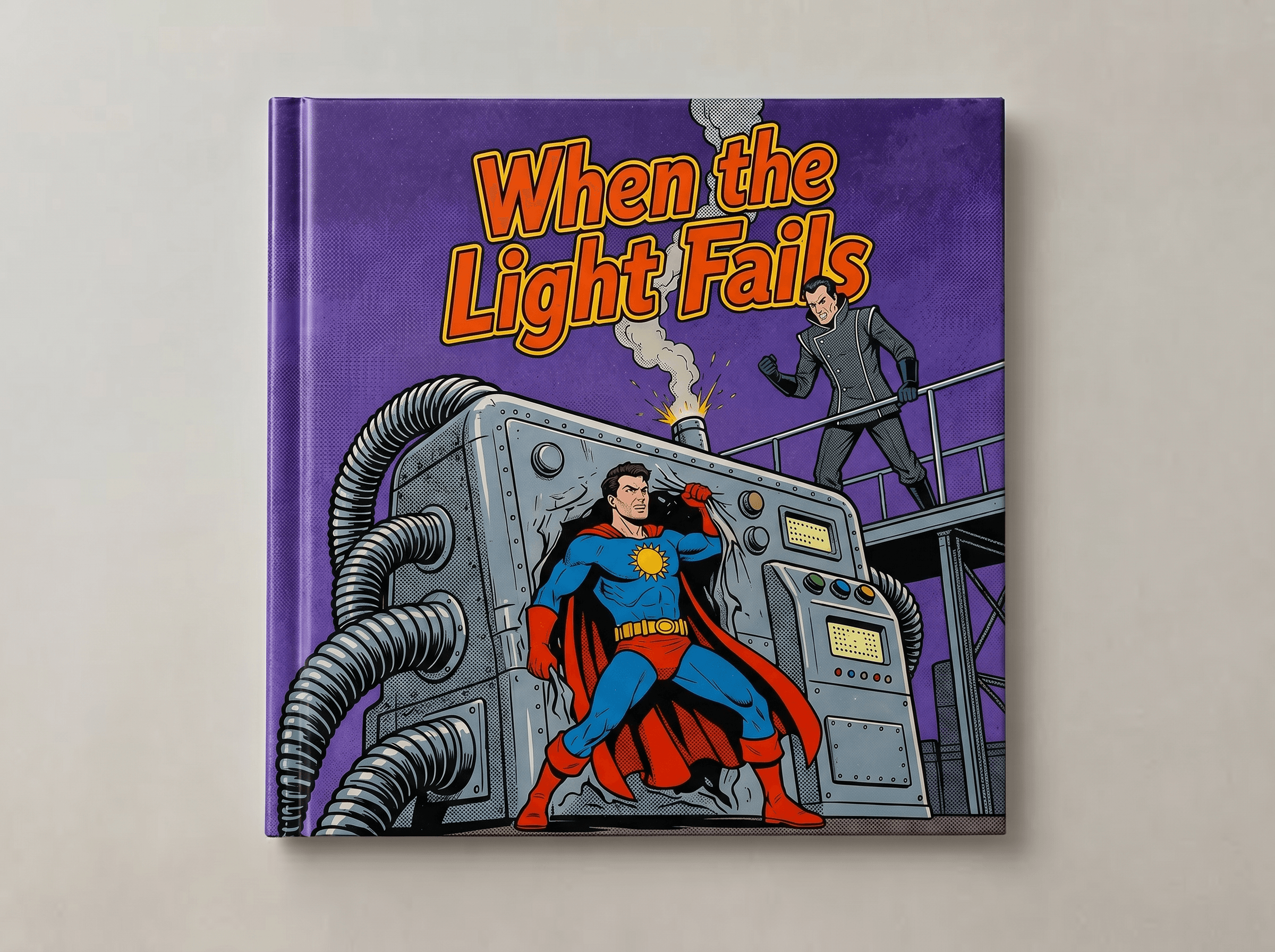
Comic book art has moved through roughly six major eras: the flat, bold Golden Age (1930s-1950s), the brighter, more polished Silver Age (1950s-1970s), the gritty, shadow-heavy Bronze and Modern Ages (1970s-2000s), the clean-lined European tradition that developed alongside it, manga's expressive black-and-white style, and now AI-generated comic art, which lets anyone choose from multiple historic and modern styles without needing to draw a single panel. Story Spark's personalized comic book tool lets you create a full illustrated comic in several of these styles, starring you or someone you love as the main character.
Why Comic Book Art Styles Matter More Than the Story
Ask a comic reader why they love a particular series and the answer is rarely just the plot. It's the way the artist draws motion, the color palette, the thickness of the linework, the shape of a hero's jaw. Comic book art style is not decoration layered on top of a story. It is a huge part of how the story gets told, since panels have to communicate pacing, emotion, and drama through images alone, often with far fewer words than a novel or short story would use.
That's also why art style matters just as much when you're creating your own comic book, not just reading one. A story about a grandparent's fishing trip told in a bold, primary-colored American superhero style reads completely differently from the same story told in a soft, clean-lined European style. The words might be identical. The feeling is not.
Understanding where these styles came from, and what makes each one distinct, helps you make a better creative decision whether you're a lifelong comic collector or you're building your first personalized comic book with an AI-assisted tool. This guide walks through the major eras and styles of comic book art, in roughly chronological order, and ends with a practical look at how AI-generated comic art fits into that history rather than standing apart from it.
It also helps to remember that these styles didn't emerge in a vacuum. Printing costs, censorship boards, cultural taste, and even the physical size of newsstand racks all pushed artists toward certain visual choices over others. A comic style is as much a product of its era's technology and constraints as it is a purely artistic decision, which is part of why each style still carries such a distinct emotional signature today, even decades after the constraints that shaped it have disappeared.
The Golden Age (Late 1930s to Early 1950s)
The Golden Age of comics began with the debut of Superman in Action Comics #1 in 1938 and ran through the early 1950s. Visually, Golden Age comics are defined by bold, flat colors (usually a primary palette of red, blue, and yellow), thick black outlines, simplified anatomy, and dynamic but often stiff poses. Printing technology at the time was limited, so artists worked within tight constraints: color separations were done by hand, paper stock was cheap and absorbent, and fine detail tended to blur on the page. Artists responded by drawing bold, simple shapes that held up under those printing limits.
This is the era that gave the medium its visual grammar: the widescreen "splash page" introducing a hero, speech balloons with hand-lettered text, and covers built around a single dramatic action shot rather than a complex scene. Characters like Superman, Batman, Captain America, and Wonder Woman were all born in this period, and their earliest depictions look markedly different from how they're drawn today: simpler faces, blockier muscles, and flatter shading.
If you're building a personalized comic today and want that nostalgic, classic superhero feel, a Golden Age-inspired style delivers instant recognition. It signals "hero story" almost immediately, even before a reader has processed the plot. Story Spark's comic book creator includes an American Classic style option built for exactly this kind of story, ideal for turning a grandparent, parent, or friend into a larger-than-life hero in the visual tradition that started the entire medium.
The Silver Age (Mid-1950s to Early 1970s)
By the mid-1950s, the comic book industry had been through a public backlash (fueled partly by Fredric Wertham's book "Seduction of the Innocent," which argued comics corrupted young readers) and the introduction of the Comics Code Authority, a self-censorship body that limited violent or morally ambiguous content. Visually, the Silver Age reflects that shift toward brighter, more optimistic storytelling.
Silver Age art is more polished than Golden Age work: line weights become more consistent, anatomy grows more proportionate and dynamic, and colors, while still bold, are applied with more nuance and gradient. This is the era of Jack Kirby and Steve Ditko at Marvel, defining the visual identity of Spider-Man, the Fantastic Four, and the Hulk, and of Curt Swan's clean, approachable art defining Superman at DC. Panel layouts became more experimental too, breaking away from strict grids into diagonal panels and dramatic close-ups that pulled a reader's eye across the page in a specific order.
For a personalized comic, a Silver Age-inspired style suits stories that want to feel classic but slightly more refined than the Golden Age look, punchier action, brighter palettes, and a bit more anatomical realism while keeping that unmistakable superhero comic energy.
The Bronze Age (Early 1970s to Mid-1980s)
The Bronze Age marks a turn toward darker, more socially conscious storytelling, tackling drug addiction, racism, and other real-world issues within superhero narratives. Visually, this shows up as moodier coloring, more detailed inking, and a general move away from the pure primary palette of earlier decades. Artists like Neal Adams brought a more realistic, almost cinematic sense of anatomy and lighting to mainstream superhero comics, using heavier shadow work and more dynamic, twisting poses.
This era bridges the gap between the brightness of the Silver Age and the grit that would define much of the 1980s and beyond, and it's a useful reference point if you want a comic style that feels dramatic and slightly weathered without going fully into noir territory.
The Modern Age and the Rise of Noir (Mid-1980s Onward)
The mid-1980s brought a wave of comics that fundamentally changed how dark, mature, and visually complex the medium could be. Frank Miller's "The Dark Knight Returns" and Alan Moore and Dave Gibbons' "Watchmen" (both 1986) pushed comic art toward heavy use of shadow, restrained color palettes, and a more literary, cinematic sense of panel composition. This period is often associated with what's now called noir style: high-contrast black and white or muted color work, dramatic use of negative space, rain-soaked city scenes, and characters drawn with harder, more angular features.
Noir comic art borrows heavily from film noir cinematography of the 1940s: low-angle shots, deep shadow, silhouettes, and a general sense of moral ambiguity conveyed visually rather than through dialogue alone. It's a style built for detective stories, crime narratives, and any comic that wants to feel tense and atmospheric rather than bright and heroic.
This is one of the style options available in Story Spark's personalized comic book creator, and it tends to suit stories with a mystery or detective theme, or simply a grandparent, partner, or friend who has a wry, no-nonsense personality that fits a hardboiled narrator.
The European Comic Tradition and Clear Line Style
While American comics were going through their Golden, Silver, and Bronze Ages, a parallel and distinct tradition developed across Europe, particularly in Belgium and France. The most influential style to emerge from this tradition is "ligne claire," or clear line, popularized by Belgian artist Hergé through his Tintin series starting in the late 1920s.
Clear line style uses uniform line weight throughout a panel (no thick-to-thin variation for depth or drama), flat, evenly applied colors without heavy shading or gradients, and a clean, almost architectural sense of composition. There's an intentional lack of visual noise: shadows are minimal, cross-hatching is rare, and everything in a panel is drawn with equal clarity, whether it's a character's face or a background building. This creates an accessible, almost storybook-like quality that reads as warm and approachable rather than intense or moody.
The clear line tradition extended well beyond Tintin, influencing artists across the Franco-Belgian "bande dessinée" tradition and shaping a huge portion of European comic art through the 20th century. It remains distinct from American superhero comics in both subject matter (often adventure, humor, and everyday life rather than superheroics) and visual approach (flat clarity rather than dramatic shadow and dynamic musculature).
For personalized comics, a European Clear Line style works beautifully for adventure stories, travel narratives, or gentler, more whimsical tales, particularly if the comic is meant for a wider age range or a reader who prefers a softer visual tone. Story Spark offers this as a dedicated style option, ideal for turning a real trip, a family adventure, or a lighthearted story into something that feels like a classic European graphic album.
It's worth noting that the clear line tradition has proven remarkably durable precisely because of its simplicity. Where American superhero art has cycled through many stylistic phases chasing realism, grit, and dynamism, clear line's flat clarity has aged gracefully, since it was never trying to look cinematic or hyper-detailed in the first place. That's part of why it remains such a popular choice for family-oriented personalized comics today.
Manga and the Global Influence of Japanese Comic Art
No history of comic book art is complete without manga, the Japanese comic tradition that has become one of the most commercially dominant and visually influential styles in the world. Modern manga's visual language largely traces back to Osamu Tezuka in the mid-20th century, whose work drew inspiration from early American animation (particularly the large, expressive eyes associated with Disney characters of the era) and combined it with cinematic paneling techniques borrowed from film.
Manga art is typically characterized by large, expressive eyes that convey emotion instantly, exaggerated reaction expressions (sweat drops, blush lines, comically simplified faces during comedic beats), dynamic speed lines to convey motion, and a strong reliance on black-and-white linework with screentone shading rather than full color, largely due to the weekly and monthly serialized printing schedules manga is traditionally produced under. Panel layouts in manga are often far more experimental than Western comics, breaking grids entirely to convey intensity, speed, or emotional impact.
Manga's influence has spread globally, shaping not just Japanese comics but Western comic art, animation, and even the visual language of many AI image generation tools, since manga-inspired art is one of the most widely referenced styles in visual training data. If you want a personalized comic with expressive, emotionally driven art and a distinctly different feel from Western superhero comics, a manga-inspired style is worth considering as your reference point when describing the tone you want.
Manga also popularized storytelling techniques that later spread well beyond Japan, including decompressed pacing (spending several panels or even pages on a single dramatic beat rather than rushing through it) and a much heavier reliance on visual metaphor over dialogue to convey a character's inner state. Those techniques now show up regularly in Western comics and even in prose fiction influenced by manga pacing, which is part of why manga's impact on comic storytelling runs deeper than its immediately recognizable visual style.
Underground and Alternative Comics
Running parallel to mainstream superhero and adventure comics, the underground comix movement of the late 1960s and 1970s (led by artists like Robert Crumb) rejected the polished, code-approved look of mainstream comics entirely. Underground comics favored deliberately rough, exaggerated, sometimes grotesque linework, dense cross-hatching, and unfiltered subject matter that mainstream publishers wouldn't touch.
This tradition continued into the alternative and indie comic scenes of the 1980s onward, producing a huge range of distinct personal styles rather than one unified visual language. Artists like Chris Ware brought meticulous, almost architectural precision to deeply personal, melancholic stories, while others leaned into loose, sketchy, intentionally imperfect linework. Alternative comics proved that comic art didn't need to follow any single visual formula to be effective, and that style could be as personal and varied as prose writing.
Digital Comic Art and the 2000s Shift
The 2000s and 2010s brought a major shift in how comic art gets made, as digital tools like Photoshop, Clip Studio Paint, and later fully digital-first webcomic platforms changed both the production process and the visual results. Digital coloring allowed for far more complex gradients, lighting effects, and texture work than traditional cel-based coloring ever could, and digital inking made revisions and experimentation dramatically cheaper.
This era also saw the explosive rise of webcomics, which didn't need to conform to print page counts or genre conventions, leading to an even wider diversity of visual styles than the print era had produced. By the late 2010s, comic art spanned everything from hyper-detailed digital painting to deliberately minimalist stick-figure webcomics, and readers had grown comfortable with an enormous range of visual approaches within a single medium.
AI-Generated Comic Art in 2026
Which brings the history up to now. AI-generated comic art represents the newest chapter in this timeline, not a replacement for it. Rather than introducing an entirely new visual language, AI comic tools like Story Spark's typically let creators choose from styles rooted in the eras and traditions described above: a bold American Classic look drawing on Golden and Silver Age conventions, a European Clear Line style drawing on the Franco-Belgian tradition, a shadow-heavy Noir style drawing on 1980s comic art and film noir, and a range of Modern and Fantasy styles that blend contemporary digital comic art conventions with more expressive, painterly rendering.
What's genuinely new is who gets to use these styles. Historically, producing a comic in any of these visual traditions required years of drawing practice, or the budget to commission a professional artist. AI-generated comic art removes that barrier. With Story Spark, you upload a photo of yourself or someone you want to feature, describe the storyline you want to tell, choose one of the available illustration styles, and the tool illustrates a full, consistent comic book around that character, panel by panel, in the visual tradition you selected.
This matters most for personal, one-off projects that would never have justified hiring a professional illustrator: a birthday comic where a grandfather becomes an American Classic-style superhero, a comic that turns a couple's first date into a European Clear Line adventure, or a Noir-style detective story starring a best friend as the world-weary lead. These are the kinds of comics that historically simply didn't get made, because the cost and skill barrier was too high for a single personalized book. AI-assisted creation collapses that barrier without collapsing the visual craft the different styles represent.
How Story Spark Turns These Art Styles Into a Real Printed Comic
Story Spark's personalized comic book tool is built around four simple steps: upload a photo, describe (or choose) a storyline, preview every page, and receive a printed hardcover. The tool currently offers several distinct illustration styles rooted in the traditions covered in this guide, including an American Classic style for a bold Golden and Silver Age superhero feel, a European Clear Line style for a warmer, adventure-driven look, a Noir style for detective and mystery stories, and Modern and Fantasy styles for a more contemporary, painterly comic feel.
Every comic is printed as a 21cm x 21cm hardcover, 24 pages long, with full-quality print throughout, and includes a dedication page, useful if the comic is being made as a gift. You can preview every single page before it goes to print, so nothing is finalized until you approve it, and orders are typically printed and dispatched within 5 working days.
Because the underlying tool is built on Story Spark's broader Storybook Creator and book creation platform, the same account also gives you access to longer-form illustrated storybooks and full prose books, useful if a story you start as a comic ends up wanting more room than 24 pages allow. You can compare formats and pricing on the Pricing page, and browse other comic examples on the personalized comic book landing page, including the American Classic, European Clear Line, Noir, and Modern Comics examples shown there.
Choosing the Right Comic Art Style for Your Story
If you're deciding which style fits your project, a few quick questions help narrow it down.
Is the story meant to feel triumphant and larger-than-life? American Classic style, rooted in Golden and Silver Age conventions, delivers instant "hero story" recognition through bold colors and dynamic poses.
Is the story an adventure, a trip, or something gentler and more whimsical? European Clear Line style, built on the ligne claire tradition, suits lighter, more accessible storytelling with flat colors and clean composition.
Is the story a mystery, a detective tale, or something with a bit of edge? Noir style, drawing on 1980s comic art and classic film noir, uses shadow and high contrast to build tension and atmosphere.
Do you want something that feels current and painterly rather than tied to a specific historic era? Modern and Fantasy styles blend contemporary digital comic conventions with more expressive rendering, ideal for stories that don't fit neatly into a retro category.
There's no wrong answer here. Many creators simply preview a page or two in a couple of different styles before committing, since Story Spark lets you see how your character and story look before finalizing anything.
Frequently Asked Questions
What are the main comic book art style eras? The major eras are the Golden Age (1930s-1950s), Silver Age (1950s-1970s), Bronze Age (1970s-1980s), and Modern Age (1980s onward), alongside parallel traditions like European clear line comics, Japanese manga, and, most recently, AI-generated comic art.
What is Golden Age comic book art style? Golden Age style refers to comics from the late 1930s through the early 1950s, characterized by flat, bold primary colors, thick outlines, simplified anatomy, and dynamic but relatively stiff poses, largely shaped by the printing limitations of the era.
What makes European clear line comic art different from American comics? Clear line style, popularized by Hergé's Tintin, uses uniform line weight, flat colors without heavy shading, and clean, uncluttered composition, creating a warmer, more accessible visual tone compared to the shadow and dynamic musculature typical of American superhero comics.
What is noir style in comic books? Noir comic art uses heavy shadow, high contrast, and restrained color palettes, drawing on 1940s film noir cinematography and popularized in comics through works like "The Dark Knight Returns" and "Watchmen" in the mid-1980s. It suits detective and mystery-driven stories.
Can I create a comic book in one of these styles without knowing how to draw? Yes. Story Spark's personalized comic book tool lets you upload a photo and describe your storyline, then illustrates a full comic in the style you choose, whether that's American Classic, European Clear Line, Noir, or a more Modern or Fantasy look, with no drawing skill required.
How is AI-generated comic art different from traditional comic art? AI-generated comic art typically draws on the same visual traditions described throughout comic history rather than inventing a new one. What's different is accessibility: creating a personalized comic in a specific style no longer requires years of drawing practice or hiring a professional illustrator.
Can I print a personalized comic book, or is it only digital? With Story Spark, every personalized comic is printed as a premium 21cm x 21cm hardcover, 24 pages long, and dispatched within 5 working days after you approve the final preview.
Start Your Own Comic in the Style That Fits Your Story
Comic book art has always been shaped by its constraints, printing technology in the Golden Age, censorship rules in the Silver Age, a hunger for grit in the Modern Age, and, now, a genuine democratization of who gets to produce comic art at all. The eras and traditions covered in this guide aren't just art history. They're a practical toolkit for deciding how your own story should look on the page.
Whether you want a bold American Classic hero story, a warm European Clear Line adventure, or a shadowy Noir mystery, create your personalized comic book with Story Spark and see your story illustrated in the style that fits it best, printed as a hardcover you can hold in your hands. For more on Story Spark's comic tool, read Personalized Comic Book: Turn Anyone Into a Hero on the Story Spark blog.
Related reading:
- The Personalized Comic Book
- Personalized Comic Books: Turn Anyone Into a Hero
- The Best AI Story Generator
- How To Choose The Best AI Story Generator For Your Child
- 9 Best AI Photo-to-Storybook Tools
Written by the Story Spark Team. Story Spark is an AI-powered platform for creating, illustrating, and printing your own books.