


To make a children's book your child will actually love, build it around what already fascinates them (not a generic "age-appropriate" theme), put your child inside the story as the main character, keep the pacing tight enough for one page-turn per idea, and choose illustrations and a physical format that hold up to nightly rereading. Personalized storybooks succeed where generic ones fail because children pay closer attention to stories where they recognize themselves, their names, their pets, and their own small worries and triumphs. Platforms like Story Spark let parents build this kind of book in minutes, using a child's name, photo, and interests to generate a fully illustrated, printed hardcover without any writing or design experience.
Why So Many Children's Books Miss the Mark
Most parents have a shelf of children's books that were bought with good intentions and read exactly once. The story was fine. The illustrations were fine. And yet the child never asked for it again, while a handful of well-worn favorites get requested every single night, sometimes word for word, sometimes with a running commentary from a child who has clearly memorized every page.
The difference usually isn't quality in the traditional sense. It's relevance. A book written for a general audience of five-year-olds has to appeal to every five-year-old, which means it can't speak directly to any particular one. It can't know that your child is scared of the vacuum cleaner, obsessed with dump trucks, or secretly worried about starting school next month. A story built for "kids in general" is, almost by definition, a story built for no one in particular.
Children, more than adults, respond to specificity. A three-year-old doesn't care that a book won an award. They care whether the dog in the story looks like their dog, whether the character has their name, and whether the plot touches something they're actually thinking about. Once you start treating "will my child love this" as a design problem rather than a shopping problem, the whole process of making a children's book looks different, and a lot more solvable.
Start With What Your Child Already Loves, Not What You Think They Should Read
The instinct when making a children's book is often to start with a lesson: sharing, bravery, kindness, trying new foods. Lessons matter, but they are not what hooks a child's attention on page one. What hooks attention is recognition. Children gravitate toward stories that reflect their current obsessions, whether that's dinosaurs, a specific cartoon character, garbage trucks, glitter, or the particular texture of a bedtime routine they go through every night.
Before you write a single line, it helps to make a short list of what your child is currently into. Not what they were into six months ago, and not what you wish they were into. What they are asking about, pointing at, and repeating right now. This list becomes your raw material. A story about a reluctant sleeper who is secretly a superhero at night works far better if that child already believes, on some level, that they have secret powers after dark.
This is also where a personalized approach pulls ahead of a bookshop shelf. A traditional publisher can't chase every child's current fixation with garbage trucks or glow-in-the-dark stickers, because they're printing thousands of identical copies for a broad market. A tool built for personalization can. On Story Spark's storybook creator, you describe the interests, characters, and setting you want, and the AI story generator builds a narrative and illustrations around them, so the dump truck obsession or the dinosaur phase becomes the actual plot rather than a passing mention.
Make Your Child the Actual Hero of the Story
If there is one single change that does more than anything else to make a children's book land, it's putting the child inside it as the main character, not a side character, not a dedication on the first page, but the protagonist whose name appears throughout and whose choices drive the plot.
Psychologists who study reading and memory have long noted what's sometimes called the self-reference effect: people process and recall information more deeply when it's connected to themselves. Children are no exception, and arguably show this even more strongly, since so much of early childhood is about figuring out who they are and where they fit in a story. A child who hears "Once upon a time, a brave girl named Priya climbed the tallest mountain in the kingdom" is having a fundamentally different experience than one hearing about "a brave girl" in the abstract.
This is the entire premise behind personalized storybooks, and it's worth taking seriously rather than treating it as a novelty. When your child's name is the one being read aloud, when the illustrated character has their hair color and their favorite jacket, and when the story's small victories are framed as their victories, the book stops being something that happens to be nearby at bedtime and becomes something they are inside of.
Story Spark's storybook creator is built around exactly this idea. You can upload a photo of your child (or a parent, sibling, pet, or even a favorite toy) and the platform's "Illustrate My Photo" feature turns it into an illustrated character that appears consistently across every page, in whatever art style you choose. Because the character creation tools support up to four figures in a single story, you can put your child alongside a sibling, a best friend, or a pet, which matters more than it sounds. Children often love stories more when the people they love are in them too, not just themselves.
If you're building the book as a gift rather than for your own child, the same logic applies. A personalized book for a niece, godchild, or grandchild reads as a genuinely different category of gift than a book bought off a shelf, and Story Spark's personalized gifts page has more on how families use this for birthdays, new siblings, and other milestones.
Get the Pacing and Reading Level Right
A story can have the perfect premise and still fail to hold a child's attention if the pacing is off. This is one of the most common mistakes in homemade or first-draft children's books: too much text per page, too many ideas introduced at once, or a plot that takes too long to reach something interesting.
Children's picture books work on a page-turn rhythm. Ideally, each spread introduces one idea, ends on a small hook, and gives the illustration room to do some of the storytelling so the words don't have to. For a board book aimed at toddlers, that might mean a single short sentence per page. For an early picture book aimed at four to seven-year-olds, it might mean two to four sentences, with the emotional or funny beat landing right before the page turn so the child (or the parent reading aloud) has a reason to keep going.
If you're building a longer, more structured story rather than working directly in a creation tool, it helps to storyboard it first, mapping out what happens on each page in one line before you write a single full sentence. Our guide on going from storyboard to finished picture book walks through this process in more detail, including how to plan page-turn moments so the pacing doesn't sag in the middle, which is where most home-written stories lose their audience.
When you're working with an AI-assisted platform like Story Spark, a lot of this pacing work is handled for you. Describe the story you want and the AI story generator will structure it into an appropriately paced sequence of pages, though it's still worth reading the draft back with your specific child in mind and trimming anything that runs long. You know their attention span better than any algorithm does.
Let Your Child Help Make It
Books that children help create tend to be loved more than books simply handed to them, for the same reason that a meal you helped cook tastes better than one someone else made. Even a small amount of input, choosing the character's costume, picking whether the dragon is friendly or fearsome, deciding what the pet's name should be, gives a child a sense of ownership that carries through every future reading.
This doesn't require your child to actually write anything. For younger children, it can be as simple as asking a handful of questions before you start: what should the hero be scared of, and what should the hero be really good at? What's the best treat in the whole world? Where does the story happen, a castle, a spaceship, their own backyard? Their answers become the seeds of the plot.
For older children who are already reading and writing, Story Spark's book creator allows for a more collaborative process, where a child (with a parent's help) can write their own text and use the platform's illustration tools to bring it to life, or start from a blank canvas and build the story from scratch. Either way, a book a child helped shape tends to outlast, in terms of how often it's requested, a book that was simply presented to them as a finished object.
Match the Illustrations to How Your Child Actually Sees the World
Illustration style matters more than it's usually given credit for. A book with beautiful but overly abstract or stylized art can leave younger children cold, not because the art is bad, but because it doesn't map cleanly onto the world they know. Meanwhile, a simpler style that clearly shows a recognizable child, a recognizable pet, and a recognizable bedroom can feel far more real to a three or four-year-old, even if the linework is less sophisticated.
This is part of why photo-to-illustration tools have become such a meaningful addition to personalized publishing. Rather than describing your child in words and hoping the resulting illustration looks close enough, you can upload an actual photo and have it transformed into an illustrated character in the book's chosen art style, whether that's soft watercolor, bold cartoon, or something in between. The character then stays consistent across every page, wearing the same outfit or the same missing-tooth grin the whole way through, which matters for continuity in a child's mind even if they can't articulate why.
If you're looking for more ideas on this specific technique, our post on how to turn your photos into a bedtime story covers practical tips on choosing which photos work best for illustration (clear lighting, a visible face, a favorite outfit) and how to combine several photos into a single consistent character across a book.
Add a Dedication and Turn the Book Into a Keepsake
A children's book that gets loved for years, not just weeks, usually has something in it that marks the moment it was made. A dedication page with a parent's message, the date, or the occasion (a first birthday, a new sibling, a first day of school) turns the book from a story into a small piece of family history. Children often flip to this page long before they can read the words on it, simply because they know it's where the "grown-up message" lives.
Story Spark's storybook creator includes a dedication area on every book, where you can add a personal message alongside a photo, which becomes especially meaningful for books given as gifts. A grandparent's handwriting-style message at the front of a personalized story tends to be one of the parts of the book that gets referenced years later, long after the plot itself has been read a hundred times.
Make It Rereadable: Comics, Search-and-Find, and Interactive Formats
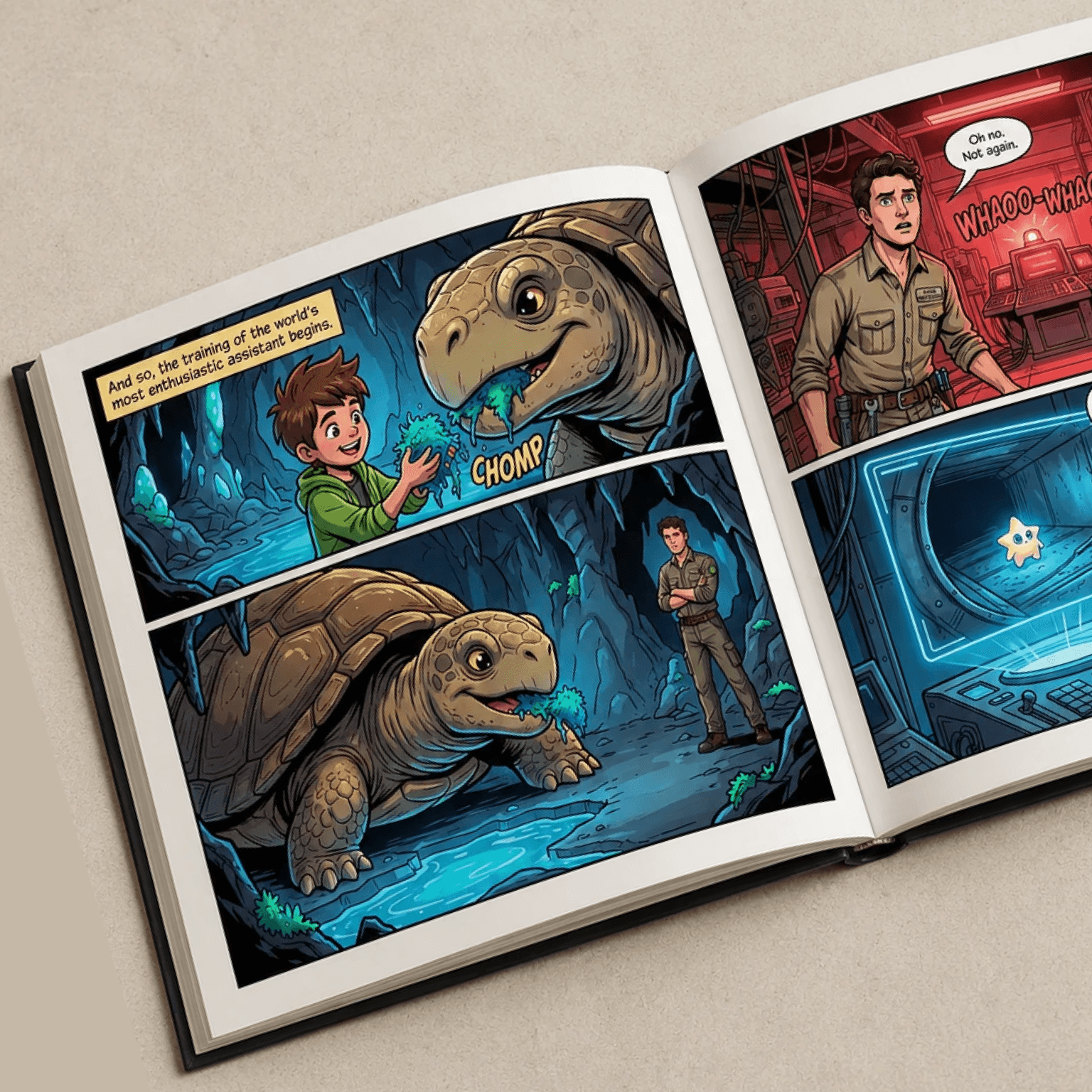
Not every child bonds most strongly with a traditional narrative picture book, and it's worth matching the format to your specific child's taste rather than assuming one style fits every kid in the house. Some children, especially slightly older ones, respond far more to comic-style storytelling, with panels, speech bubbles, and a faster visual pace. Story Spark's personalized comic book tool lets you build exactly this kind of story, with your child as the lead character navigating a comic-panel adventure rather than a traditional page-by-page narrative.
Other children, particularly those who love a challenge or enjoy poring over a single page for a long time, do best with a search-and-find style book, where they have to spot themselves hidden among a busy illustrated crowd. Story Spark's personalized search-and-find book turns your child (or the whole family) into the hidden characters across densely illustrated scenes, in either a classic edition or an around-the-world themed edition. Books like this tend to get reread constantly, not because the story changes, but because the game of finding yourself again never quite gets old for a young child.
The broader point is that "a book my child will love" doesn't have to mean a traditional picture book at all. If your child already gravitates toward comics, puzzles, or search-and-find games in other parts of their life, building their personalized book in that format rather than forcing it into a classic storybook shape will usually get you a much more enthusiastic reader.
Choose a Format and Materials That Survive Bedtime
A book that gets genuinely loved gets handled roughly. Pages get turned by small, sticky fingers, corners get chewed by younger siblings, and the same book might get pulled off the shelf every night for months. A flimsy paperback often can't survive that level of affection, which is part of why hardcover format matters more for children's books than it might for adult reading.
Story Spark's storybooks are printed as hardcovers with a matte finish and full-color print throughout, in a 21cm by 21cm format for storybooks (up to 60 pages) or a larger 16.5cm by 24cm format for longer books and novels (up to 200 pages), which holds up well to nightly use. Pricing starts from $29.99 for a 24-page storybook and scales up to $49.99 for a full 64-page book, with printing and delivery typically taking around five working days. Full details on formats, page counts, and pricing tiers are available on the pricing page, including the subscription plans that include AI credits for creating multiple books over time rather than paying per project.
If you're planning to make more than one personalized book (which is common once families realize how well the first one goes over), it's worth comparing the subscription plans rather than paying one-off, since a plan with a monthly AI credit allowance works out considerably cheaper across a birthday, a holiday, and a "just because" book later in the year.
Special Considerations: Neurodivergent Readers and Accessibility
Not every child engages with books the same way, and a book that's genuinely loved by a neurodivergent child sometimes needs a few adjustments that a standard picture book doesn't offer. This can include simplified text layouts, particular font choices that are easier to track for children with dyslexia, or a slower, more repetitive story structure that works better for a child on the autism spectrum who finds predictability comforting rather than boring.
Story Spark builds in accessibility and neurodivergent-friendly options directly into the creation tools, including text settings that have been optimized for children with autism, dyslexia, or ADHD, so families don't have to retrofit a generic book to fit their child's needs. Because the story, character, and pacing are all customizable from the ground up, it's possible to build a book around a specific routine (like the exact steps of a child's bedtime ritual) in a way that a mass-market book simply can't replicate. For families exploring how personalized books can support learning and development more broadly, our stories for education page covers how personalized narratives are being used in classrooms and at home to support reading confidence.
Step by Step: Making a Book Your Child Will Actually Love
Bringing all of this together, here's a practical order of operations for building a children's book that has a real shot at becoming a favorite rather than a one-time read:
First, spend a few days paying attention to what your child is currently obsessed with, rather than starting from a generic theme. Second, decide whether your child will respond best to a classic storybook, a comic-style adventure, or a search-and-find format, based on how they already play and what kinds of books or shows already hold their attention.
Third, gather two or three clear photos of your child (and any pets, siblings, or favorite toys you want included) so the illustrations feel like them specifically. Fourth, build the story on Story Spark's storybook creator, describing the plot, interests, and characters you want, or start from a blank canvas if you already have specific text in mind. Fifth, involve your child in a couple of small decisions during the process, like the costume, the setting, or the sidekick's name, so they feel ownership over the finished book. Sixth, add a short dedication with the occasion and the date, so the book becomes a keepsake as well as a story. Finally, order it as a hardcover so it can survive the repeated rereading that a genuinely loved book gets.
If you're a more experienced writer and want to take the process further, whether that's turning a personalized story into something you self-publish more broadly or exploring what it takes to get a children's book in front of a wider audience, our guides on self-publishing children's books and how to get a children's book published cover the next steps in detail. And if you'd like a broader roundup of what's working well right now in personalized publishing generally, our complete guide to the best personalized children's books is a useful companion piece to this one.
The Real Test Is the Second Read
The clearest sign that you've made a children's book your child actually loves isn't the first reaction, most children are polite enough, or excited enough about anything new, to seem pleased the first time through. The real test is whether they ask for it again the next night, and the night after that, and whether they start narrating along before you've finished the sentence. That kind of repeated, voluntary rereading is the actual bar, and it's a bar that generic, mass-market books often struggle to clear precisely because they weren't built for one specific child in the first place.
Personalization, thoughtful pacing, the right format, and a bit of your child's own input aren't decorative extras. They're the mechanism by which a book earns that second, third, and hundredth read. Once you've made one book that clears that bar, the process of making the next one, for a new obsession, a new sibling, or a new milestone, gets considerably easier, because you already know what your specific child responds to.
Frequently Asked Questions
What makes a children's book more likely to become a favorite? Books that put the child inside the story as the main character, reflect their current interests rather than generic themes, and use a pacing and format that suits their attention span tend to become favorites far more often than books chosen off a shelf for a general age range.
Do I need writing or illustration experience to make a personalized children's book? No. Platforms like Story Spark's storybook creator are built so parents with no design or writing background can describe a story and have it fully written and illustrated by AI, or upload their own text and have it illustrated for them.
Can I use a real photo of my child in the book? Yes. Story Spark's "Illustrate My Photo" feature converts an uploaded photo into an illustrated character in your chosen art style, and that character then appears consistently across the whole book.
What age range are personalized storybooks best suited for? Personalized storybooks work well from toddler age through early elementary years for traditional storybooks, while personalized comic books and search-and-find books tend to suit slightly older children, roughly six and up, who enjoy a faster pace or a hidden-picture challenge.
How long does it take to receive a printed personalized book? Printed hardcover books through Story Spark typically ship within five working days of finalizing the design, with delivery times depending on location. Full shipping details are available on the FAQ page.
Is it worth choosing a hardcover over a paperback for a children's book? For books you expect to be reread often, yes. Hardcover storybooks hold up significantly better to the repeated handling that a genuinely loved children's book gets, which is part of why Story Spark prints all of its personalized storybooks as matte-finish hardcovers.
Can personalized books help children with autism, dyslexia, or ADHD engage more with reading? Many families find that they do, particularly when the text settings and pacing are adjusted to suit the child. Story Spark includes accessibility and neurodivergent-friendly text options directly in its creation tools, so a book can be built around a specific child's needs from the start rather than adapted afterward.
Written by the Story Spark Team. Story Spark is an AI-powered platform for creating, illustrating, and printing your own books.