


Long before children can read a single word, they are already learning how to be good people from the stories read aloud to them. A gentle rabbit who shares its carrots. A brave mouse who stands up for a friend. A stubborn tortoise who learns that patience beats speed. These are not just charming plots. They are quiet lessons in empathy, honesty, courage, and kindness, delivered in a form young minds are wired to absorb: narrative.
Storytelling has shaped how humans pass down values for thousands of years, long before formal education existed. Today, storybooks remain one of the most powerful tools parents and educators have for shaping a child's moral compass. Yet not every storybook on the shelf is built with that purpose in mind, and many modern children's titles lean heavily on entertainment, fast pacing, or franchise characters, sometimes at the expense of any real lesson at all.
This is where Story Spark comes in. Story Spark is an AI powered platform that lets parents, grandparents, teachers, and gift givers create fully personalized, illustrated storybooks in minutes, with each story built around the child's name, interests, and the specific values a caregiver wants to reinforce. In this guide, we will explore why moral messages in storybooks matter so much for child development, what separates a genuinely effective moral storybook from a forgettable one, and exactly how Story Spark helps families turn everyday values into stories kids will want to hear again and again.
Why Moral Messages in Storybooks Matter So Much
Children do not learn values primarily through lectures. They learn through modeling, repetition, and emotional connection, and storybooks deliver all three at once. When a child watches a character face a moral dilemma, whether to share a toy, tell the truth, or help a struggling friend, they are rehearsing that same decision in a low-stakes, emotionally safe environment. Developmental psychologists have long noted that narrative is one of the earliest and most effective ways children build a framework for understanding right and wrong, because stories let them experience consequences vicariously, through a character, rather than only through their own mistakes.
There are a few reasons storybooks are uniquely suited to this job.
Stories create emotional investment. A child who cares about a character is far more likely to internalize that character's choices than a child being told a rule in the abstract. "Be kind" is an instruction. Watching a small, frightened character choose kindness anyway, and seeing how that choice changes the story, is an experience.
Repetition reinforces behavior. Children famously ask to hear the same storybook again and again. Each rereading is another rehearsal of the moral lesson embedded in the plot, which helps values move from something a child has heard once into something they actually understand and remember.
Stories model complexity, not just rules. Real moral situations are rarely simple, and good storybooks show characters wrestling with hard choices rather than being handed easy answers. This helps children build genuine judgment rather than rote compliance.
Stories build a shared vocabulary between parent and child. Once a family has read a storybook about honesty together, "remember what happened when the fox told a fib" becomes a shorthand parents can use in everyday moments, at the dinner table, in the car, at bedtime, long after the book itself has been put back on the shelf.
Storybooks also tend to reach children during some of the most formative years of moral development, roughly between ages two and eight, when a child's sense of fairness, empathy, and self-control is still taking shape. A story read during this window is not simply entertainment passing through a young mind; it is raw material a child uses to build their own internal sense of how people should treat one another. That is a significant amount of influence to leave to chance, which is exactly why so many parents are now looking for storybooks that are intentional about the values they carry, rather than treating the moral lesson as an afterthought.
Given how much weight storybooks carry in shaping character, it matters enormously what values those storybooks are actually teaching.
The Problem With Many Modern Storybooks
Not every book on a shelf earns its place as a moral teacher. A great deal of contemporary children's media is built primarily around entertainment value, bright visuals, fast jokes, merchandising tie-ins, rather than character development. That is not necessarily a bad thing on its own, but it does mean many families end up with a bookshelf that is long on fun and short on substance.
Worse, some storybooks unintentionally send mixed or even counterproductive messages. A story might present a character getting ahead through trickery without consequence, glamorize being the loudest or most aggressive character in the room, or resolve conflict through greed or one-upmanship rather than empathy or compromise. Children are highly perceptive, and they absorb what a story rewards, not just what it says out loud. If cleverness at someone else's expense is framed as heroic, that lesson lands, whether or not it was intended.
There is also a more practical problem: generic storybooks are, by definition, generic. A book written for a mass audience cannot speak directly to the specific challenges a particular child is facing, whether that is learning to share a new sibling's attention, building the confidence to try something new, or working through a recent instance of unkindness at school. A one-size-fits-all moral lesson often lands with far less impact than one tailored to a child's actual life.
This is the gap Story Spark was built to close.
What Makes a Storybook Genuinely Effective at Teaching Morals
Before looking at how Story Spark approaches this, it is worth defining what actually makes a moral storybook work, rather than just existing.
The lesson is woven into the plot, not bolted onto the ending. A moral message that only appears as a one-line summary on the final page rarely sticks. The most effective storybooks build the value into the character's choices and the consequences of the plot itself, so the child experiences the lesson rather than being told it.
The character is relatable. Children connect far more strongly with a character who shares their name, their interests, or their circumstances than with a generic protagonist. This is one of the most consistent findings in how children engage with narrative: the closer a story feels to a child's own life, the more attention and emotional investment it receives.
The tone matches the age and temperament of the child. A story about courage aimed at a cautious four-year-old needs a very different pace and stakes than one aimed at a confident seven-year-old. Effective moral storybooks are calibrated to the child reading them, not just to a broad age bracket.
The value is specific, not vague. "Be good" is not a lesson a child can act on. "Notice when a friend is left out, and invite them to play" is something a child can actually carry into the playground on Monday morning.
The story is genuinely enjoyable. A moral lesson wrapped in a boring story teaches children that lessons are boring. The best moral storybooks are, first and foremost, stories a child wants to hear again.
These principles are exactly what Story Spark builds into every personalized storybook it creates.
How Story Spark Builds Moral Messages Into Every Storybook
Story Spark's storybook creator allows any parent, grandparent, or educator to generate a fully illustrated, personalized storybook in minutes, without needing any writing or design experience. The process is built around three simple choices that determine both the story and its underlying values.
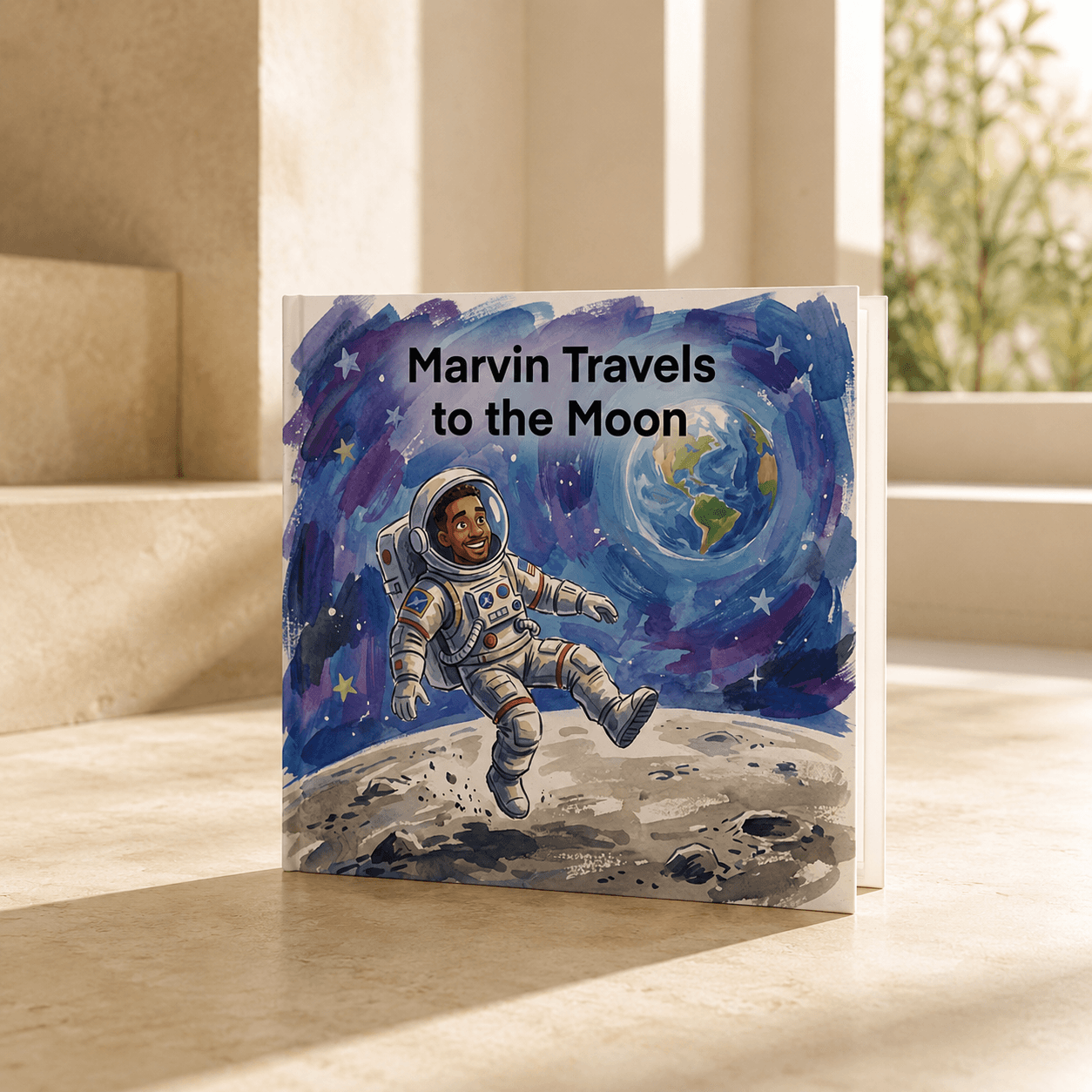
Choose the child's world. Parents start by naming the child (or children) at the center of the story, along with the setting, characters, and interests that matter to them, whether that is dinosaurs, space travel, a beloved pet, or a favorite everyday activity. Because the story is built around a real child rather than a generic protagonist, the moral lesson lands with far more personal weight.
Choose the moral theme. This is the heart of what makes Story Spark different from a book pulled off a shelf. Parents can select the specific value they want the story to reinforce, whether that is kindness, honesty, courage, patience, empathy, gratitude, perseverance, or teamwork, and the AI weaves that theme naturally into the plot, rather than pasting a moral onto the final page.
Choose the format and illustration style. Every story can be shaped into a full storybook, a full-length book, a personalized comic book, or even a search-and-find adventure, and illustrated in a style that suits the child, then printed as a premium hardcover keepsake and delivered to the family's door.
Because the entire story is generated around the specific child and the specific value a parent wants to reinforce, the lesson is not generic. A child who struggles with sharing gets a story about a character who struggles with sharing, in a setting the child already loves, with characters who reflect their own interests. That specificity is what separates a storybook a child reads once from one they ask for at bedtime for months.
Story Spark also includes "Spark," an in-editor AI writing assistant that helps refine the story's tone, pacing, and message once the first draft is generated, so parents who want more creative control can fine-tune exactly how a lesson is delivered.
Popular Moral Themes Parents Choose With Story Spark
While Story Spark can build a personalized storybook around almost any value a family wants to teach, a handful of themes come up again and again because they map so directly onto the everyday challenges of growing up.
Kindness and empathy. Stories that put a child's character in another character's shoes, literally experiencing a situation from someone else's perspective, are one of the most effective ways to build empathy at an early age. These storybooks often center on noticing when someone is struggling and choosing to help.
Honesty. A storybook exploring what happens after a small lie snowballs, and what it takes to make things right, gives children a low-stakes way to understand why honesty matters before they face that choice themselves.
Courage. Not the loud, sword-fighting kind of courage, but the quieter kind: trying something new, speaking up when something feels wrong, or facing a fear like the first day at a new school or sleeping in a new bed.
Patience and perseverance. Stories where a character wants to succeed instantly, but has to work through frustration and setbacks first, help children build resilience in a way that a lecture about "trying your best" rarely achieves.
Gratitude. A storybook where a character learns to notice and appreciate what they already have, rather than focusing on what they lack, is a gentle antidote to the constant messaging children receive about wanting more.
Teamwork and inclusion. Especially popular for classroom settings or sibling groups, these stories show a group of characters succeeding by combining different strengths, including a character who initially feels left out.
Parents do not need to be children's authors to choose the right theme. Story Spark simply asks what value matters most to a family right now, and builds the entire story, plot, characters, and setting, around bringing that value to life.
The Parent-Child Bonding Benefit
Beyond the moral content itself, there is a second, equally important benefit to creating a personalized storybook: the experience of making it together, and reading it together afterward.
When a parent sits down with a child to choose a story's characters, setting, and theme, that conversation is itself a values-focused moment. Asking a child "what do you think it means to be brave?" or "what would you do if a friend was left out?" before the story is even generated opens a dialogue that continues once the book arrives. Reading a personalized storybook together, one where the child recognizes their own name and interests on the page, tends to produce longer, more engaged reading sessions than a generic title, simply because the child feels genuinely present in the story.
This matters because moral development is not a solitary activity. Children build their understanding of right and wrong largely through conversation with the trusted adults around them, and a shared storybook gives parents a natural, low-pressure way to have those conversations without it feeling like a lecture. A bedtime story about courage becomes an opening to ask, gently, whether anything at school has felt scary lately. A story about kindness becomes a chance to talk about a moment when a sibling felt left out. The story does the emotional groundwork, and the follow-up conversation does the rest.
Using Moral Storybooks in Education and at Home
Moral storybooks are not only a bedtime tool. Story Spark's stories for education offering extends the same personalization to classroom and homeschool settings, blending academic subjects like maths, science, history, and languages with the same values-driven storytelling approach. Teachers can build a story around a specific classroom challenge, whether that is encouraging inclusion after a new student joins, reinforcing patience during a difficult unit, or celebrating teamwork after a group project, and use it as a discussion starter with the whole class.
At home, moral storybooks work well as part of an established routine rather than a one-off. Many families find the greatest impact comes from:
Reading the same personalized storybook multiple times over a few weeks, rather than moving straight on to the next book, so the lesson has time to sink in.
Pausing mid-story to ask what the child thinks a character should do next, before revealing what actually happens.
Connecting the story's lesson to a real moment afterward, such as noting when a child shows the same kindness the storybook's character did.
Letting the child help choose the next theme, which builds a sense of ownership over their own moral growth rather than it feeling imposed from outside.
How to Create Your Own Moral-Message Storybook With Story Spark
Getting started takes only a few minutes. Here is what the process looks like from start to finish.
Step one: start your story. Head to the create a book page and choose the type of book you want to make, whether that is a storybook, a full-length book, a personalized comic, or a search-and-find adventure.
Step two: personalize the world. Enter the child's name, choose up to four characters to feature, and select the setting and interests that will shape the plot, from outer space to a treehouse in the backyard.
Step three: choose the moral theme. Select the value you want the story to reinforce, whether that is kindness, honesty, courage, patience, or another theme entirely, and let the AI generate a first draft built around that lesson.
Step four: refine with Spark. Use Story Spark's in-editor AI assistant to adjust the tone, pacing, or specific wording of the story until it feels exactly right for your child.
Step five: choose illustrations. Pick from a range of illustration styles, or convert real photos into illustrated characters, so the book feels visually connected to your child as well.
Step six: preview and print. Review the full book in the editor before ordering, then have it printed as a premium hardcover and delivered to your door within about five working days.
The entire process is designed so that no writing, illustrating, or design experience is required. A parent who has never written a story before can still create one that feels thoughtful, specific, and genuinely their child's own.
Story Spark Pricing at a Glance
Story Spark offers a free plan for basic book creation and printing, alongside two paid subscription tiers for families who want deeper access to the AI storytelling tools. The Dreamer plan adds AI story generation, character creation, and branded downloads, while the Creator plan unlocks a higher monthly allowance, audio narration, and watermark-free assets. Printed storybooks start from $29.99, with volume discounts available for families or classrooms ordering five copies or more. Full, up to date pricing details are available on the pricing page.
Frequently Asked Questions
Why are moral messages in storybooks important for children? Moral messages in storybooks give children a safe, low-stakes way to experience the consequences of choices like honesty, kindness, and courage before they face similar situations themselves. Because children absorb values more effectively through narrative and emotional connection than through direct instruction, storybooks are one of the most reliable tools parents have for shaping character.
What age is best for introducing storybooks with moral lessons?
Most children can begin engaging with simple moral storybooks from around age two, when they start following basic plots and recognizing cause and effect. Story Spark's storybooks are designed to flex with a child's age and reading level, from short picture-book style stories for toddlers up to longer, more nuanced narratives for children up to around age ten.
How is a Story Spark storybook different from a book bought in a store?
A Story Spark storybook is built entirely around one specific child, using their name, interests, and chosen setting, and around the specific moral value a parent wants to reinforce. A store-bought storybook is written for a general audience and cannot be tailored to an individual child's circumstances or current challenges.
Can I choose the exact value or lesson my child's storybook teaches?
Yes. When creating a book with the storybook creator, parents select the specific theme they want woven into the story, such as kindness, honesty, courage, patience, gratitude, or teamwork, and the AI builds the plot around that value.
Do personalized moral storybooks actually help with behavior at home?
Many families use personalized storybooks as a conversation starter rather than a stand-alone fix. Reading a story about a specific value, then talking about it afterward and referencing it in everyday moments, tends to reinforce the lesson far more effectively than the story alone.
How long does it take to create a storybook with Story Spark?
Most parents can generate a complete first draft of a personalized storybook in a matter of minutes using the AI storybook creator, though refining the text and illustrations can take a little longer depending on how much customization is wanted.
Are Story Spark storybooks suitable for classrooms as well as home use?
Yes. Story Spark's stories for education tools let teachers build stories around classroom values like inclusion, patience, and teamwork, and classroom pricing is available for educators ordering multiple copies.
How much does a personalized moral storybook cost?
Printed storybooks start from $29.99, with subscription plans available for families who want ongoing access to the AI story generator, character creation tools, and audio narration. Full details are on the pricing page.
Can grandparents or other family members create a storybook too?
Yes. Story Spark is used just as often by grandparents, aunts, uncles, and family friends as it is by parents, particularly for birthdays, holidays, and other gifting occasions. Because the platform only needs a child's name, interests, and a chosen theme, anyone in a child's life can create a personalized, values-driven storybook without needing to know the child's daily routine in detail.
Ready to Turn Your Child's Values Into Their Favorite Story?
Every child is already forming their sense of right and wrong, one story, one conversation, one bedtime at a time. The only question is which stories are doing that shaping. A generic book pulled off a shelf might land a lesson by accident. A storybook built specifically around your child, their name, their world, and the exact value you want to nurture, is far more likely to land it on purpose, and to be asked for again and again until the lesson truly sticks.
Story Spark makes that kind of storybook possible in minutes, not months. Choose a theme, personalize the world, and let your child see themselves choosing kindness, courage, honesty, or patience on every page.
Start creating your child's personalized storybook today and give them a story that teaches the values you care about most.
Related Reading
What Parents Want in AI Storybooks in 2026
Best AI Story Generators of 2026
The Complete AI Book Generator Comparison 2026
The Best Storybook Creator Platforms: The Complete Guide
Written by the Story Spark Team. Story Spark is an AI-powered platform for creating, illustrating, and printing your own books.