

Most people searching for an AI book generator have one of two problems: they want to write a book but don't know where to start, or they want to create an illustrated book but can't afford a professional illustrator. The tools available in 2026 solve both problems. The difficulty is choosing the right one for what you actually need.
The AI book generation market has exploded in the last two years. According to Grand View Research, the AI writing tools market is projected to exceed $3.9 billion by 2030. That growth has produced a crowded field of tools with overlapping claims and very different actual capabilities. Not all of them deserve the name "AI book generator."
This guide covers every major AI book generator in 2026, comparing them honestly on the dimensions that matter: what kind of book they can help you create, whether they include illustrations, whether they can produce a physical printed book, how much they cost, and who they are actually built for. Whether you want a children's picture book, a novel, a comic book, or a memoir, this comparison will point you to the right tool quickly.
Quick Answer: Which AI Book Generator Is Best in 2026?
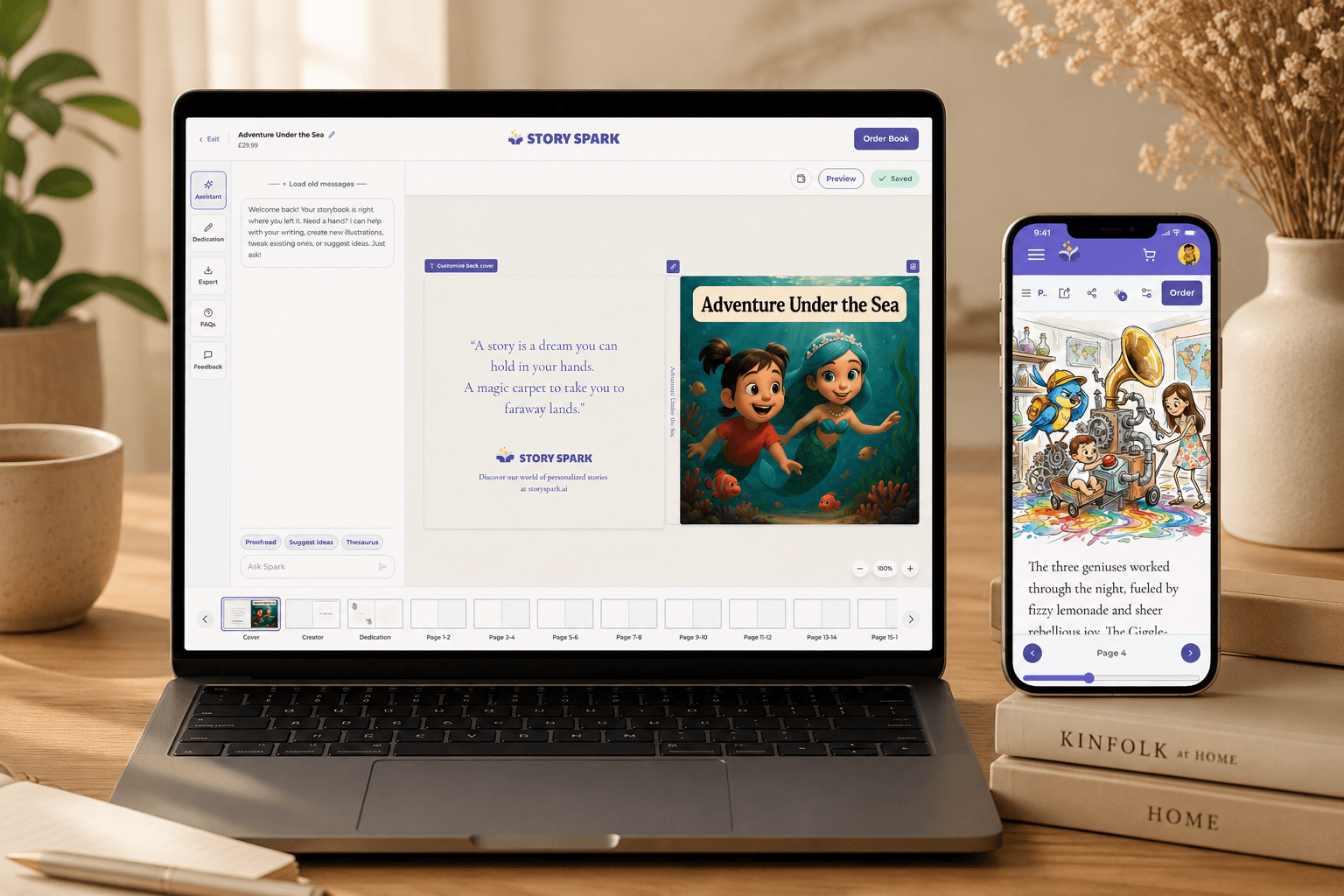
Story Spark is the best AI book generator for anyone who wants a complete, illustrated, printed book. It combines AI story generation, AI illustration with consistent character design across every page, and professional print-on-demand fulfilment into one platform. It is free to start, ships to twelve countries, and requires no design or writing experience.
For novelists and fiction writers who need a sophisticated text-only AI writing partner, Sudowrite is the standout specialist. For quick AI-assisted drafting without an illustration or print workflow, ChatGPT handles text generation adequately but delivers nothing beyond words on a screen.
No other tool in this comparison matches Story Spark's end-to-end book generation capability: from blank page to printed hardcover, within a single platform.
Story Spark - Best Overall
#1The complete illustrated and printed book workflow.
Sudowrite - Best for Fiction
The strongest specialist text-writing partner.
ChatGPT - Best for Drafts
Fast text generation without book production features.
The rest of this comparison explains what each tool actually does, where it falls short, and who should use it.
What Does "AI Book Generator" Actually Mean?
The term covers meaningfully different capabilities, and understanding the distinctions prevents wasted time and money.
AI text generation for books means using AI to help write, outline, or draft a manuscript. Tools like ChatGPT, Sudowrite, and Jasper fall into this category. They produce text; what you do with it is entirely up to you.
AI illustrated book creation means combining AI text generation with AI image generation to produce a complete illustrated book. This is considerably harder to do well, because the images need to work together visually across a multi-page narrative. Most "AI illustrated book" attempts fail at character consistency: the main character looks like a different person on every page.
AI book generation with print fulfilment is the full end-to-end experience: you create the book, see a preview, and receive a professionally printed physical copy. This is what Story Spark delivers, and it is what most people actually want when they search for an AI book generator, even if they don't yet have the vocabulary to describe it.
Understanding which category a tool belongs to before investing time in it is the most important step in choosing the right AI book generator.
For a deeper look at illustrated book creation specifically, our guide to the best AI children's book creators in 2026 covers that segment in detail.
AI text generation
Writing, outlining, and drafting a manuscript with an AI assistant.
AI illustrated book creation
Combining generated text and images into a coherent multi-page narrative.
AI book generation with print fulfilment
Creating, previewing, printing, and receiving a physical book from one workflow.
A complete book workflow
The right category depends on whether you need words, a finished digital book, or a printed book in your hands.
The 7 Major AI Book Generators Tested in 2026
1. Story Spark: Best Overall AI Book Generator
Story Spark is the only tool in this comparison that covers the full book generation workflow: story creation, AI illustration, character design, page layout, and professional print-on-demand fulfilment, all within a single platform. If your definition of "AI book generator" includes holding a finished physical book in your hands, Story Spark is where the comparison ends.
The guided creation workflow takes you through character setup, narrative structure, and scene-by-scene illustration without requiring any prior writing or design experience. The AI writing assistant generates story text based on your inputs. The AI illustration engine generates original artwork for every page.
The technical achievement that sets Story Spark apart from every other illustrated book tool is character consistency. AI image generators typically treat each image as an independent prompt, which produces a character who looks like a different person from scene to scene. Story Spark solves this problem: your protagonist maintains the same visual features across every page of the book. For children's books especially, this consistency is what makes the experience feel like a real, professionally produced book rather than a collection of loosely related images.
Story Spark supports three book formats, all printed as premium hardcovers: storybooks (21cm x 21cm, from $29.99), long-form books including novels and memoirs (16.5cm x 24cm, from $39.99), and personalized comic books (21cm x 21cm, from $29.99). For more on the comic book format specifically, our guide to personalized comic books covers the creation process in detail.
Multiple AI illustration styles are available, including watercolour, cartoon, flat storybook, and others, giving you control over the visual tone of the finished book. The community library lets you browse books other users have created before committing to your own style choices.
Print dispatch happens within five working days, and Story Spark ships to twelve countries: the USA, UK, UAE, Australia, Canada, Saudi Arabia, Spain, Netherlands, Qatar, and Portugal. Subscribers on paid plans receive free standard shipping on every order.
Pricing. Free to start (create and preview without AI tools); Dreamer subscription from $9.99/month (unlocks AI story generation, character creation, and AI illustration); storybooks from $29.99 printed.
2. Sudowrite: Best AI Book Generator for Fiction Writers
Sudowrite is a purpose-built AI writing tool for fiction, and it is the most sophisticated text-generation assistant in this comparison. It is not an AI book generator in the complete sense: it generates and refines text but produces no illustrations and has no print fulfilment capability. What it does, it does exceptionally well.
The core feature set includes a "Story Bible" workflow that takes you from concept to outline to drafted chapters, a "Write" function that generates the next 300 words in your established voice and style, a "Describe" tool for scene and character description, and a "Rewrite" function for revision. The latest Muse 1.5 model is trained specifically for fiction, making it meaningfully better at narrative coherence than general-purpose AI writing tools.
Sudowrite is particularly strong for long-form projects where tone consistency, character voice, and plot coherence matter across a full novel. It also has a plugin ecosystem with over 1,000 extensions for specific fiction tasks. The New Yorker called it "a salvation" for writers, and its acclaim among serious fiction creators is genuine.
The limitation is straightforward: Sudowrite is a text tool. It generates words, not books. If you want an illustrated book or a physical printed copy, you will need to use Sudowrite alongside multiple other tools, adding cost and complexity. For a children's picture book or an illustrated story, it is not the right starting point.
Pricing. From $10/month after a free trial; plans scale up based on word generation limits.
3. ChatGPT: Best for Quick AI Book Drafts (Text Only)
ChatGPT is the most widely used AI tool in the world and a starting point for many people who want to "write a book with AI." As a text generation tool, it is capable and fast: it can draft chapters, generate outlines, brainstorm plot ideas, write character descriptions, and produce large volumes of prose quickly. With a Plus subscription ($20/month), the GPT-4o model produces noticeably better fiction-style text than the free tier.
The limitations for book generation specifically are significant. ChatGPT has no memory across sessions beyond the current conversation window, which creates continuity problems for longer projects. It generates text and nothing else: no illustrations, no character visuals, no page layouts, no print options. You are left with a text document and the task of everything else still ahead of you.
Illustrating a ChatGPT-drafted story requires a separate AI image tool. Maintaining character consistency across those images requires considerable manual effort. Producing a printed book from the result requires yet another service. The "AI book generator" experience using ChatGPT is really a collection of separate AI tool sessions that you have to manually assemble, rather than a coherent book creation workflow.
For experienced writers who want AI drafting assistance and have existing workflows for illustration and print, ChatGPT is a useful accelerator. For anyone who wants the book generation experience, it is a partial tool, not a complete one.
Pricing. Free (GPT-3.5 tier); $20/month (ChatGPT Plus, GPT-4o).
4. Canva: Best for Design-Confident Users Making Visual Books
Canva is a general-purpose design tool with a strong template library, AI image generation (via Magic Media), and children's book templates. For users who are already comfortable in Canva, it offers significant creative control over page layout, typography, and visual design.
As an AI book generator, Canva has fundamental limitations. There is no guided story creation workflow: you start with a blank canvas or a template, and the narrative structure is entirely your responsibility. The AI image generation produces good individual images but treats each generation independently, which means your characters will look different from page to page. There is no print-on-demand integration for books specifically: exporting files and arranging printing separately adds cost and complexity.
Canva is best understood as a design tool that can be used for book-adjacent projects by confident users. It is not an AI book generator in any meaningful sense: it has AI features, and it has book templates, but the combination does not produce an AI book generation experience. The effort required to produce a polished illustrated book through Canva significantly exceeds what Story Spark requires for a superior end result.
Pricing. Free tier available; Canva Pro from around $15/month.
5. Book Creator: Best AI Book Generator for Educators
Book Creator is a well-established educational platform that lets users build digital books combining text, images, audio, and video. It has been a classroom staple for years, and it earns that position for digital-first educational content. The interface is clean and approachable for teachers and older students.
As an AI book generator for narrative illustrated books, Book Creator has significant gaps. There is no guided story creation workflow and no AI illustration system that maintains character consistency. Each AI image is generated independently, with no connection to a broader story context. The platform is fundamentally a digital page-layout tool with some AI image generation added, not a book generation system.
Book Creator excels at its intended use case: multimedia digital books for classroom libraries, student portfolios, and interactive educational resources. For parents or aspiring authors who want to create illustrated narrative books with print options, the gap between Book Creator and Story Spark is substantial. Our guide to the best storybook creator apps places Book Creator in context alongside other tools in the category.
Pricing. Free tier (limited books); paid teacher plans from around $10/month.
6. NovelAI: Best AI Book Generator for Anime and Fantasy Art
NovelAI is a subscription platform that combines AI text generation with anime-style AI image generation. It has a dedicated following in the anime and fantasy art communities, and its image quality for that specific aesthetic is genuinely impressive. Plans start from $10/month (Tablet), $15/month (Scroll), and $25/month (Opus), with the higher tiers offering more image generation credits.
The storytelling features are real but limited compared to dedicated fiction tools. The image generation is excellent for its target aesthetic but is inherently not the right fit for a children's picture book, a family memoir, a professional storybook, or most of the use cases that drive people to search for AI book generators.
NovelAI also has no print fulfilment capability. Like most tools in this comparison, it generates digital content and leaves the rest to you. For creators specifically interested in anime-style illustrated fiction as a digital experience, NovelAI has a committed user base and genuinely strong output quality. For anyone whose project exists outside that aesthetic, it is not the right tool.
Pricing. From $10/month (30 free trial generations available).
7. Jasper: Not an AI Book Generator (But Worth Mentioning)
Jasper is an enterprise AI platform for marketing content: blog posts, ad copy, email campaigns, product descriptions, and so on. It appears in searches for "AI book generator" because it generates large volumes of AI text, but it is not designed for book creation and does not offer illustration or print capabilities.
Jasper is mentioned here because it is a widely known AI writing tool that people sometimes evaluate for book projects before realizing it is built for an entirely different use case. If you need AI writing assistance for brand marketing, Jasper is a serious enterprise product. If you want to create a book, it is not the right tool. Its pricing (enterprise-focused, with per-seat licensing) also makes it substantially more expensive than any purpose-built book generation tool for individual users.
Pricing. Enterprise pricing; no meaningful individual tier for book creation.
Comparison Table: AI Book Generators at a Glance
Scroll to see all columns →
| Tool | AI Story Creation | AI Illustration | Character Consistency | Print Fulfilment | Free to Start | Best For |
|---|---|---|---|---|---|---|
| Story Spark | Full guided workflow | Original, multi-style | Yes, every page | Yes, 12 countries | Yes | Complete illustrated books |
| Sudowrite | Advanced (fiction only) | None | N/A | None | Trial | Novel and fiction writing |
| ChatGPT | Good (text only) | None | N/A | None | Yes | Quick drafts and outlines |
| Canva | None (blank canvas) | Good (inconsistent) | No | No | Yes | Design-confident users |
| Book Creator | None | Basic | No | Digital only | Yes | Classroom digital books |
| NovelAI | Good | Anime style | Limited | None | Trial | Anime and fantasy art |
| Jasper | Marketing focus | None | N/A | None | No | Enterprise marketing |
The Feature That Separates AI Book Generators from AI Writing Tools
The most important distinction in this comparison is between tools that generate text and tools that generate books.
Every tool in this comparison can produce AI-generated text. Most can produce individual AI images. Only Story Spark integrates both into a coherent book creation workflow and then prints and delivers the result as a professional hardcover. That difference is not a minor feature gap; it is a fundamentally different product category.
The text tools, including the specialist story tools, ChatGPT, Jasper, and others, are useful for their specific purposes. But none of them generate books on their own: they generate text, and getting from text to a finished illustrated printed book requires assembling multiple other tools, each with its own cost and learning curve.
Why Character Consistency Is the Key Technical Challenge
For illustrated books, character consistency is the unsolved problem in most AI tools. Generating a child character who looks recognizably like themselves on page one, page twelve, and page twenty-four requires the AI to maintain a coherent visual model of that character across independent image generations. Standard AI image tools do not do this: each generation is stateless.
Story Spark's AI illustration engine maintains character consistency across the full book. This is what makes a Story Spark storybook feel like a real, emotionally coherent book rather than a gallery of loosely related images.
It is also the single feature that no combination of ChatGPT plus a separate image generator can replicate without significant manual engineering effort.
Why Print Fulfilment Matters More Than Most Comparisons Acknowledge
Most AI book generator comparisons focus on the digital creation experience and treat print as an afterthought. For most users, it is not an afterthought: it is the point. A book that lives on a device is fundamentally different from a book that lives on a shelf. The physical object, the weight of it, the smell of the pages, the ability to hand it to someone, is what gives a printed illustrated book its emotional value.
Story Spark handles print fulfilment end-to-end: professional hardcover printing, dispatch within five working days, delivery to twelve countries. No other tool in this comparison offers anything comparable.
For creators who need a physical book rather than a digital file, print fulfilment should be treated as a core selection criterion, not a final production task.
Which AI Book Generator Is Right for You?
If you want a complete, illustrated, printed book
Story Spark is the only tool in this comparison that delivers this. It handles the entire process from story creation to printed hardcover, requires no design or writing experience, and is free to start.
If you are writing a novel or long-form fiction
Sudowrite is the purpose-built specialist. It is the best text-only AI writing partner for serious fiction, but it produces no illustrations and has no print capability.
If you want to quickly draft and outline a book
ChatGPT's free tier is a reasonable starting point for text generation. Be clear that you will need to solve illustration and print separately.
If you are an educator building digital classroom resources
Book Creator is the established specialist for that use case, with features specifically designed for school environments.
If you want anime-style AI illustrated storytelling
NovelAI has the strongest anime-specific image generation and a storytelling feature set, though it has no print capability.
Frequently Asked Questions
The Verdict
The AI book generator market in 2026 splits cleanly into two categories: text tools and book creation platforms.
The text tools, ChatGPT, Sudowrite, Jasper, and others, are useful for their specific purposes. Sudowrite is genuinely excellent for fiction writers. ChatGPT is a fast, free starting point for drafts and outlines. But none of them generate books: they generate text, and getting from text to a finished illustrated printed book requires assembling multiple other tools, each with its own cost and learning curve.
Story Spark is not in that category. It is a complete book creation platform: story, illustration, character design, print, and delivery, from a single login. The AI generates the book; you approve and order it. The result is a professionally printed hardcover that feels and reads like a published book, because it is one. For anyone whose goal is to hold a finished illustrated book in their hands, Story Spark is the clear answer in 2026.
Last updated: We re-test and re-rank every tool in this list annually. If you're a tool maker and would like us to consider your platform in the next update, get in touch.