



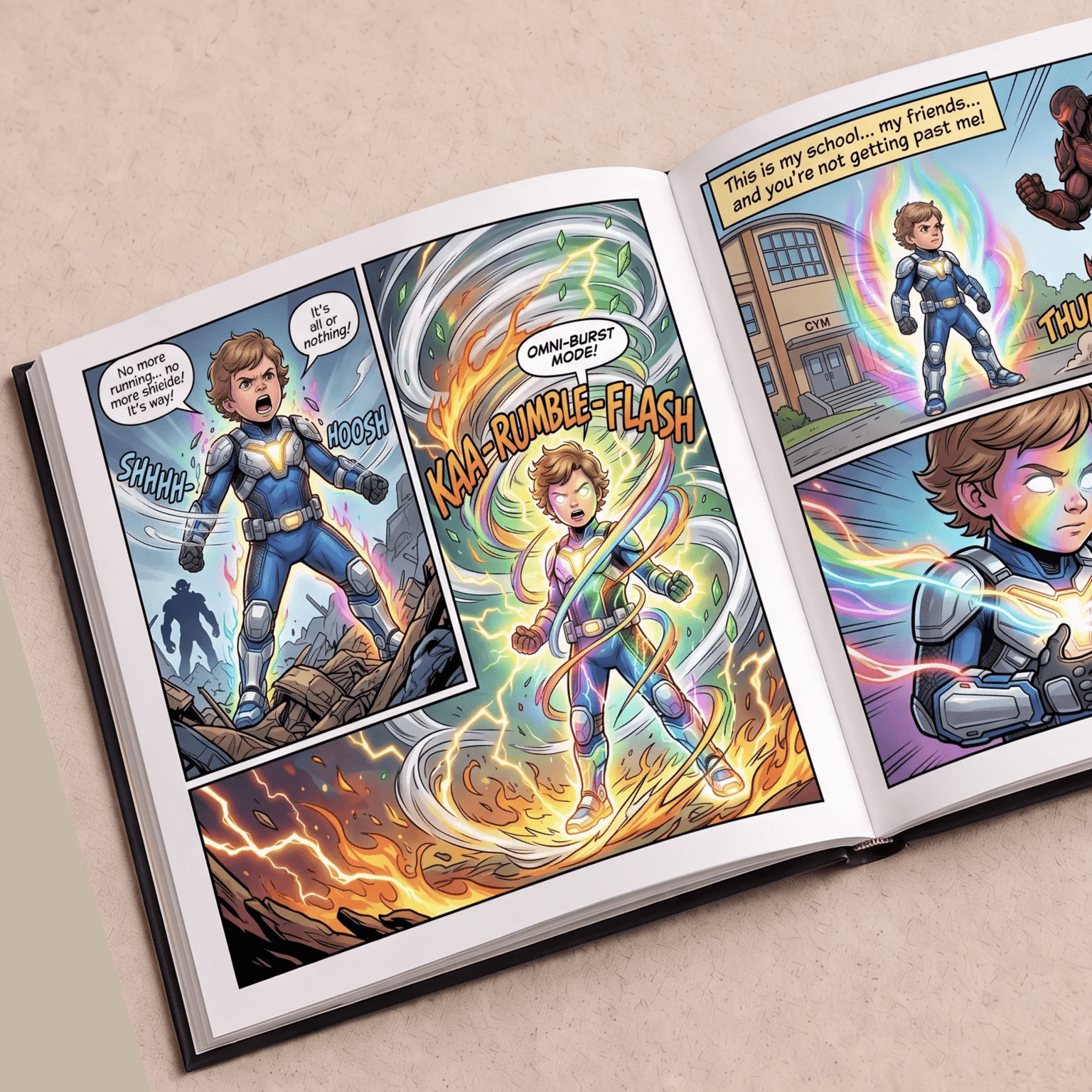
Storytelling helps parents work through common challenges, bedtime resistance, picky eating, separation anxiety, tantrums, and sibling rivalry, by giving children a safe, imaginative distance from a problem so they can process emotions, rehearse solutions, and build confidence without feeling lectured. Research on bibliotherapy and narrative transportation shows that children absorb lessons more readily through a character's journey than through direct instruction. Personalized storybook platforms like Story Spark make this technique easy to use at home, letting parents turn their own child into the hero of a story built around whatever challenge they are facing, in minutes.
If you are a parent, you already know the scene. It is 8 p.m., your child is convinced there is something under the bed, and every rational explanation you offer bounces right off. Or it is dinnertime, and the plate of vegetables might as well be a plate of gravel for how willing your toddler is to touch it. Parenting is full of these small, repeated battles, and most of us have tried the usual playbook: reasoning, bargaining, bribery, the occasional raised voice we regret five minutes later.
There is another tool that quietly works better than most of these, and it has been working for thousands of years: story.
Below, we will walk through why storytelling is such an effective parenting tool, the psychology behind why it works, and how to use it for the specific challenges that come up most often, from bedtime fears to picky eating to big, overwhelming emotions. We will also show you how a modern twist on this ancient practice, personalized AI storybooks, can make the technique dramatically easier to put into practice tonight.
Why Storytelling Works Better Than Lecturing
Children do not process the world the way adults do. A five-year-old who is afraid of the dark is not being irrational; their brain is still developing the ability to separate imagination from reality, and a direct instruction like "there is nothing to be scared of" does not address the feeling at all. It only tells them their feeling is wrong.
Stories work differently. When a child hears about a character facing a similar fear, something called narrative transportation happens: the child mentally steps into the story, experiences the character's fear alongside them, and then experiences the character's resolution too. Psychologists have studied this effect for decades under the umbrella of bibliotherapy, the use of stories to help people process and work through emotional difficulties. It is used by therapists, teachers, and increasingly, by parents at home.
A few reasons storytelling succeeds where direct instruction often fails:
It creates emotional distance. A story about "a brave little bunny who is afraid of the dark" lets a child engage with their own fear without the vulnerability of talking about themselves directly. That distance makes the topic safer to explore.
It shows rather than tells. Instead of being told to be brave, a child watches a character be brave, and models the behavior afterward. Children learn enormous amounts through imitation, and a well-told story gives them a template to imitate.
It is engaging, not corrective. A story invites curiosity. A lecture invites defensiveness. Children who feel like they are being told off tend to shut down; children who are absorbed in a story tend to stay open and receptive to the message inside it.
It builds a shared language. Once a family has a story about "the brave little bunny," that character becomes shorthand you can return to. "Remember how the bunny felt when the room got dark? What did the bunny do?" This turns a one-time story into an ongoing coping tool.
The Most Common Parenting Challenges Storytelling Can Help With
Let us get practical. Below are the challenges parents ask about most, along with how a story can be shaped to address each one.
Bedtime Fears and Anxiety
Fear of the dark, monsters under the bed, and general nighttime anxiety are some of the most universal childhood experiences. A calming story, read consistently at the same time each night, does two things at once: it signals to the body that sleep is coming (what sleep researchers call a conditioned response), and it gives the child a character to model their own courage on.
A simple structure works well here: a character who shares your child's fear, a small, believable moment of courage (not a magical fix, a believable one), and a peaceful resolution that ends on calm, sleepy language. Story Spark's guide, The Definitive Parent's Handbook for Bedtime Stories, goes deeper into building a bedtime routine around storytelling, including how long a story should be and how to choose tone and pacing for different ages.
Picky Eating
Picky eating is rarely about the food itself. It is often about control, novelty aversion, or sensory sensitivity, and pushing harder at the dinner table usually backfires. A story that reframes a new food as an adventure, say, a character who discovers a magical garden and befriends a shy vegetable who just wants to be tried, can lower a child's guard in a way that no amount of "just one bite" ever will.
The goal is not to trick a child into eating broccoli through a story. It is to reduce the anxiety and power struggle around trying new things, so the child approaches the next meal a little more curious and a little less defensive.
Separation Anxiety and Big Transitions
Starting nursery or school, a parent going back to work, moving to a new house: these transitions are enormous from a child's point of view, even when they seem small to adults. A story where a character goes through the same transition, feels nervous, and comes out the other side having made a friend or discovered something good, gives a child a mental rehearsal of the experience before it happens. This is one of the reasons early reading habits matter so much; Story Spark's article on when parents should start reading to their children covers how early exposure to stories builds the emotional vocabulary children will lean on during these transitions later.
Tantrums and Big Emotions
Young children have big feelings and small vocabularies to describe them, which is a recipe for meltdowns. Stories that name emotions clearly, "Leo felt a hot, fizzy anger bubbling up in his chest", give children words for sensations they have felt but never been able to describe. Over time, a child who has heard several stories that name and work through anger, frustration, or jealousy starts borrowing that language themselves, which is often the first step toward self-regulation.
Sibling Rivalry
Few things test a household's patience like sibling conflict. A story featuring two characters who compete for attention, argue, and eventually find their way back to teamwork, can plant the idea that conflict is normal and repairable without a parent needing to referee every single squabble in real time. Bonus: personalized stories that feature both siblings as characters, working through a conflict together, tend to land far better than a generic book pulled off a shelf, because the children see themselves in it directly.
Building Empathy and Confidence
Beyond specific behavioral challenges, storytelling is one of the most reliable ways to build empathy and self-esteem more broadly. Hearing about characters different from themselves helps children understand other perspectives, and seeing a character who looks and sounds like them succeed at something difficult is a powerful, direct boost to confidence. This is part of why Story Spark's approach to storytelling in education treats narrative as a genuine teaching tool, not just entertainment, and why schools increasingly use character-driven stories to teach both academic and social-emotional skills side by side.
What the Research Says About Storytelling and Child Development
The developmental case for storytelling is well established. Reading aloud supports vocabulary growth, listening comprehension, and attention span. The American Academy of Pediatrics has long recommended reading aloud to children from infancy, not only for literacy but for the bonding and emotional regulation benefits it provides. Beyond straightforward reading, therapists and educators use bibliotherapy specifically because narrative engagement activates empathy and perspective-taking in ways that direct advice does not.
What is newer is the ability for any parent, without training in child psychology or a library of specialized therapeutic books, to create a story tailored to their exact child and their exact challenge, in the time it takes to make a cup of tea. That is the gap Story Spark was built to close.
How Story Spark Turns This Into a Practical Parenting Tool
Story Spark is a platform that helps you turn an idea into a finished, illustrated storybook, written and illustrated with AI assistance, then printed as a premium hardcover if you want a physical keepsake. For parenting challenges specifically, the process looks like this:
- Describe the challenge. Tell the Storybook Creator what your child is struggling with: fear of the dark, starting school, sharing with a sibling, whatever it is.
- Add your child's details. Their name, age, and even their likeness can be woven into the story, so your child is not just reading about "a" brave bunny, they are the hero of their own book.
- Choose length and tone. A short, calming bedtime story reads very differently from a longer, more adventurous story for daytime reading, and the tool adjusts accordingly.
- Generate and review. Within a couple of minutes you have a full story with illustrations, which you can read on screen immediately or edit before finalizing.
- Print it, if you want to keep it. Because these stories often become tools you return to again and again ("remember what happened when the bunny felt scared?"), many parents choose to print theirs as a hardcover storybook so it becomes a permanent part of the bedtime shelf.
This is meaningfully different from picking a generic storybook off a shelf. A generic book about a nervous bunny is fine, but a personalized storybook where your own child is the character facing the exact situation they are dealing with this week tends to land with far more impact, because there is no translation required. The child does not have to imagine themselves into someone else's story; they are already in it.
Tips for Using Storytelling With Your Child, Starting Tonight
You do not need a printed, illustrated book to start using this technique, though it helps. A few practical tips:
Keep the challenge close to real life, but not identical. A character who is "a little bit like" your child, rather than a direct copy of last night's meltdown, gives enough distance for the story to feel safe rather than like a callback to trouble.
Let the character struggle before they succeed. A story where everything is easy teaches nothing. A story where the character feels the same fear or frustration your child feels, and works through it believably, is the one that actually helps.
Reuse your characters. A single story is a nice moment. A recurring character your family returns to becomes a genuine coping tool, one you can reference in the moment ("what would the brave bunny do right now?").
Read at a calm, predictable time. Especially for bedtime and anxiety-related stories, consistency matters as much as content. The routine itself is doing part of the work.
Involve your child in the story, when appropriate. Asking "what do you think happens next?" partway through a story turns a passive listening experience into an active problem-solving one, which builds the skill you are ultimately trying to teach.
A Worked Example: Turning a Real Struggle Into a Story
It can help to see the process laid out step by step, rather than in the abstract. Say your five-year-old, Maya, has started refusing to sleep with the light off after watching a movie with a spooky scene in it. Here is how a parent might build a story around that exact problem.
Step 1: Name the real feeling, but move it into a character. Instead of a story about Maya, the story features Pip, a small fox who has just discovered that nighttime shadows can look like scary shapes. This is close enough to Maya's experience that she recognizes it instantly, but distant enough that she does not feel singled out or embarrassed.
Step 2: Let the character feel the fear fully. Pip's heart beats fast, Pip pulls the blanket up high, Pip is not laughed at or told to "just be brave." The story takes the fear seriously, the same way you would want a friend to take your own fear seriously.
Step 3: Introduce a small, believable tool. Maybe Pip's older sibling teaches Pip to look closely at the shadow until it turns back into a coat on a chair, or Pip learns to whisper "just a shadow" three times as a kind of calming ritual. The tool should be something a real child could actually use, not a magic spell that solves everything instantly.
Step 4: End on calm, not excitement. The story closes with Pip settling back into bed, breathing slowly, and falling asleep, mirroring the state you want Maya to be in a few minutes later.
Step 5: Reuse the character. The next time Maya hesitates at bedtime, a parent can simply ask, "What did Pip do when the shadows looked scary?" The story has become a reusable coping tool rather than a one-off read.
This is exactly the kind of story you can build in a few minutes using Story Spark's Storybook Creator: describe the challenge (fear of shadows at night), add the child's details, and let the platform generate a story with this same shape, tailored to your own child instead of a generic character.
The Role of Representation and Familiarity
One detail that gets overlooked in generic advice about "just read more stories" is how much representation matters. A child is far more likely to absorb a story's lesson when the character looks like them, shares their name, or reflects their family situation, whether that is having two mums, being adopted, using a wheelchair, or simply sharing the same favorite color. Off-the-shelf books cannot account for every family's specifics, which is part of why personalization has become such a meaningful upgrade rather than a novelty. When a child sees themselves clearly in the hero of the story, the emotional lesson is no longer abstract; it is happening to "them," which is precisely the mechanism that makes bibliotherapy effective in clinical settings, and the same mechanism Story Spark applies at home.
When to Use a Story, and When to Get Extra Support
Storytelling is a genuinely powerful tool, but it works best for everyday challenges: normal childhood fears, ordinary sibling friction, the usual resistance to bedtime or vegetables. If a child is showing signs of persistent anxiety, ongoing behavioral difficulty, or distress that does not ease with time and reassurance, a story is a helpful supplement, not a replacement for speaking with a pediatrician, teacher, or child psychologist. Storytelling works alongside good parenting, professional support, and time; it is not a substitute for any of them.
For children who experience specific learning differences, Story Spark's guide on reading and ADHD is worth a look too, since attention and focus challenges change how a bedtime or learning story should be paced and structured.
Storytelling as a Learning Tool, Not Just a Bedtime Ritual
While much of this article focuses on emotional and behavioral challenges, it is worth noting that storytelling is just as effective for academic and educational struggles. A child who is anxious about starting to read, struggling with a new math concept, or needs encouragement in a specific subject can benefit from the same narrative approach: a character who shares the struggle, works through it in an engaging way, and comes out the other side more confident. Story Spark's educational storybooks apply this exact technique to subjects like math, science, and language learning, wrapping the lesson inside a story your child actually wants to keep reading.
Personalized storybooks also make excellent, meaningful gifts for milestones that double as emotional transitions, a new sibling arriving, moving to a new home, starting school, since the story can be built specifically around the change the child is about to go through.
Frequently Asked Questions
Does storytelling actually change a child's behavior, or is it just entertainment?
Both. A story is genuinely entertaining, which is part of why it works, but it also gives children a template for handling emotions and situations they have not yet mastered in real life. The behavioral impact tends to build with repetition rather than appearing after a single read.
What age is storytelling most effective for behavioral challenges?
Most parents see the strongest results between ages two and eight, when children are old enough to follow a simple narrative but still developing the ability to regulate emotions and separate imagination from reality. That said, older children benefit too, especially from stories that tackle more nuanced challenges like friendship conflict or self-confidence.
How long should a bedtime story be to help with nighttime fears?
Shorter is usually better for anxiety and bedtime specifically, often five to ten minutes, ending on calm, resolved language rather than an exciting cliffhanger. Story Spark's bedtime story guide has age-by-age recommendations on length and pacing.
Can a personalized storybook actually feature my child as the main character?
Yes. Platforms like Story Spark let you enter your child's name, age, and other details so the story is built around them directly, rather than a generic character your child has to imagine themselves into.
Is storytelling a replacement for professional help with anxiety or behavioral issues?
No. Storytelling is a genuinely useful supplement for everyday challenges, but it is not a substitute for professional guidance when a child is dealing with persistent or severe anxiety, behavioral difficulty, or emotional distress. If you are concerned, speak with your pediatrician or a child psychologist.
How is a personalized storybook different from a regular children's book?
A regular storybook can absolutely still help, but a personalized one removes the extra step of a child having to imagine themselves into someone else's story. When the character shares their name, age, and situation, the lesson tends to land faster and stick longer.
Do I need any writing or design skill to make a personalized storybook?
No. Story Spark's Storybook Creator is built for parents with no writing or illustration background. You describe the challenge and the child, and the tool handles the writing and illustration.
How much does it cost to create a storybook with Story Spark?
Story Spark offers a free tier for writing and editing your own content, with paid plans for AI-generated stories and illustrations. Full details are on the pricing page, and printed hardcover storybooks start at $29.99 for a 24 page book.
Can storytelling help with more than one challenge at a time?
Yes, though it usually works best when each story focuses on one challenge at a time so the message stays clear. A family might build a small library of stories over time, one for bedtime fears, one for sharing with a sibling, one for starting school, rather than trying to solve everything in a single book.
The Takeaway
Parenting challenges rarely get solved in one conversation, and they almost never get solved through lecturing. What actually tends to work is patience, repetition, and giving your child a way to process what they are feeling that does not put them on the defensive. Storytelling has been doing that job for families for generations, and tools like Story Spark simply make it easier to put a story to work on the exact challenge you are facing tonight, with your own child as the hero.
If bedtime, mealtimes, or the next big transition are wearing you down, it might be worth trying a story built specifically for your child before you try anything else. You can start with Story Spark's Storybook Creator, browse the wider Learning Centre for more parenting and storytelling guidance, or check the FAQ if you have questions about how the process works. And if you want to know more about why Story Spark exists in the first place, our About Us page shares the mission behind it: helping every family tell their own story.
Related Reading
How to Publish Your Book and Become an Author
AI Book Publishing: The Complete Guide
Best AI Story Generators of 2026
The Complete AI Book Generator Comparison 2026
The Best Storybook Creator Platforms: The Complete Guide
Written by the Story Spark Team. Story Spark is an AI-powered platform for creating, illustrating, and printing your own books.