


Writing a novel with AI without losing your voice means using AI as an assistant, not an author. You decide the story, the characters, the themes and the way every sentence sounds, and you use AI for the jobs that slow you down: brainstorming, outlining, tracking continuity, unblocking a stuck scene and catching errors. The finished book should read as though only you could have written it, because in every way that matters, you did.
That balance is harder than it sounds. AI writing tools are trained to produce the most likely next word, which pulls prose toward the familiar, the safe and the generic. Left unchecked, a novel drafted with AI can drift into the same smooth, polite, slightly hollow voice as millions of other AI-assisted books. This guide shows you how to avoid that. You will learn a practical, step-by-step method for writing a novel with AI, the specific techniques that protect your voice, the warning signs that it is slipping, and how to take your finished manuscript all the way to a printed hardcover with Story Spark's Book Creator.
Quick Answers: Writing a Novel With AI
Can you write a novel with AI and keep your own voice? Yes. Keep ownership of the creative decisions, give the AI examples of your own writing, use it mostly for planning and problem-solving, and rewrite anything it drafts in your own words before it goes into the book.
What is the best way to use AI for novel writing? Use AI as a brainstorming partner, outliner, continuity checker and editor rather than a ghostwriter. The more of the final prose you write or rewrite yourself, the more the book sounds like you.
Will readers know my novel was written with AI? Readers notice generic phrasing, repeated sentence patterns and emotionally flat dialogue. A thorough rewrite and a read-aloud pass remove most of these signs.
Is a novel written with AI copyrightable? In the US, the Copyright Office's January 2025 report confirmed that copyright requires human authorship and that prompts alone are not enough. The words, structure and creative choices you contribute are what protect your work.
Where can I write and print an AI-assisted novel? Story Spark's Book Creator lets you draft chapter by chapter with AI or write from a blank canvas, edit everything, design a cover and print your novel as a 16.5cm by 24cm hardcover of up to 200 pages.
What Is Writing Voice, and Why Does It Matter?
Your writing voice is the personality on the page. It is the combination of word choice, sentence rhythm, humour, point of view, what you notice and what you leave out. Two writers can tell the same story about a woman returning to her childhood home, and one version will feel wry and clipped while the other feels lush and melancholy. That difference is voice.
Voice is why readers follow authors from book to book. Plots can be summarised and premises can be borrowed, but a voice cannot be replaced. In a crowded market where millions of new books appear every year, voice is also your most valuable commercial asset. It is the thing that makes a reader say, "I would know this writer anywhere."
Why AI Tends to Flatten Voice
Large language models generate text by predicting likely words based on enormous amounts of existing writing. That makes them excellent at fluent, grammatical, reasonable prose. It also means their default output drifts toward the average. Left to its own devices, AI tends to:
- Reach for familiar phrases and stock imagery rather than surprising, specific details.
- Smooth out sentence rhythm so that every paragraph has a similar length and cadence.
- Explain emotions directly instead of letting subtext do the work.
- Make characters sound alike, especially in dialogue.
- Resolve tension too quickly and tie scenes up neatly.
- Overuse certain words and constructions that experienced readers now recognise as AI patterns.
None of this means AI is bad for novelists. It means AI needs direction. A skilled writer uses AI the way a musician uses a metronome or a session player: as a tool that supports the performance rather than replacing it.
AI-Assisted vs AI-Generated: An Important Distinction
It helps to separate two very different ways of working. AI-assisted writing is when you write the book and AI helps you brainstorm, research, outline, check continuity or polish your own sentences. AI-generated writing is when the AI produces the actual text of the book and you mostly accept it.
This distinction matters creatively, legally and commercially. Creatively, the more the AI generates, the harder it is to keep your voice. Legally, the US Copyright Office concluded in January 2025 that works entirely generated by AI are not copyrightable, and that even detailed prompts do not give a person enough control to count as the author of AI output; human contribution has to be assessed case by case. Commercially, retailers such as Amazon KDP ask authors to disclose AI-generated text, images and translations, while AI-assisted editing of your own work is treated differently. The method in this guide keeps you firmly on the assisted side of the line.
How to Write a Novel With AI Without Losing Your Voice: Step by Step
Step 1: Capture Your Voice Before You Open the AI
Before you write a single prompt, write something without any help. Draft two or three pages of your novel, or a scene you can already see clearly, entirely by yourself. Do not worry about quality. The goal is to have a sample of your natural voice on the page.
Then build a short voice profile. Answer these questions in a few lines each:
- What point of view and tense are you writing in?
- Are your sentences mostly short and punchy, long and flowing, or deliberately varied?
- What is the emotional temperature of your prose: warm, cool, ironic, intense?
- Which writers do you sound a little like, and which do you definitely not want to sound like?
- What words or phrases would you never use?
This profile, plus your sample pages, becomes the reference you give the AI every time you ask it to help with prose. It also becomes the standard you measure every AI suggestion against.
Step 2: Own the Core Creative Decisions
Certain decisions should always be yours, because they define the book. These include the premise, the central question, the theme, the ending, the protagonist's deepest want and fear, and the emotional journey of the story.
Use AI to stress-test these decisions, not to make them. Ask it to list ten ways your premise could go wrong, to argue against your ending, or to suggest what a reader might expect at each turn so that you can subvert it. You stay the decision-maker, and the AI acts as a tireless sparring partner.
Step 3: Outline With AI as a Thinking Partner
Outlining is where AI shines for many novelists. Describe your premise, characters and ending, then ask the AI to suggest a chapter-by-chapter structure. Ask for several alternatives, not one. Compare them, take the beats that excite you, discard the rest and write your own final outline.
Story Spark's Book Creator works naturally this way. You describe your concept, choose your language and a writing style, and the book is organised chapter by chapter with guided formatting, so you can see the shape of the whole novel and rearrange it before you commit to drafting. If you prefer to plan everything yourself, the Blank Canvas option gives you a clean, professionally formatted editor where you structure every chapter by hand.
Step 4: Build a Story Bible
A story bible is a reference document that records the facts of your novel: character names, ages, appearances, relationships, backstories, locations, timelines, rules of your world and recurring motifs. Long manuscripts of 60,000 to 100,000 words are full of details that are easy to contradict, and general AI chats often lose track of them across sessions.
Keep your story bible open while you write, update it as the book evolves, and paste the relevant parts into your prompts when you ask for help with a chapter. This simple habit prevents the continuity errors that make AI-assisted novels feel careless. For more on why consistency matters, read our article on why character consistency matters.
Step 5: Choose Your Drafting Mode
There is no single right way to draft with AI. Choose the mode that suits your goals and your confidence, and feel free to switch between chapters.
You write, AI supports. You draft every scene yourself and use AI only when you are stuck, for example to suggest three ways a conversation could turn or to describe what a setting might smell like. This mode protects your voice most strongly.
AI drafts, you rewrite. The AI produces a rough draft of a chapter from your outline, and you rewrite it line by line in your own voice. Treat the AI draft as clay, not as finished prose. This mode is faster, but only works if you commit to a full rewrite.
Hybrid by scene type. Some writers draft emotional, character-driven scenes entirely by hand and use AI help for transitional or logistical scenes, such as getting a character from one city to another. This keeps your voice strongest where it matters most.
On Story Spark, Spark, the in-editor AI writing assistant, sits inside your manuscript, so you can ask for help with a single line or paragraph without leaving the page or handing over a whole chapter.
Step 6: Prompt for Your Voice, Not Generic Prose
When you do ask AI for prose, the quality of your prompt shapes how close it gets to your voice. Strong prompts for novelists usually include:
- Your voice profile and a short sample of your own writing.
- The relevant section of your story bible.
- What the scene must achieve, emotionally and in the plot.
- Specific constraints, such as "no metaphors about light", "keep sentences under fifteen words" or "let the subtext carry the tension".
- A request for several short options rather than one long passage.
Asking for options keeps you in the role of chooser and editor. It also makes it obvious which suggestions sound like you and which do not.
Step 7: Rewrite Everything in Your Own Words
This is the step that protects your voice more than any other. Every sentence that came from AI should pass through your hands before it stays in the book. Read it, then ask yourself whether you would have written it that way. If not, rewrite it.
A useful technique is to read an AI-suggested paragraph, close it, and write the paragraph again from memory in your own words. You keep the idea and the structure that helped you, but the language becomes yours. Over a whole manuscript, this transforms an AI-assisted draft into a book with a single, consistent voice.
Step 8: Run a Voice Audit
Once a draft is complete, read your novel specifically for voice. Look for chapters or passages that feel smoother, flatter or more generic than the rest. These are often the places where AI suggestions survived without enough rewriting.
Reading aloud is the fastest way to spot them. Your ear will catch rhythms that do not sound like you long before your eye does. Story Spark's Creator plan can also turn your book into audio narration, which gives you another way to hear your manuscript as a reader would.
Step 9: Edit and Proofread With AI as a Second Pair of Eyes
AI is genuinely useful in the editing stage, as long as you ask it to find problems rather than rewrite your prose. Ask it to flag continuity errors against your story bible, repeated words, pacing problems, plot holes, inconsistent character names and grammar mistakes. Then you decide how to fix each one.
Story Spark's Creator plan includes a built-in proofreading tool to polish your writing before you print. You can also preview every page of your book exactly as it will appear in print, which is often when you notice the last few errors.
Step 10: Finish, Print and Publish Your Novel
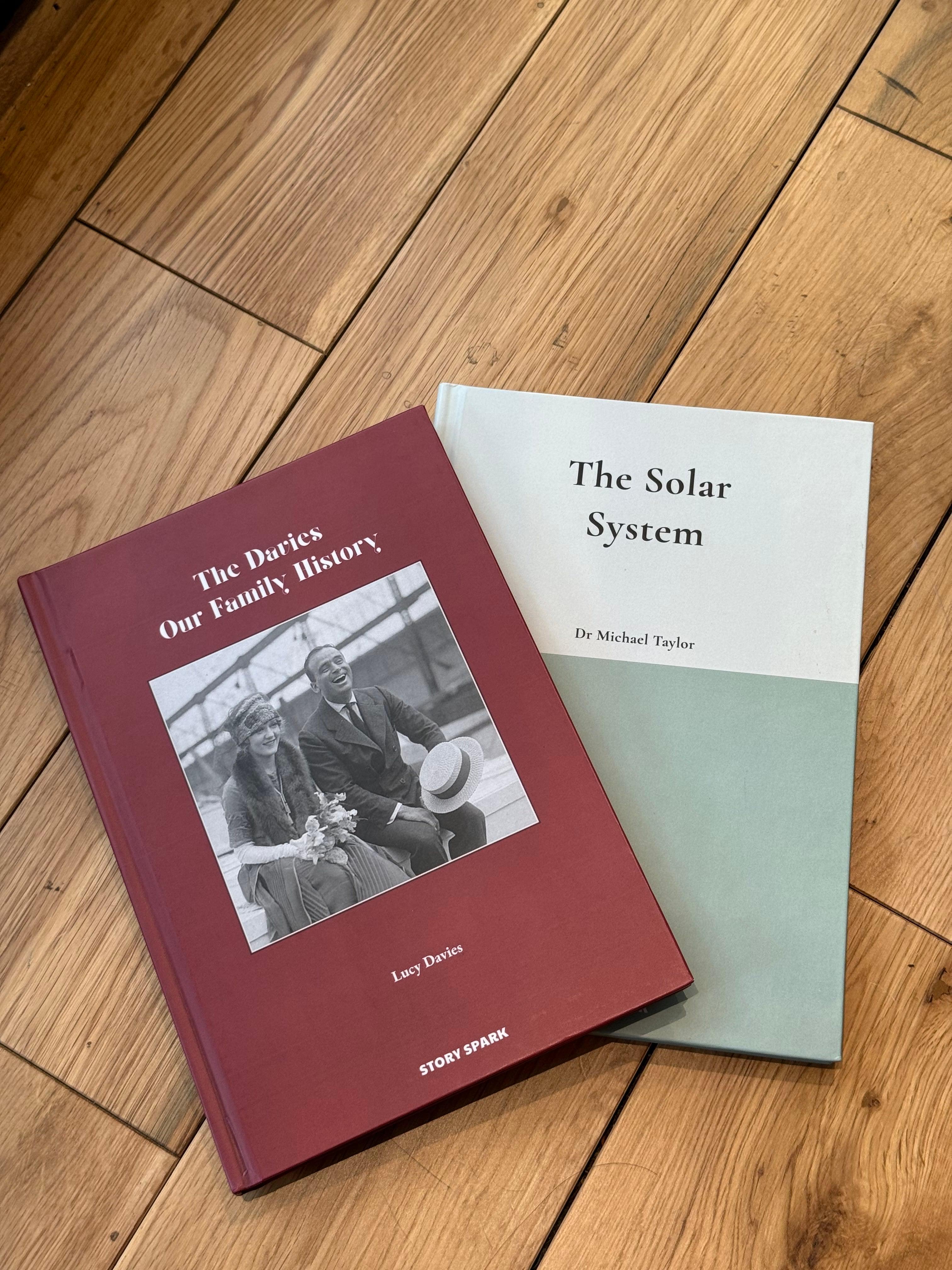
A finished novel deserves to be held. With Story Spark's Book Creator, you can design an eye-catching front cover or upload your own, add a personal dedication page and print your novel as a 16.5cm by 24cm hardcover of up to 200 pages. Printed books start from $39.99 for 50 pages and rise to $54.99 for 200 pages, and they are printed and dispatched within five working days. Volume discounts apply from five copies per title, and Dreamer and Creator subscribers get free standard shipping. See the full details on the pricing page.
If you want to sell your novel, the Creator plan includes watermark-free PDF and EPUB downloads and commercial rights to sell your books, so you can share it in the Story Spark Storyteller community and distribute it on other platforms as well. Our guide on how to publish your book and become an author covers the publishing side in more detail.
Ten Techniques to Protect Your Voice When Writing With AI
- Write the first and last lines of every chapter yourself. Openings and endings carry voice more strongly than anything else.
- Write all key dialogue by hand. Characters reveal themselves through the way they speak, and AI dialogue tends to make everyone sound the same.
- Keep a banned-words list. Note the phrases and constructions you never want in your book, and check your manuscript for them before each revision.
- Feed the AI your writing, not famous authors. Asking for prose in the style of a well-known novelist pulls you toward imitation. Your own pages are the best style guide.
- Ask for less. Request a sentence, a list of options or a single idea rather than a full chapter. Smaller pieces are easier to make your own.
- Add specific, lived detail. AI defaults to the general. You know the exact brand of biscuits your grandmother kept in the tin. Those details are voice.
- Protect your quirks. If you love long sentences, fragments or unusual punctuation, keep them. Do not let an AI edit smooth away what makes you distinctive.
- Write without AI regularly. Draft some sessions entirely alone so that your natural voice stays strong and you do not become dependent on prompts.
- Compare against your voice sample. Reread the pages you wrote in Step 1 before every revision session to recalibrate your ear.
- Get human feedback. Beta readers, writing groups and editors will tell you when a passage does not sound like you.
Warning Signs Your Voice Is Slipping
Watch for these signs as you revise. Every chapter starts to feel the same length and shape. Characters explain their feelings in tidy, articulate sentences. Descriptions rely on familiar images rather than specific ones. Dialogue sounds polite and complete rather than messy and human. Scenes resolve their tension too neatly. You read a paragraph and cannot remember writing it.
If you notice any of these, slow down. Go back to your voice sample, rewrite the passage by hand, and reduce how much AI prose you are accepting in that part of the book.
Common Mistakes When Writing a Novel With AI
Asking AI to write the whole book. A one-prompt novel will almost always be generic, inconsistent and hard to call your own.
Skipping the outline. Without a clear structure, AI drafts wander, and you spend more time fixing than writing.
Accepting the first suggestion. The first output is usually the most predictable. Ask for alternatives and push for something fresher.
Ignoring continuity. Without a story bible, names, ages and timelines drift across a long manuscript.
Over-editing with AI. Running every paragraph through an AI polish can sand away your personality. Use AI to find problems, then fix them yourself.
Forgetting about rights and disclosure. Check what each tool allows you to do with the content it generates, and disclose AI-generated content where retailers require it.
Ethics, Ownership and Disclosure
Writing with AI raises fair questions, and thinking them through protects both your book and your reputation.
Ownership. Check the terms of any AI tool you use. On Story Spark, you own 100 percent of your own words and content. With a Creator subscription, you also own the AI-generated content in your books and have commercial rights to sell them.
Copyright. In the US, copyright protects human authorship. The more of the creative expression in your novel that is yours, the stronger your position. Keep your drafts, outlines and story bible as a record of your creative process.
Disclosure. If you publish through retailers such as Amazon KDP, answer their AI content questions honestly for each title and format. For a broader look at publishing with AI, see our complete guide to AI book publishing.
Honesty with readers. Many authors now share how they use AI in an author's note. Readers tend to respond well to transparency, especially when the creative heart of the book is clearly human.
How Story Spark Helps You Write a Novel in Your Own Voice
Story Spark is built so that you stay in control from the first idea to the printed book.
Two ways to write. Use the AI-assisted Book Creator to describe your concept and draft chapter by chapter, or start from the Blank Canvas and write every word yourself with professional formatting built in.
Spark, your in-editor assistant. Get help with a single stuck line or paragraph right inside your manuscript, without handing over the whole chapter.
Full editing control. Rewrite paragraphs, restructure and reorder chapters, adjust formatting and preview every page, with nothing locked in until you are ready.
Room for a full novel. The Creator plan includes up to 1,000,000 AI words and 200 images a month, plus proofreading, audio narration with two custom voice clones a month and watermark-free downloads. The Dreamer plan includes up to 250,000 words and 50 images a month with the Spark writing assistant.
A real book at the end. Print your novel as a premium hardcover with your own cover and dedication page, dispatched within five working days.
You can start on the Free plan, which includes the book editor and lets you write your own content and order a hardcover, then upgrade when you want AI support. Compare tools in our roundup of the best AI tools for writing and printing a novel or the best free AI book writing tools.
Frequently Asked Questions
Is it cheating to write a novel with AI?
No, as long as you are honest about how you use it and the creative work is yours. Writers have always used tools, from thesauruses to editors to writing software. What matters is that the story, the choices and the voice are yours, and that you follow the disclosure rules of the platforms where you publish.
How much of my novel should AI write?
There is no fixed rule, but the less final prose the AI writes, the more the book will sound like you. Many novelists use AI mainly for brainstorming, outlining, continuity and editing, and write or fully rewrite every sentence themselves.
What should I never let AI write in my novel?
Keep the premise, the ending, key dialogue, the opening and closing lines of chapters, and the most emotional scenes in your own hands. These are the moments readers remember, and they carry your voice most strongly.
How do I make AI-assisted writing sound less like AI?
Rewrite it in your own words, add specific lived details, vary your sentence rhythm, cut explanations of emotion, let dialogue be messy and read every chapter aloud. Comparing each chapter against a sample of your unassisted writing also helps.
Can AI help with writer's block?
Yes. Ask the AI for several possible next moves in a scene, questions your character might ask, or what could go wrong next. Choose one idea and write the scene yourself. On Story Spark, Spark can help you get past a stuck line without leaving the editor.
How long does it take to write a novel with AI?
It depends on how much you write yourself, but AI usually speeds up planning, unblocking and editing. Once your manuscript is ready, Story Spark prints and dispatches your hardcover within five working days.
Can I print my AI-assisted novel as a real book?
Yes. Story Spark's Book Creator prints novels as 16.5cm by 24cm hardcovers of up to 200 pages, from $39.99, with your own cover and a personal dedication page.
Can I sell a novel I wrote with AI on Story Spark?
Yes. The Creator plan includes commercial rights to sell your books and watermark-free PDF and EPUB downloads, so you can sell through the Story Spark community and distribute elsewhere.
Key Takeaways
- Use AI as an assistant for planning, unblocking, continuity and editing, not as your ghostwriter.
- Capture your voice in a sample and a voice profile before you start prompting.
- Keep the core creative decisions, key dialogue and emotional scenes in your own hands.
- Rewrite every AI-suggested sentence in your own words, then read the whole book aloud.
- Own your work: check your rights, keep your drafts and disclose AI use where required.
Start Writing Your Novel With Story Spark
Your novel should sound like you, from the first line to the last. Story Spark gives you an AI writing assistant that supports your voice rather than replacing it, full control over every chapter, and a beautiful printed hardcover at the end.
Start creating your book for free, explore the Book Creator, see how self-publishing with Story Spark works, or browse the Story Spark FAQ and the Learn Centre for more guidance.
Related Reading
From the Story Spark Blog
- The Best AI-Assisted Tools for Writing and Printing a Novel
- AI Book Publishing: From Generator to Amazon KDP in 7 Steps
- Why Character Consistency Matters in Storybooks
- How to Create Your Own Characters
- Best AI for Writing Non-Fiction Books
- How to Write a Family History Book
- Story Spark vs Book Creator: Which Tool Is Right for You?
From the Story Spark Learn Centre
- The Best AI Story Generators
- Complete AI Book Generator Comparison
- The Best Book Creators: A Complete Guide
- The History of Storytelling
Written by the Story Spark Team. Story Spark is an AI book creation platform for creating, illustrating and printing your own books, trusted by more than 200,000 authors.